Gertrude H. Sergievsky Center, and Department of Epidemiology, Mailman School of Public Health, Columbia University, New York, NY 10032, USA.
Sci Transl Med. 2013 Apr 17;5(181):181ra51. doi: 10.1126/scitranslmed.3005113.
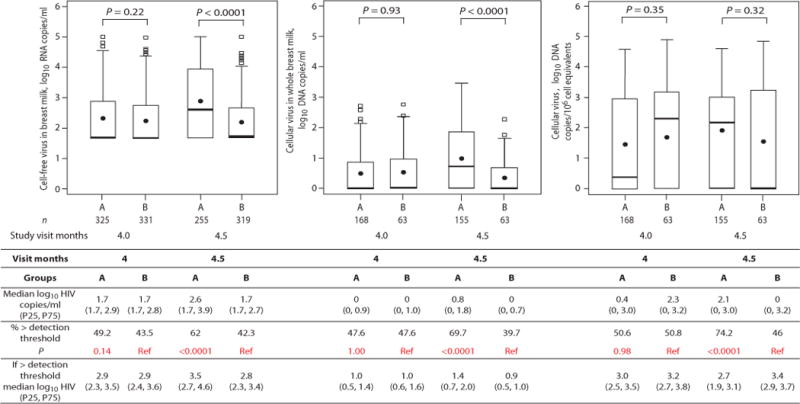
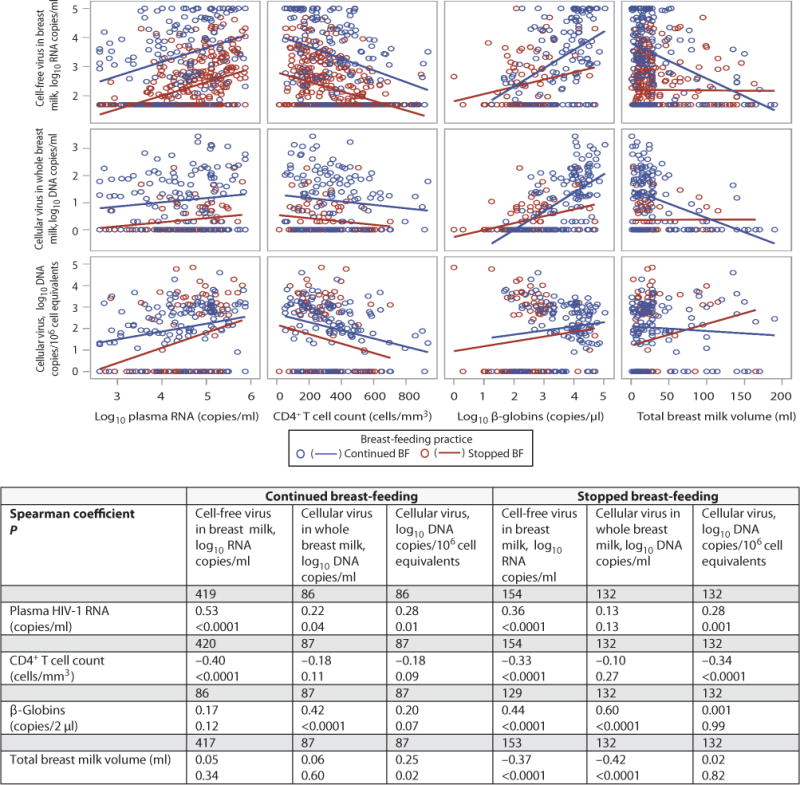
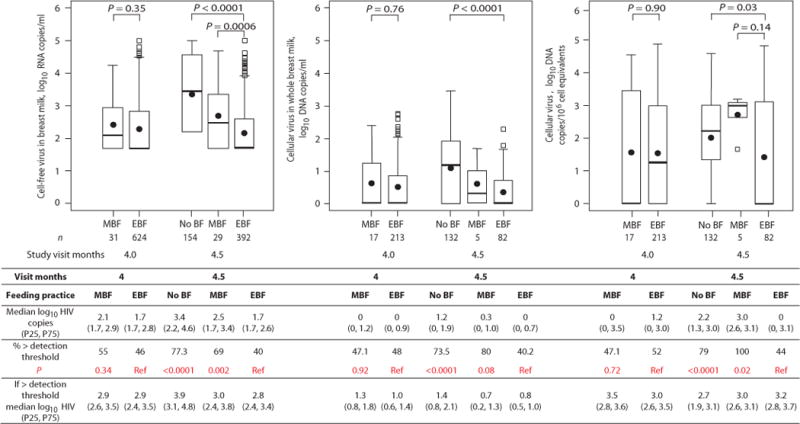
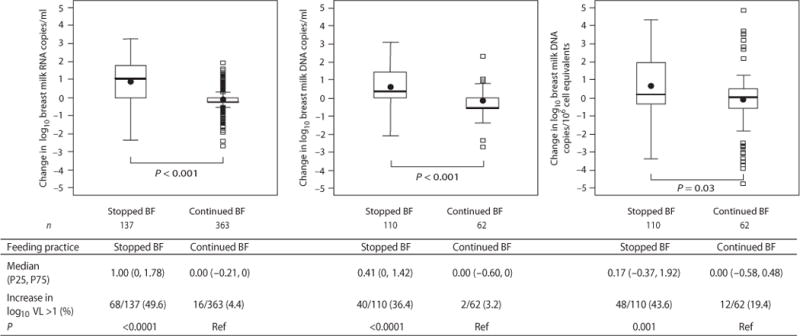
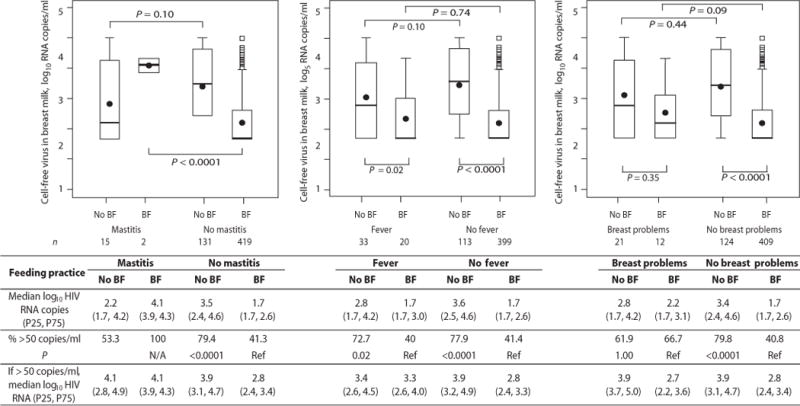
Concentrations of HIV-1 RNA and DNA in mucosal compartments influence the risk of sexual transmission and mother-to-child transmission of HIV-1. Breast milk production is physiologically regulated such that supply is a function of infant demand, but whether demand also influences HIV-1 dynamics in breast milk is unknown. We tested whether minor and major changes in feeding frequency influence breast milk viral concentrations in 958 HIV-1-infected women and their infants followed, for 24 months during a trial in Lusaka, Zambia. Women were randomized to wean abruptly at 4 months or to continue breast-feeding for a duration of their own choosing. Two weeks after breast-feeding cessation (4.5 months), HIV-1 concentrations in breast milk were substantially higher (median RNA, 2708 copies/ml; DNA, 14 copies/ml) than if breast-feeding continued (median RNA, <50 copies/ml; DNA, <1 copy/ml; P < 0.0001). Among those continuing breast-feeding, HIV-1 concentrations in milk were higher if breast-feeding was nonexclusive (median RNA, 293 copies/ml; DNA, 2 copies/ml; P = 0.0006). Elevated milk viral concentrations after stopping breast-feeding explained higher than expected rates of late postnatal HIV transmission in those who weaned early. Changes in the frequency of breast-feeding peri-weaning and with nonexclusive breast-feeding influenced milk viral concentrations. This may explain the reduced risk of HIV-1 transmission associated with exclusive breast-feeding and why early weaning does not achieve the magnitude of HIV prevention predicted by models. Our results support continuation of maternal antiretroviral drug interventions over the full duration of time when any breast milk exposures may occur after planned weaning.
艾滋病毒-1 RNA 和 DNA 在黏膜部位的浓度会影响艾滋病毒-1 的性传播和母婴传播风险。乳汁分泌是由生理调节的,其供应是婴儿需求的函数,但需求是否也会影响母乳中的艾滋病毒-1 动力学尚不清楚。我们检测了在赞比亚卢萨卡的一项试验中,958 名艾滋病毒-1 感染妇女及其婴儿在 24 个月期间,哺乳频率的微小和显著变化是否会影响母乳中的病毒浓度。妇女被随机分为 4 个月时突然断奶组或根据自己的选择继续母乳喂养组。停止母乳喂养后 2 周(4.5 个月),母乳中的艾滋病毒-1 浓度明显升高(中位数 RNA,2708 拷贝/ml;DNA,14 拷贝/ml),如果继续母乳喂养(中位数 RNA,<50 拷贝/ml;DNA,<1 拷贝/ml;P<0.0001)。在继续母乳喂养的妇女中,如果母乳喂养不排他(中位数 RNA,293 拷贝/ml;DNA,2 拷贝/ml;P=0.0006),则母乳中的艾滋病毒-1 浓度更高。停止母乳喂养后母乳中病毒浓度升高,解释了那些早期断奶的人产后后期 HIV 传播率高于预期的原因。围断奶期和非排他性母乳喂养频率的变化影响了母乳中的病毒浓度。这可能解释了与纯母乳喂养相关的艾滋病毒-1 传播风险降低的原因,以及为什么早期断奶并不能达到模型预测的艾滋病毒预防的幅度。我们的研究结果支持在计划断奶后任何可能发生母乳暴露的时间内,继续进行孕产妇抗逆转录病毒药物干预。