Laboratory of Environmental Toxicology, National Institute of Chemical Physics and Biophysics, Akadeemia Tee 23, 12618 Tallinn, Estonia.
Arch Toxicol. 2013 Jul;87(7):1181-200. doi: 10.1007/s00204-013-1079-4. Epub 2013 Jun 1.
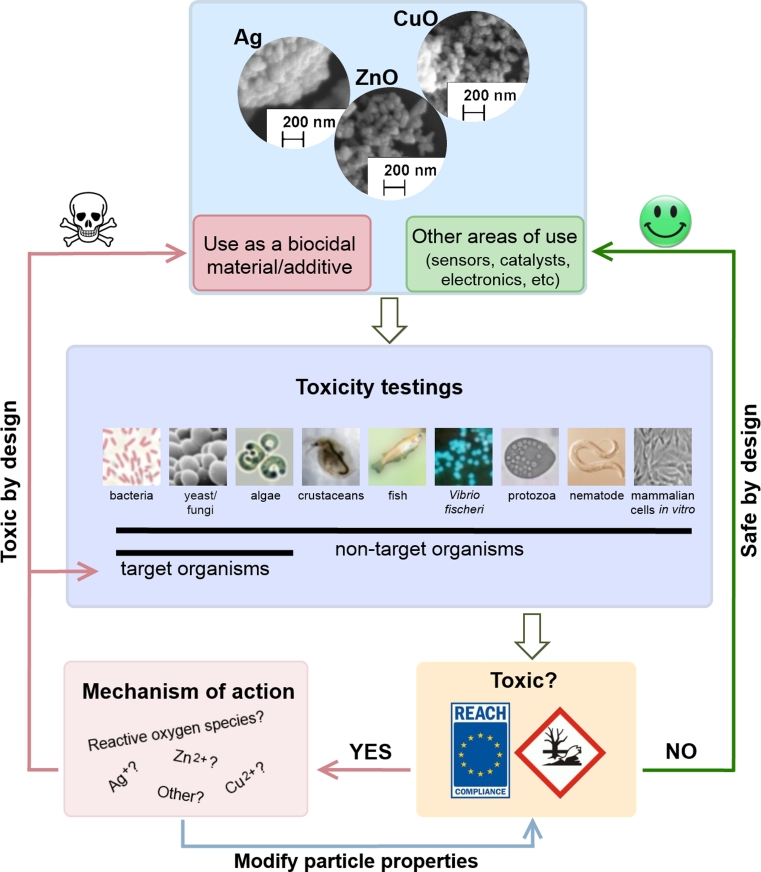
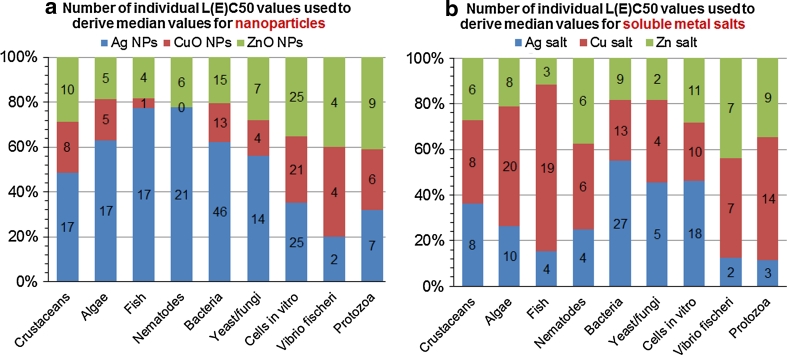
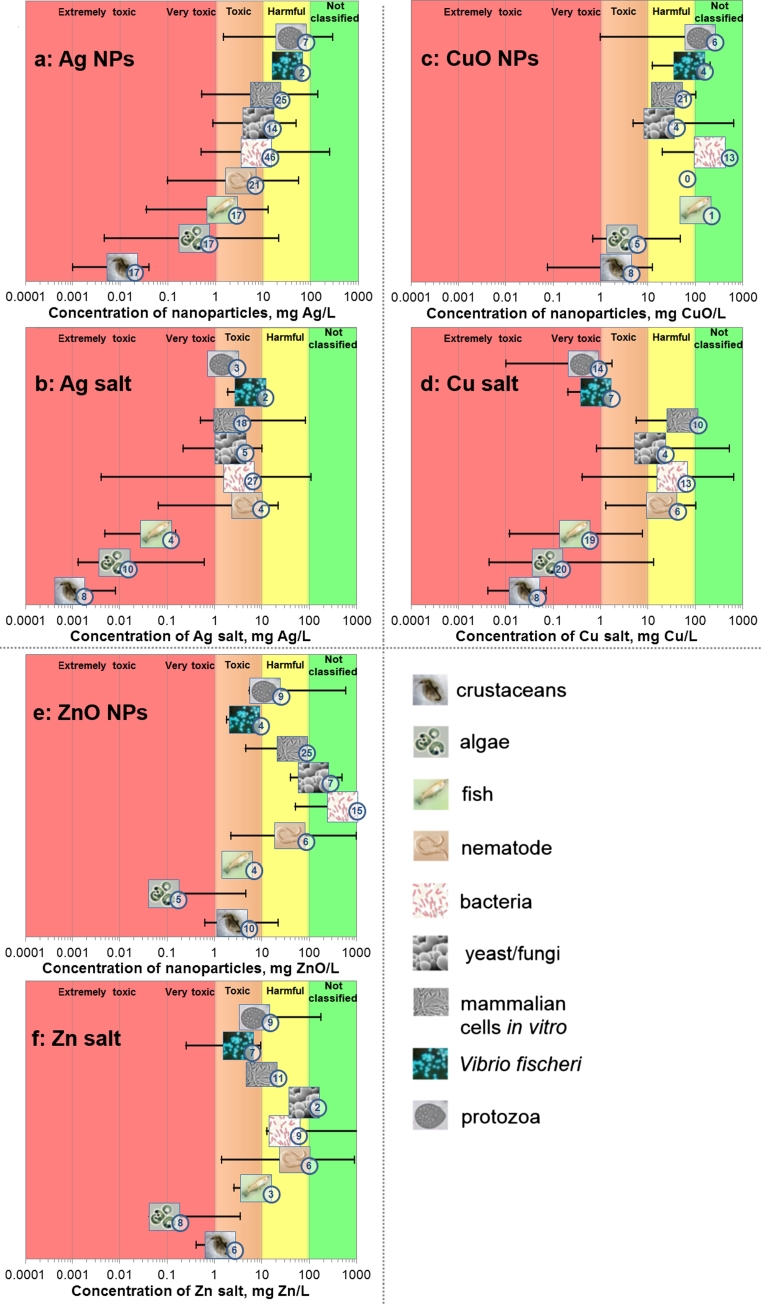
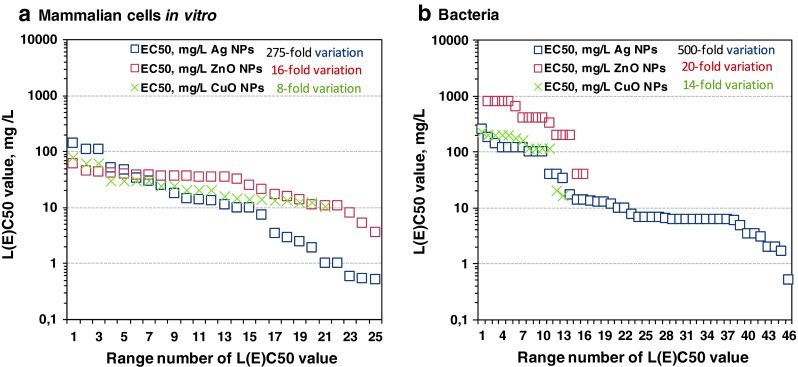
Nanoparticles (NPs) of copper oxide (CuO), zinc oxide (ZnO) and especially nanosilver are intentionally used to fight the undesirable growth of bacteria, fungi and algae. Release of these NPs from consumer and household products into waste streams and further into the environment may, however, pose threat to the 'non-target' organisms, such as natural microbes and aquatic organisms. This review summarizes the recent research on (eco)toxicity of silver (Ag), CuO and ZnO NPs. Organism-wise it focuses on key test species used for the analysis of ecotoxicological hazard. For comparison, the toxic effects of studied NPs toward mammalian cells in vitro were addressed. Altogether 317 L(E)C50 or minimal inhibitory concentrations (MIC) values were obtained for algae, crustaceans, fish, bacteria, yeast, nematodes, protozoa and mammalian cell lines. As a rule, crustaceans, algae and fish proved most sensitive to the studied NPs. The median L(E)C50 values of Ag NPs, CuO NPs and ZnO NPs (mg/L) were 0.01, 2.1 and 2.3 for crustaceans; 0.36, 2.8 and 0.08 for algae; and 1.36, 100 and 3.0 for fish, respectively. Surprisingly, the NPs were less toxic to bacteria than to aquatic organisms: the median MIC values for bacteria were 7.1, 200 and 500 mg/L for Ag, CuO and ZnO NPs, respectively. In comparison, the respective median L(E)C50 values for mammalian cells were 11.3, 25 and 43 mg/L. Thus, the toxic range of all the three metal-containing NPs to target- and non-target organisms overlaps, indicating that the leaching of biocidal NPs from consumer products should be addressed.
纳米粒子(NPs),如氧化铜(CuO)、氧化锌(ZnO),尤其是纳米银,被有意用于抑制细菌、真菌和藻类的不良生长。然而,这些 NPs 从消费产品和家用产品中释放到废物流中,并进一步进入环境,可能会对非目标生物,如自然微生物和水生生物,构成威胁。本综述总结了近期关于银(Ag)、CuO 和 ZnO NPs 的(生态)毒性的研究。就生物体而言,它侧重于用于分析生态毒性危害的关键测试物种。为了进行比较,还探讨了研究中 NPs 对体外哺乳动物细胞的毒性影响。总共获得了 317 个藻类、甲壳类动物、鱼类、细菌、酵母、线虫、原生动物和哺乳动物细胞系的 LC50 或最小抑制浓度(MIC)值。通常情况下,甲壳类动物、藻类和鱼类对研究中的 NPs 最为敏感。Ag NPs、CuO NPs 和 ZnO NPs 的 LC50 (mg/L)中位数分别为甲壳类动物的 0.01、2.1 和 2.3;藻类的 0.36、2.8 和 0.08;鱼类的 1.36、100 和 3.0。令人惊讶的是,与水生生物相比,NPs 对细菌的毒性较低:Ag、CuO 和 ZnO NPs 的 MIC 中位数分别为细菌的 7.1、200 和 500 mg/L。相比之下,哺乳动物细胞的相应 LC50 中位数分别为 11.3、25 和 43 mg/L。因此,所有三种含金属的 NPs 对靶标生物和非靶标生物的毒性范围重叠,表明应解决消费产品中杀菌 NPs 的浸出问题。