Departamento de Bioquímica e Imunologia, Instituto de Ciências Biológicas, Universidade Federal de Minas Gerais Belo Horizonte, Minas Gerais, Brazil ; Instituto de Investigação em Imunologia (iii) São Paulo, Brazil.
Front Immunol. 2013 May 17;4:102. doi: 10.3389/fimmu.2013.00102. eCollection 2013.
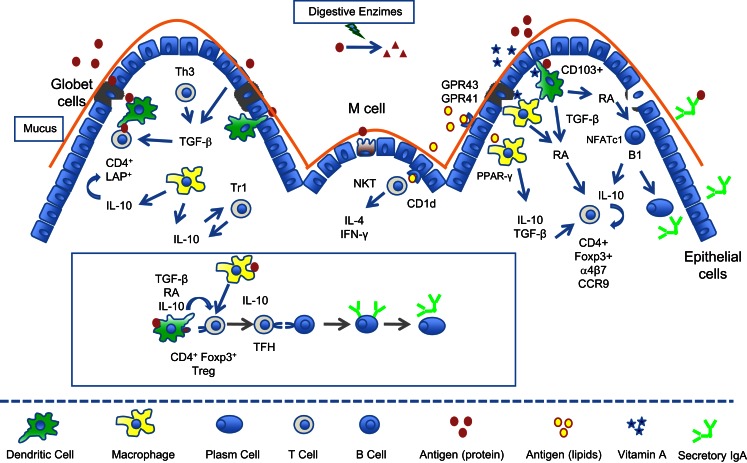
The intestinal mucosa is the major site of contact with antigens, and it houses the largest lymphoid tissue in the body. In physiological conditions, microbiota and dietary antigens are the natural sources of stimulation for the gut-associated lymphoid tissues (GALT) and for the immune system as a whole. Germ-free models have provided some insights on the immunological role of gut antigens. However, most of the GALT is not located in the large intestine, where gut microbiota is prominent. It is concentrated in the small intestine where protein absorption takes place. In this review, we will address the involvement of food components in the development and the function of the immune system. Studies in mice have already shown that dietary proteins are critical elements for the developmental shift of the immature neonatal immune profile into a fully developed immune system. The immunological effects of other food components (such as vitamins and lipids) will also be addressed. Most of the cells in the GALT are activated and local pro-inflammatory mediators are abundant. Regulatory elements are known to provide a delicate yet robust balance that maintains gut homeostasis. Usually antigenic contact in the gut induces two major immune responses, oral tolerance and production of secretory IgA. However, under pathological conditions mucosal homeostasis is disturbed resulting in inflammatory reactions such as food hypersensitivity. Food allergy development depends on many factors such as genetic predisposition, biochemical features of allergens, and a growing array of environmental elements. Neuroimmune interactions are also implicated in food allergy and they are examples of the high complexity of the phenomenon. Recent findings on the gut circuits triggered by food components will be reviewed to show that, far beyond their role as nutrients, they are critical players in the operation of the immune system in health and disease.
肠黏膜是与抗原接触的主要部位,它拥有体内最大的淋巴组织。在生理条件下,微生物群和饮食抗原是肠道相关淋巴组织(GALT)和整个免疫系统的天然刺激源。无菌模型为肠道抗原的免疫作用提供了一些见解。然而,大部分的 GALT 并不位于大肠,那里是肠道微生物群集中的地方。它主要集中在小肠,蛋白质吸收就在这里进行。在这篇综述中,我们将讨论食物成分在免疫系统的发育和功能中的作用。在小鼠中的研究已经表明,膳食蛋白是使未成熟的新生免疫特征向完全发育的免疫系统转变的关键因素。其他食物成分(如维生素和脂质)的免疫作用也将被讨论。GALT 中的大多数细胞都被激活,局部促炎介质丰富。调节因子被认为提供了一种微妙而强大的平衡,维持肠道内环境稳定。通常,肠道中的抗原接触会引发两种主要的免疫反应,即口服耐受和分泌型 IgA 的产生。然而,在病理条件下,黏膜内环境稳定被破坏,导致炎症反应,如食物过敏。食物过敏的发展取决于许多因素,如遗传易感性、过敏原的生化特征以及越来越多的环境因素。神经免疫相互作用也与食物过敏有关,它们是该现象高度复杂性的例子。我们将回顾食物成分触发肠道回路的最新发现,以表明,它们远不止是营养物质,而是健康和疾病中免疫系统运作的关键参与者。