Mathur Atin, Tripathi Ardhendu S, Kuse Manohar
Department of Computer Science, The LNM Institute of Information Technology, Jaipur, India.
J Pathol Inform. 2013 Mar 30;4(Suppl):S15. doi: 10.4103/2153-3539.109883. Print 2013.
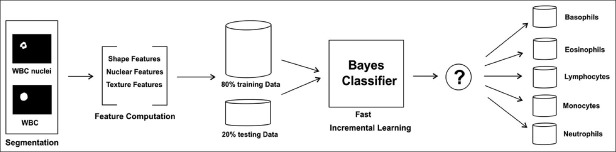
The White Blood Cell (WBC) differential count yields clinically relevant information about health and disease. Currently, pathologists manually annotate the WBCs, which is time consuming and susceptible to error, due to the tedious nature of the process. This study aims at automation of the Differential Blood Count (DBC) process, so as to increase productivity and eliminate human errors.
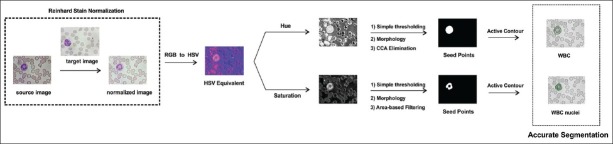
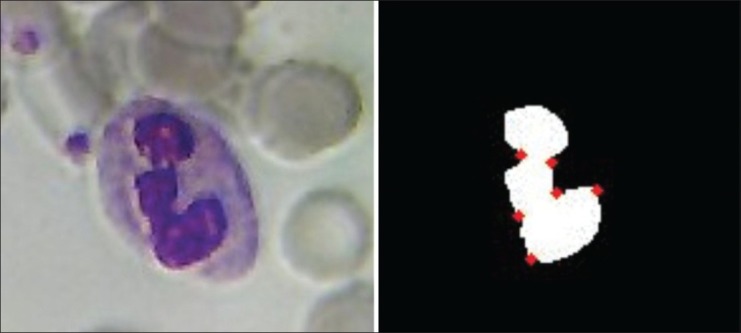
The proposed system takes the peripheral Leishman blood stain images as the input and generates a count for each of the WBC subtypes. The digitized microscopic images are stain normalized for the segmentation, to be consistent over a diverse set of slide images. Active contours are employed for robust segmentation of the WBC nucleus and cytoplasm. The seed points are generated by processing the images in Hue-Saturation-Value (HSV) color space. An efficient method for computing a new feature, 'number of lobes,' for discrimination of WBC subtypes, is introduced in this article. This method is based on the concept of minimization of the compactness of each lobe. The Naive Bayes classifier, with Laplacian correction, provides a fast, efficient, and robust solution to multiclass categorization problems. This classifier is characterized by incremental learning and can also be embedded within the database systems.
An overall accuracy of 92.45% and 92.72% over the training and testing sets has been obtained, respectively.
Thus, incremental learning is inducted into the Naive Bayes Classifier, to facilitate fast, robust, and efficient classification, which is evident from the high sensitivity achieved for all the subtypes of WBCs.
白细胞(WBC)分类计数可提供有关健康和疾病的临床相关信息。目前,病理学家手动标注白细胞,由于该过程繁琐,既耗时又容易出错。本研究旨在实现血液分类计数(DBC)过程的自动化,以提高效率并消除人为错误。
所提出的系统以外周血利什曼染色图像作为输入,并生成每种白细胞亚型的计数。对数字化的显微图像进行染色归一化处理以进行分割,从而在各种载玻片图像上保持一致。使用活动轮廓对白细胞的细胞核和细胞质进行稳健分割。通过在色调 - 饱和度 - 明度(HSV)颜色空间中处理图像来生成种子点。本文介绍了一种计算新特征“叶数”以区分白细胞亚型的有效方法。该方法基于使每个叶的紧凑度最小化的概念。带拉普拉斯校正的朴素贝叶斯分类器为多类分类问题提供了快速、高效且稳健的解决方案。该分类器具有增量学习的特点,并且还可以嵌入到数据库系统中。
在训练集和测试集上分别获得了92.45%和92.72%的总体准确率。
因此,将增量学习引入朴素贝叶斯分类器,以促进快速、稳健且高效的分类,这从对所有白细胞亚型实现的高灵敏度中可见一斑。