Molecular Plant Pathology Group, Institute of Environmental and Rural Science, Aberystwyth University Aberystwyth, UK.
Front Plant Sci. 2013 Jun 27;4:215. doi: 10.3389/fpls.2013.00215. Print 2013.
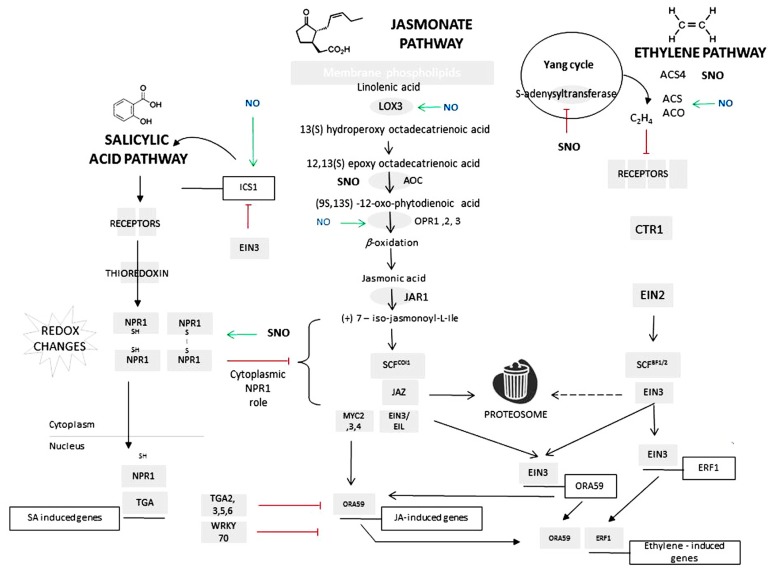
Plant defense against pests and pathogens is known to be conferred by either salicylic acid (SA) or jasmonic acid (JA)/ethylene (ET) pathways, depending on infection or herbivore-grazing strategy. It is well attested that SA and JA/ET pathways are mutually antagonistic allowing defense responses to be tailored to particular biotic stresses. Nitric oxide (NO) has emerged as a major signal influencing resistance mediated by both signaling pathways but no attempt has been made to integrate NO into established SA/JA/ET interactions. NO has been shown to act as an inducer or suppressor of signaling along each pathway. NO will initiate SA biosynthesis and nitrosylate key cysteines on TGA-class transcription factors to aid in the initiation of SA-dependent gene expression. Against this, S-nitrosylation of NONEXPRESSOR OF PATHOGENESIS-RELATED PROTEINS1 (NPR1) will promote the NPR1 oligomerization within the cytoplasm to reduce TGA activation. In JA biosynthesis, NO will initiate the expression of JA biosynthetic enzymes, presumably to over-come any antagonistic effects of SA on JA-mediated transcription. NO will also initiate the expression of ET biosynthetic genes but a suppressive role is also observed in the S-nitrosylation and inhibition of S-adenosylmethionine transferases which provides methyl groups for ET production. Based on these data a model for NO action is proposed but we have also highlighted the need to understand when and how inductive and suppressive steps are used.
植物防御害虫和病原体的机制,已知依赖于水杨酸(SA)或茉莉酸(JA)/乙烯(ET)途径,具体取决于感染或草食动物的觅食策略。已有充分证据表明,SA 和 JA/ET 途径相互拮抗,使防御反应能够针对特定的生物胁迫进行调整。一氧化氮(NO)已成为影响两种信号通路介导的抗性的主要信号分子,但尚未尝试将 NO 整合到现有的 SA/JA/ET 相互作用中。NO 已被证明可以作为每个途径的信号诱导剂或抑制剂发挥作用。NO 将启动 SA 生物合成,并将关键半胱氨酸亚硝化为 TGA 类转录因子,以帮助启动依赖 SA 的基因表达。相反,NO 会使 NPR1 发生 S-亚硝基化,从而促进 NPR1 在细胞质内寡聚化,从而减少 TGA 的激活。在 JA 生物合成中,NO 将启动 JA 生物合成酶的表达,大概是为了克服 SA 对 JA 介导的转录的拮抗作用。NO 还将启动 ET 生物合成基因的表达,但 S-亚硝基化和抑制 S-腺苷甲硫氨酸转移酶也会观察到抑制作用,S-腺苷甲硫氨酸转移酶为 ET 产生提供甲基。基于这些数据,提出了一个关于 NO 作用的模型,但我们也强调了需要了解何时以及如何使用诱导和抑制步骤。