Centro de Investigación Biomédica del Sur (CIBIS), Instituto Mexicano del Seguro Social (IMSS), Argentina No. 1, Col. Centro, Xochitepec 62790, Morelos, Mexico.
Molecules. 2013 Jul 10;18(7):8136-46. doi: 10.3390/molecules18078136.
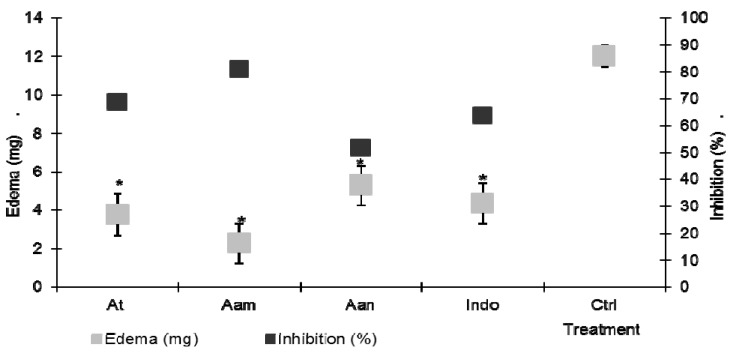
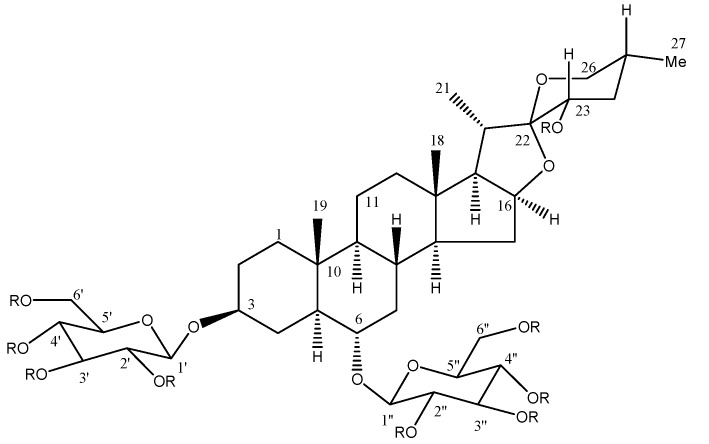
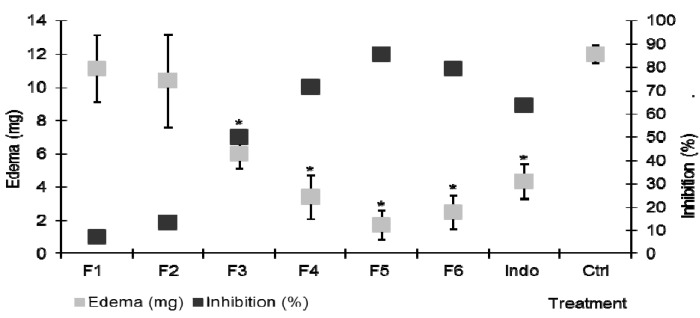
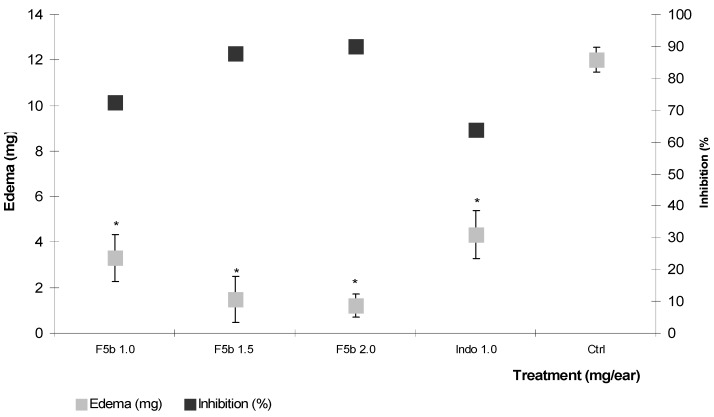
Species of the agave genus, such as Agave tequilana, Agave angustifolia and Agave americana are used in Mexican traditional medicine to treat inflammation-associated conditions. These plants' leaves contain saponin compounds which show anti-inflammatory properties in different models. The goal of this investigation was to evaluate the anti-inflammatory capacity of these plants, identify which is the most active, and isolate the active compound by a bio-directed fractionation using the ear edema induced in mice with 12-O-tetradecanoylphorbol-13-acetate (TPA) technique. A dose of 6 mg/ear of acetone extract from the three agave species induced anti-inflammatory effects, however, the one from A. americana proved to be the most active. Different fractions of this species showed biological activity. Finally the F5 fraction at 2.0 mg/ear induced an inhibition of 85.6%. We identified one compound in this fraction as (25R)-5α-spirostan-3β,6α,23α-triol-3,6-di-O-β-D-glucopyranoside (cantalasaponin-1) through 1H- and 13C-NMR spectral analysis and two dimensional experiments like DEPT NMR, COSY, HSQC and HMBC. This steroidal glycoside showed a dose dependent effect of up to 90% of ear edema inhibition at the highest dose of 1.5 mg/ear.
龙舌兰属的一些物种,如龙舌兰 tequilana、龙舌兰 angustifolia 和龙舌兰 americana,被用于墨西哥传统医学中治疗与炎症相关的病症。这些植物的叶子含有甾体皂苷化合物,在不同的模型中显示出抗炎特性。本研究的目的是评估这些植物的抗炎能力,确定哪种植物最具活性,并通过使用 12-O-十四烷酰佛波醇-13-乙酸酯(TPA)技术诱导的小鼠耳肿胀模型进行生物导向的馏分分离来分离活性化合物。三种龙舌兰属植物的丙酮提取物剂量为 6mg/耳,可诱导抗炎作用,但来自 A. americana 的提取物最具活性。该物种的不同馏分显示出生物活性。最后,F5 馏分在 2.0mg/耳时诱导抑制率为 85.6%。我们通过 1H 和 13C-NMR 光谱分析以及 DEPT NMR、COSY、HSQC 和 HMBC 等二维实验,在该馏分中鉴定出一种化合物为(25R)-5α-螺旋甾烷-3β,6α,23α-三醇-3,6-二-O-β-D-吡喃葡萄糖苷(cantalasaponin-1)。这种甾体糖苷在最高剂量为 1.5mg/耳时,对耳肿胀的抑制作用呈剂量依赖性,最高可达 90%。