Asna Ashari Mohammad, Fayaz Fariba, Moezzi Ghadim Nahid, Alim Marvasti Laleh, Mehrabi Yadollah
Department of Endodontics, Iranian Center for Endodontic Research, Dental School, Shahid Beheshti University of Medical Sciences, Tehran, Iran.
Iran Endod J. 2009 Spring;4(2):63-8. Epub 2009 Apr 17.
The aim of this study was to compare the antimicrobial effects of MTAD, sodium hypochlorite (NaOCl) and their combination on endodontic micro-organisms.
Zone of Inhibition (ZI) and Minimum Inhibitory Concentration (MIC) were the techniques used. In ZI technique blood agar plates were inoculated with organisms, paper discs were soaked with irrigants and maximum zones of bacterial inhibition were recorded. In the MIC technique the irrigants were serially diluted in TSB tubes and 0.1 mL of the tested microbe solutions were added. Results were obtained on the basis of turbidity and growth on agar plates. Statistical analyses were carried out using ANOVA and Tukey tests.
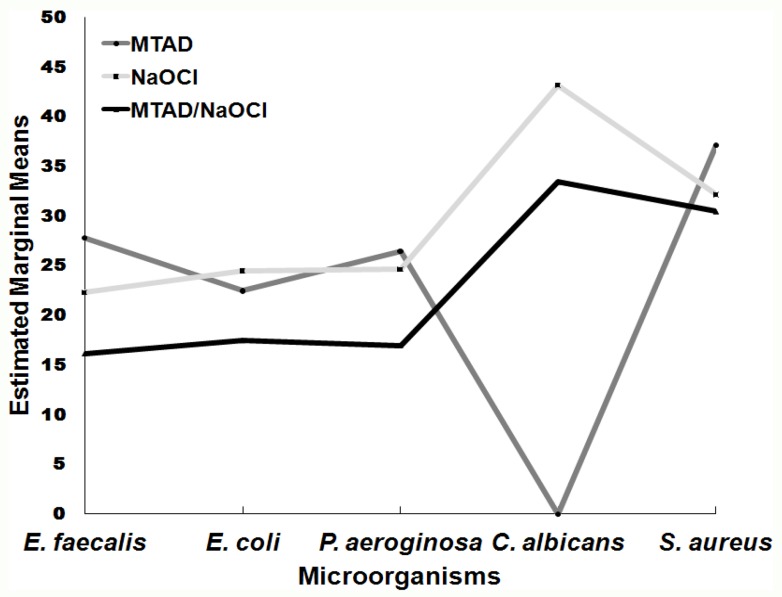
In ZI technique, we investigated 120 specimens including 5 microbial species, 3 irrigants and their control groups, each with 6 repetitions. The results demonstrated MTAD greater antimicrobial efficacy compared to NaOCl, and their mixture (M+N) against Staphylococcus (S) aureus, Enteric (E) bacteria and Enterococcus (E) faecalis (P<0.001). NaOCl was more effective in eradicating Candida (C) albicans than the others (P<0.01). MIC method (155 tubes) showed MTAD to be more effective against E. bacteria and S. aureus. MTAD and NaOCl were equally effective against E. faecalis; however, NaOCl was more effective against C. albicans.
Bacterial species were more susceptible to MTAD than NaOCl, C. albicans, however, was more susceptible to NaOCl. The advantage of NaOCl is that it has broad spectrum antimicrobial activity. The joint solution (M+N) did not prove to be more effective than their individual use.
本研究旨在比较MTAD、次氯酸钠(NaOCl)及其组合对牙髓微生物的抗菌效果。
采用抑菌圈(ZI)和最低抑菌浓度(MIC)技术。在ZI技术中,将血琼脂平板接种微生物,用冲洗剂浸泡纸片,记录最大细菌抑制圈。在MIC技术中,冲洗剂在胰酪大豆胨肉汤(TSB)管中进行系列稀释,并加入0.1 mL受试微生物溶液。根据琼脂平板上的浊度和生长情况获得结果。使用方差分析(ANOVA)和Tukey检验进行统计分析。
在ZI技术中,我们研究了120个标本,包括5种微生物、3种冲洗剂及其对照组,每组6次重复。结果表明,与NaOCl及其混合物(M+N)相比,MTAD对金黄色葡萄球菌(S)、肠道菌(E)和粪肠球菌(E)具有更高的抗菌效力(P<0.001)。NaOCl在根除白色念珠菌(C)方面比其他冲洗剂更有效(P<0.01)。MIC方法(155管)显示MTAD对肠道菌和金黄色葡萄球菌更有效。MTAD和NaOCl对粪肠球菌同样有效;然而,NaOCl对白色念珠菌更有效。
细菌种类对MTAD的敏感性高于NaOCl,而白色念珠菌对NaOCl更敏感。NaOCl的优点是具有广谱抗菌活性。联合溶液(M+N)并未证明比单独使用更有效。