Poddar Rajesh, Kawai Risa, Ölveczky Bence P
Department of Organismic and Evolutionary Biology, Harvard University, Cambridge, Massachusetts, United States of America ; Center for Brain Science, Harvard University, Cambridge, Massachusetts, United States of America.
PLoS One. 2013 Dec 6;8(12):e83171. doi: 10.1371/journal.pone.0083171. eCollection 2013.
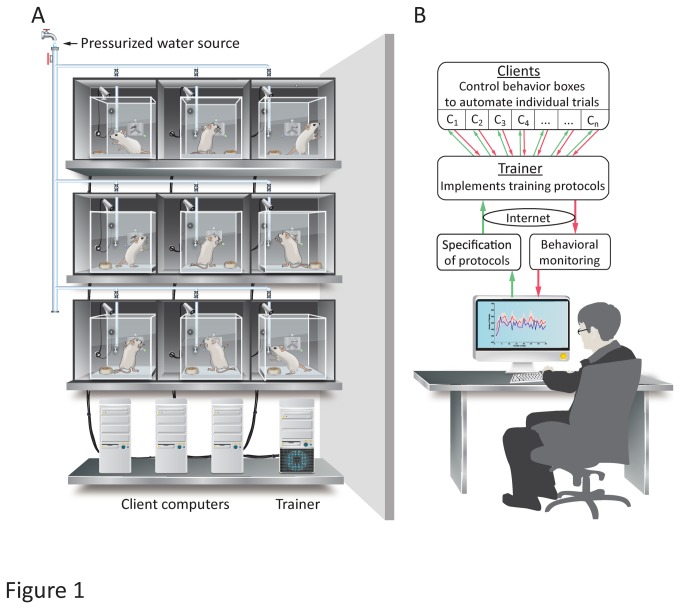
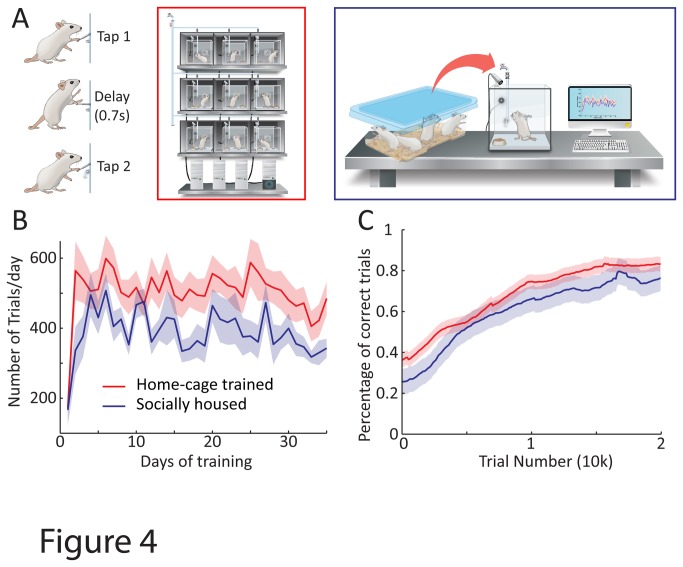
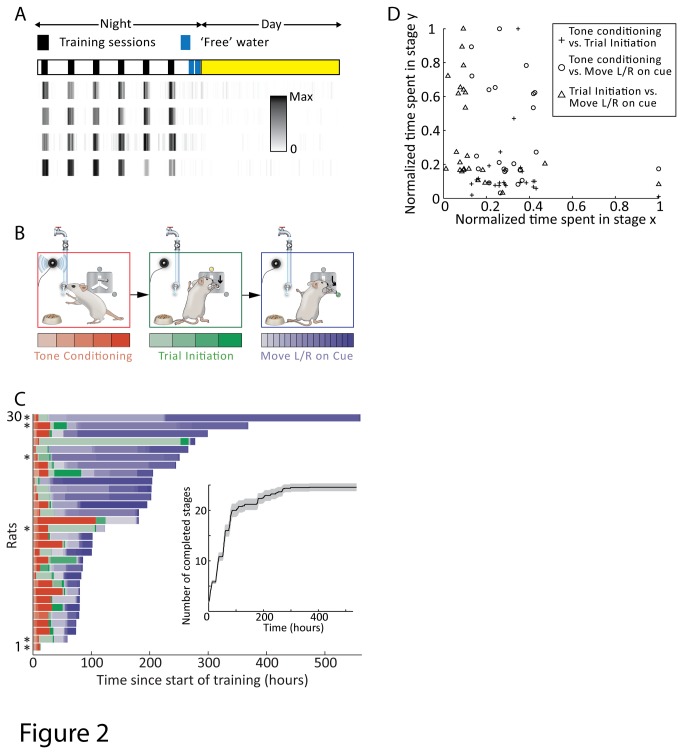
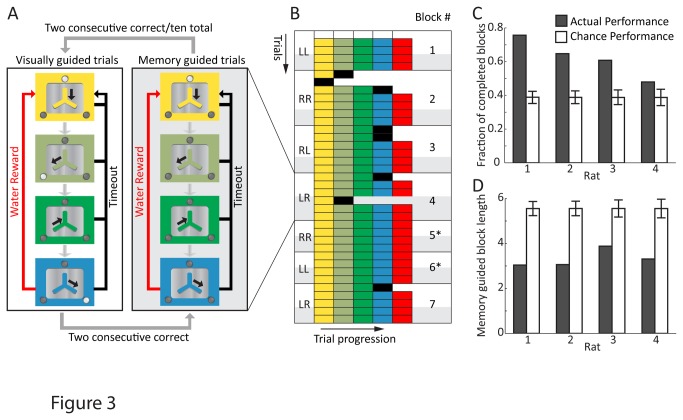
Addressing the neural mechanisms underlying complex learned behaviors requires training animals in well-controlled tasks, an often time-consuming and labor-intensive process that can severely limit the feasibility of such studies. To overcome this constraint, we developed a fully computer-controlled general purpose system for high-throughput training of rodents. By standardizing and automating the implementation of predefined training protocols within the animal's home-cage our system dramatically reduces the efforts involved in animal training while also removing human errors and biases from the process. We deployed this system to train rats in a variety of sensorimotor tasks, achieving learning rates comparable to existing, but more laborious, methods. By incrementally and systematically increasing the difficulty of the task over weeks of training, rats were able to master motor tasks that, in complexity and structure, resemble ones used in primate studies of motor sequence learning. By enabling fully automated training of rodents in a home-cage setting this low-cost and modular system increases the utility of rodents for studying the neural underpinnings of a variety of complex behaviors.
要研究复杂学习行为背后的神经机制,需要在严格控制的任务中训练动物,这一过程通常既耗时又费力,可能会严重限制此类研究的可行性。为了克服这一限制,我们开发了一种用于啮齿动物高通量训练的全计算机控制通用系统。通过在动物的笼内对预定义训练方案的实施进行标准化和自动化,我们的系统显著减少了动物训练所需的工作量,同时还消除了过程中的人为错误和偏差。我们使用该系统训练大鼠完成各种感觉运动任务,学习速度与现有的但更费力的方法相当。通过在数周的训练中逐步系统地增加任务难度,大鼠能够掌握在复杂性和结构上类似于灵长类动物运动序列学习研究中所使用的运动任务。通过在笼内环境中实现对啮齿动物的全自动化训练,这个低成本的模块化系统提高了啮齿动物在研究各种复杂行为的神经基础方面的效用。