Padmasini Elango, Padmaraj R, Ramesh S Srivani
Department of Microbiology, Dr ALM Post Graduate Institute of Basic Medical Sciences, University of Madras, Chennai 600 113, India.
Department of Paediatric Nephrology, Institute of Child Health and Research Centre, Chennai 600 008, India.
ScientificWorldJournal. 2014 Feb 4;2014:329157. doi: 10.1155/2014/329157. eCollection 2014.
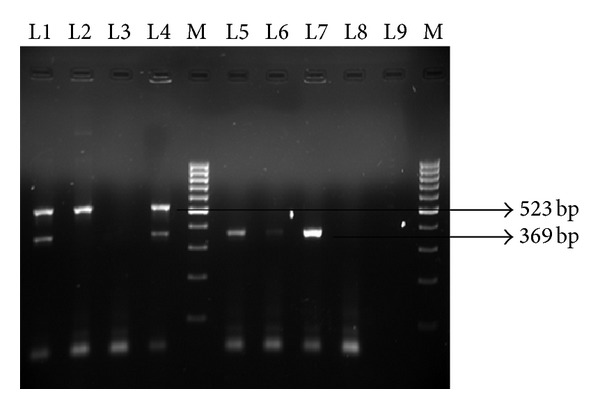
Enterococci are nosocomial pathogen with multiple-drug resistance by intrinsic and extrinsic mechanisms. Aminoglycosides along with cell wall inhibitors are given clinically for treating enterococcal infections. 178 enterococcal isolates were analyzed in this study. E. faecalis is identified to be the predominant Enterococcus species, along with E. faecium, E. avium, E. hirae, E. durans, E. dispar and E. gallinarum. High level aminoglycoside resistance (HLAR) by MIC for gentamicin (GM), streptomycin (SM) and both (GM + SM) antibiotics was found to be 42.7%, 29.8%, and 21.9%, respectively. Detection of aminoglycoside modifying enzyme encoding genes (AME) in enterococci was identified by multiplex PCR for aac(6')-Ie-aph(2'')-Ia; aph(2'')-Ib; aph(2'')-Ic; aph(2'')-Id and aph(3')-IIIa genes. 38.2% isolates carried aac(6')-Ie-aph(2'')-Ia gene and 40.4% isolates carried aph(3')-IIIa gene. aph(2'')-Ib; aph(2'')-Ic; aph(2'')-Id were not detected among our study isolates. aac(6')-Ie-aph(2'')-Ia and aph(3')-IIIa genes were also observed in HLAR E. durans, E. avium, E. hirae, and E. gallinarum isolates. This indicates that high level aminoglycoside resistance genes are widely disseminated among isolates of enterococci from Chennai.
肠球菌是通过内在和外在机制产生多重耐药性的医院病原体。临床上将氨基糖苷类药物与细胞壁抑制剂联合使用来治疗肠球菌感染。本研究分析了178株肠球菌分离株。粪肠球菌被确定为主要的肠球菌种类,此外还有屎肠球菌、鸟肠球菌、海氏肠球菌、耐久肠球菌、差异肠球菌和鹑鸡肠球菌。通过对庆大霉素(GM)、链霉素(SM)以及两者(GM + SM)抗生素的最低抑菌浓度(MIC)检测发现,高水平氨基糖苷类耐药(HLAR)分别为42.7%、29.8%和21.9%。通过多重聚合酶链反应(PCR)检测肠球菌中编码氨基糖苷修饰酶的基因(AME),检测aac(6')-Ie-aph(2'')-Ia;aph(2'')-Ib;aph(2'')-Ic;aph(2'')-Id和aph(3')-IIIa基因。38.2%的分离株携带aac(6')-Ie-aph(2'')-Ia基因,40.4%的分离株携带aph(3')-IIIa基因。在我们的研究分离株中未检测到aph(2'')-Ib;aph(2'')-Ic;aph(2'')-Id。在HLAR的耐久肠球菌、鸟肠球菌、海氏肠球菌和鹑鸡肠球菌分离株中也观察到了aac(6')-Ie-aph(2'')-Ia和aph(3')-IIIa基因。这表明高水平氨基糖苷类耐药基因在钦奈的肠球菌分离株中广泛传播。