Kemmler Wolfgang, Scharf Michael, Lell Michael, Petrasek Carina, von Stengel Simon
Institute of Medical Physics, Friedrich-Alexander University Erlangen-Nürnberg, Henkestrasse 91, 91052 Erlangen, Germany.
Institute of Radiology, Friedrich-Alexander University Erlangen-Nürnberg, Maximiliansplatz 1, 91054 Erlangen, Germany.
Biomed Res Int. 2014;2014:843095. doi: 10.1155/2014/843095. Epub 2014 Mar 11.
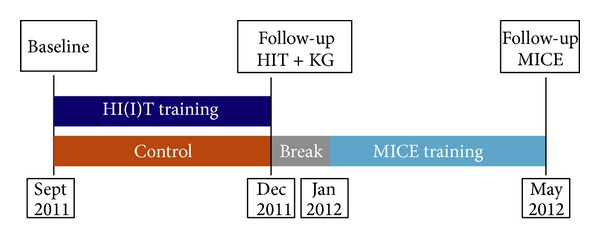
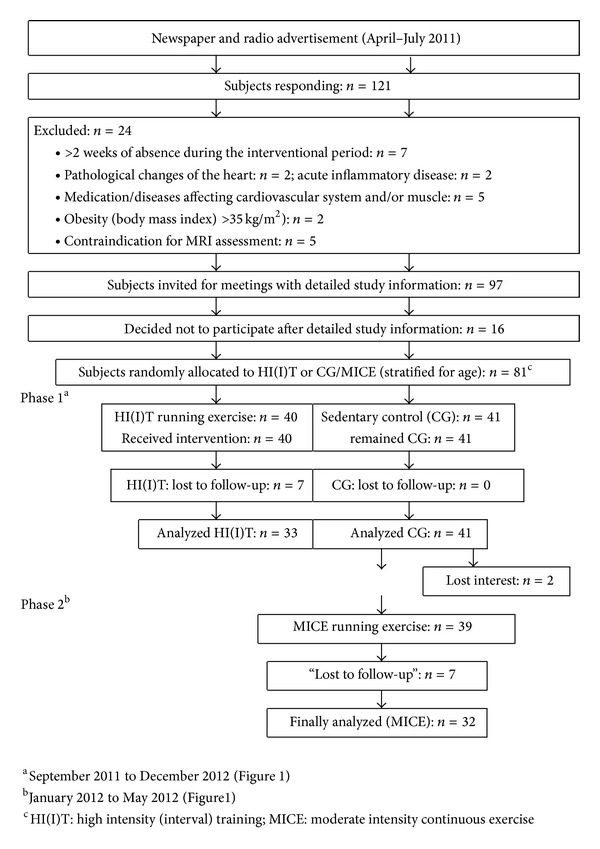
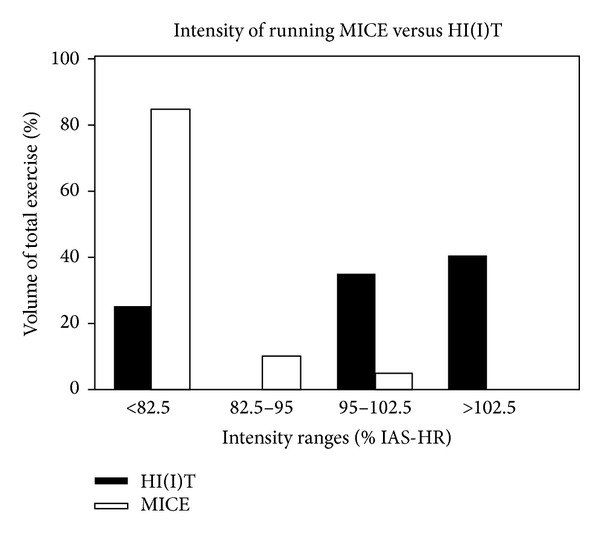
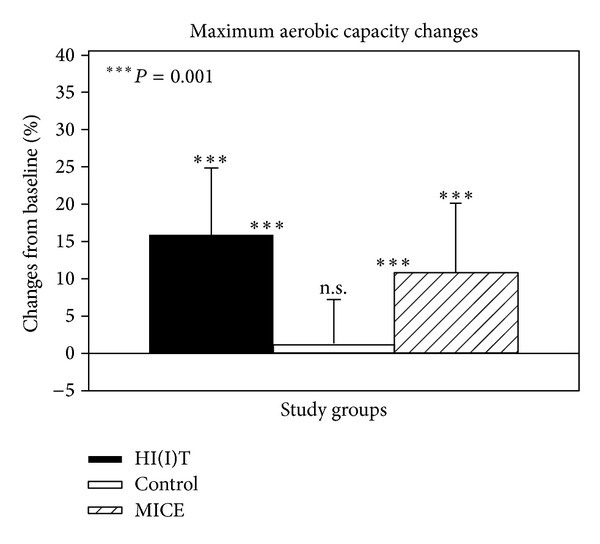
Aerobic exercise positively impacts cardiometabolic risk factors and diseases; however, the most effective exercise training strategies have yet to be identified. To determine the effect of high intensity (interval) training (HI(I)T) versus moderate intensity continuous exercise (MICE) training on cardiometabolic risk factors and cardiorespiratory fitness we conducted a 16-week crossover RCT with partial blinding. Eighty-one healthy untrained middle-aged males were randomly assigned to two study arms: (1) a HI(I)T-group and (2) a sedentary control/MICE-group that started their MICE protocol after their control status. HI(I)T focused on interval training (90 sec to 12 min >85-97.5% HRmax) intermitted by active recovery (1-3 min at 65-70% HRmax), while MICE consisted of continuous running at 65-75% HRmax. Both exercise groups progressively performed 2-4 running sessions/week of 35 to 90 min/session; however, protocols were adjusted to attain similar total work (i.e., isocaloric conditions). With respect to cardiometabolic risk factors and cardiorespiratory fitness both exercise groups demonstrated similar significant positive effects on MetS-Z-Score (HI(I)T: -2.06 ± 1.31, P = .001 versus MICE: -1.60 ± 1.77, P = .001) and (relative) VO2max (HI(I)T: 15.6 ± 9.3%, P = .001 versus MICE: 10.6 ± 9.6%, P = .001) compared with the sedentary control group. In conclusion, both exercise programs were comparably effective for improving cardiometabolic indices and cardiorespiratory fitness in untrained middle-aged males.
有氧运动对心脏代谢风险因素和疾病有积极影响;然而,最有效的运动训练策略尚未确定。为了确定高强度(间歇)训练(HI(I)T)与中等强度持续运动(MICE)训练对心脏代谢风险因素和心肺适能的影响,我们进行了一项为期16周的部分盲法交叉随机对照试验。81名未经训练的健康中年男性被随机分为两个研究组:(1)HI(I)T组和(2)久坐对照组/MICE组,后者在对照期后开始其MICE方案。HI(I)T侧重于间歇训练(90秒至12分钟,心率>85-97.5%最大心率),中间穿插主动恢复(1-3分钟,心率65-70%最大心率),而MICE则是持续以65-75%最大心率跑步。两个运动组均逐渐增加至每周进行2-4次跑步训练,每次训练35至90分钟;然而,训练方案进行了调整以达到相似的总运动量(即等热量条件)。在心脏代谢风险因素和心肺适能方面,与久坐对照组相比,两个运动组在代谢综合征Z评分(HI(I)T组:-2.06±1.31,P = 0.001;MICE组:-1.60±1.77,P = 0.001)和(相对)最大摄氧量(HI(I)T组:15.6±9.3%,P = 0.001;MICE组:10.6±9.6%,P = 0.001)方面均表现出相似的显著积极效果。总之,两种运动方案在改善未经训练的中年男性心脏代谢指标和心肺适能方面效果相当。