Costa Albert, Foucart Alice, Hayakawa Sayuri, Aparici Melina, Apesteguia Jose, Heafner Joy, Keysar Boaz
Center of Brain and Cognition, CBC, Universitat Pompeu Fabra, Barcelona, Spain; Institució Catalana de Recerca i Estudis Avançats (ICREA), Barcelona, Spain.
Center of Brain and Cognition, CBC, Universitat Pompeu Fabra, Barcelona, Spain.
PLoS One. 2014 Apr 23;9(4):e94842. doi: 10.1371/journal.pone.0094842. eCollection 2014.
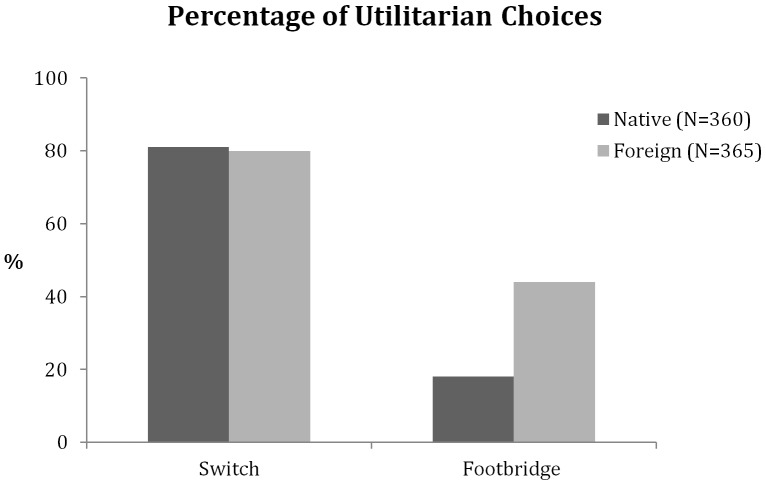
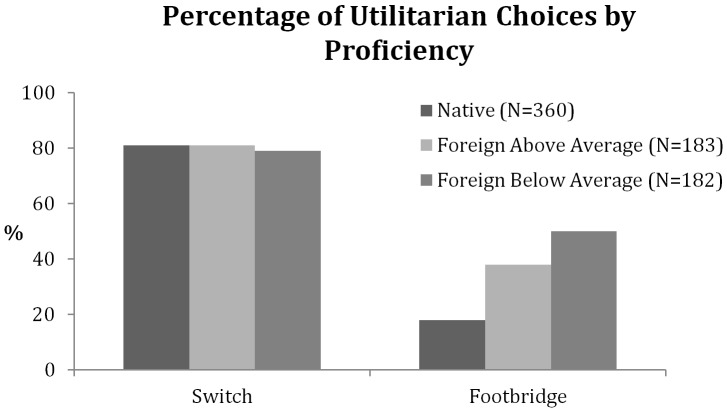
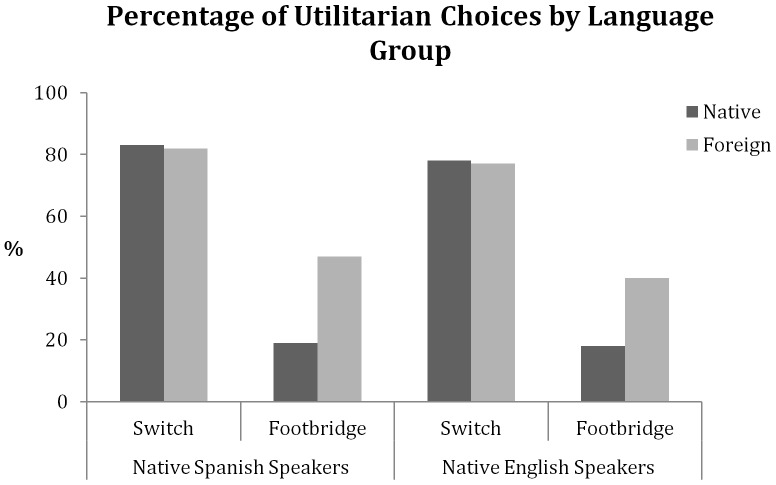
Should you sacrifice one man to save five? Whatever your answer, it should not depend on whether you were asked the question in your native language or a foreign tongue so long as you understood the problem. And yet here we report evidence that people using a foreign language make substantially more utilitarian decisions when faced with such moral dilemmas. We argue that this stems from the reduced emotional response elicited by the foreign language, consequently reducing the impact of intuitive emotional concerns. In general, we suggest that the increased psychological distance of using a foreign language induces utilitarianism. This shows that moral judgments can be heavily affected by an orthogonal property to moral principles, and importantly, one that is relevant to hundreds of millions of individuals on a daily basis.
你会为了救五个人而牺牲一个人吗?无论你的答案是什么,只要你理解了问题,答案就不应取决于你是用母语还是外语被问到这个问题。然而,我们在此报告的证据表明,使用外语的人在面对此类道德困境时会做出实质上更功利主义的决定。我们认为,这源于外语引发的情感反应减弱,从而减少了直观情感因素的影响。总体而言,我们认为使用外语带来的心理距离增加会引发功利主义。这表明道德判断可能会受到与道德原则正交的属性的严重影响,重要的是,这一属性每天都与数亿人相关。