Schatz Juliane, Freuling Conrad Martin, Auer Ernst, Goharriz Hooman, Harbusch Christine, Johnson Nicholas, Kaipf Ingrid, Mettenleiter Thomas Christoph, Mühldorfer Kristin, Mühle Ralf-Udo, Ohlendorf Bernd, Pott-Dörfer Bärbel, Prüger Julia, Ali Hanan Sheikh, Stiefel Dagmar, Teubner Jens, Ulrich Rainer Günter, Wibbelt Gudrun, Müller Thomas
Friedrich-Loeffler-Institut, Federal Research Institute for Animal Health, WHO Collaborating Centre for Rabies Surveillance and Research, Greifswald - Insel Riems, Germany.
Arbeitskreis Fledermäuse Bodensee-Oberschwaben, Naturschutzbund Deutschland e.V., Überlingen, Germany.
PLoS Negl Trop Dis. 2014 May 1;8(5):e2835. doi: 10.1371/journal.pntd.0002835. eCollection 2014 May.
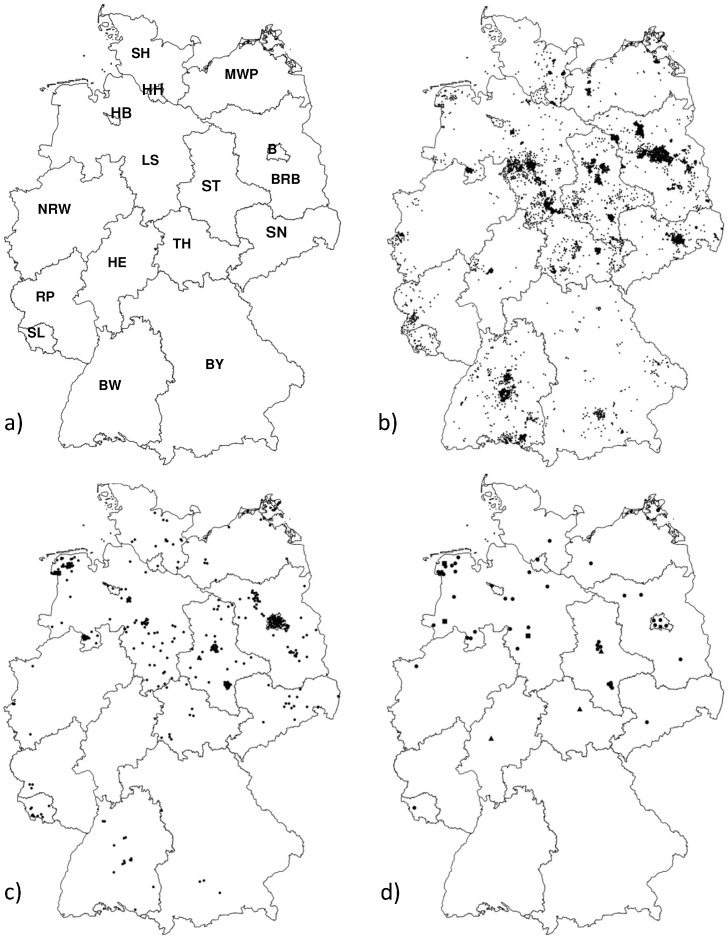
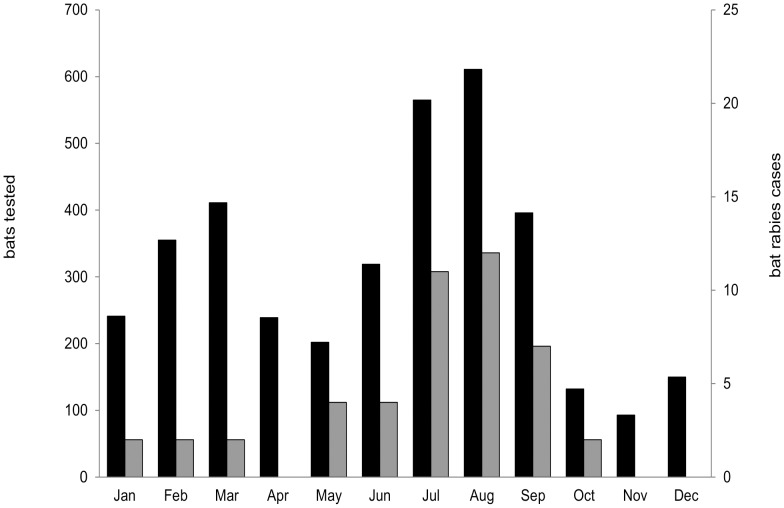
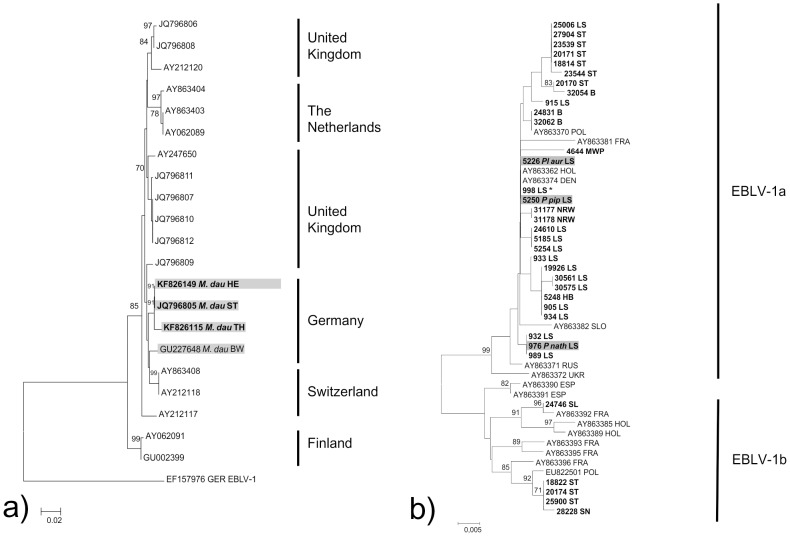
In Germany, rabies in bats is a notifiable zoonotic disease, which is caused by European bat lyssaviruses type 1 and 2 (EBLV-1 and 2), and the recently discovered new lyssavirus species Bokeloh bat lyssavirus (BBLV). As the understanding of bat rabies in insectivorous bat species is limited, in addition to routine bat rabies diagnosis, an enhanced passive surveillance study, i.e. the retrospective investigation of dead bats that had not been tested for rabies, was initiated in 1998 to study the distribution, abundance and epidemiology of lyssavirus infections in bats from Germany. A total number of 5478 individuals representing 21 bat species within two families were included in this study. The Noctule bat (Nyctalus noctula) and the Common pipistrelle (Pipistrellus pipistrellus) represented the most specimens submitted. Of all investigated bats, 1.17% tested positive for lyssaviruses using the fluorescent antibody test (FAT). The vast majority of positive cases was identified as EBLV-1, predominately associated with the Serotine bat (Eptesicus serotinus). However, rabies cases in other species, i.e. Nathusius' pipistrelle bat (Pipistrellus nathusii), P. pipistrellus and Brown long-eared bat (Plecotus auritus) were also characterized as EBLV-1. In contrast, EBLV-2 was isolated from three Daubenton's bats (Myotis daubentonii). These three cases contribute significantly to the understanding of EBLV-2 infections in Germany as only one case had been reported prior to this study. This enhanced passive surveillance indicated that besides known reservoir species, further bat species are affected by lyssavirus infections. Given the increasing diversity of lyssaviruses and bats as reservoir host species worldwide, lyssavirus positive specimens, i.e. both bat and virus need to be confirmed by molecular techniques.
在德国,蝙蝠狂犬病是一种须上报的人畜共患病,由1型和2型欧洲蝙蝠狂犬病病毒(EBLV-1和EBLV-2)以及最近发现的新型狂犬病病毒博克洛蝙蝠狂犬病病毒(BBLV)引起。由于对食虫蝙蝠物种中蝙蝠狂犬病的了解有限,除了常规的蝙蝠狂犬病诊断外,1998年还启动了一项强化被动监测研究,即对未进行狂犬病检测的死亡蝙蝠进行回顾性调查,以研究德国蝙蝠中狂犬病病毒感染的分布、数量和流行病学。本研究共纳入了代表两个科21种蝙蝠的5478只个体。夜蝠(Nyctalus noctula)和普通伏翼蝠(Pipistrellus pipistrellus)提交的标本最多。在所有调查的蝙蝠中,1.17%通过荧光抗体试验(FAT)检测出狂犬病病毒呈阳性。绝大多数阳性病例被鉴定为EBLV-1,主要与棕蝠(Eptesicus serotinus)有关。然而,其他物种的狂犬病病例,即纳氏伏翼蝠(Pipistrellus nathusii)、普通伏翼蝠和棕长耳蝠(Plecotus auritus)也被鉴定为EBLV-1。相比之下,EBLV-2是从三只道氏鼠耳蝠(Myotis daubentonii)中分离出来的。这三例病例对了解德国的EBLV-2感染有重要意义,因为在此研究之前仅报告过一例。这种强化被动监测表明,除了已知的储存宿主物种外,还有更多蝙蝠物种受到狂犬病病毒感染。鉴于全球范围内狂犬病病毒和作为储存宿主物种的蝙蝠的多样性不断增加,狂犬病病毒阳性标本,即蝙蝠和病毒都需要通过分子技术进行确认。