Park Sohee, Shin Hai-Rim, Lee Boram, Shin Aesun, Jung Kyu-Won, Lee Duk-Hee, Jee Sun Ha, Cho Sung-Il, Park Sue Kyung, Boniol Mathieu, Boffetta Paolo, Weiderpass Elisabete
Division of Cancer Registration and Surveillance, National Cancer Center, Goyang, South Korea.
BMC Cancer. 2014 Jun 10;14:420. doi: 10.1186/1471-2407-14-420.
In the Republic of Korea, cancer is the most common cause of death, and cancer incidence and mortality rates are the highest in East Asia. As alcoholic beverages are carcinogenic to humans, we estimated the burden of cancer related to alcohol consumption in the Korean population.
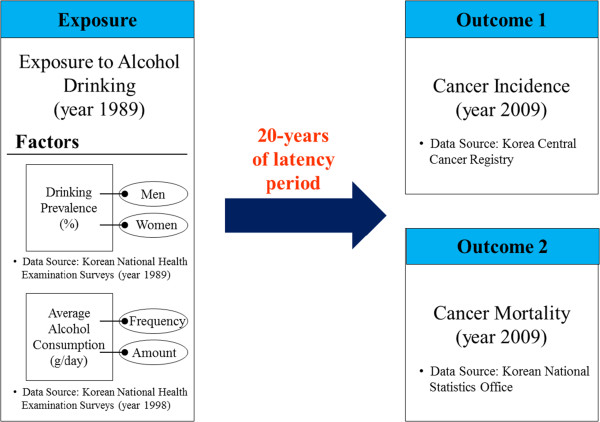
The cancer sites studied were those for which there is convincing evidence of a positive association with alcohol consumption: oral cavity, pharynx, esophagus, colon, rectum, liver, larynx and female breast. Sex- and cancer-specific population attributable fractions (PAF) were calculated based on: 1) the prevalence of alcohol drinkers among adults ≥ 20 years of age in 1989; 2) the average daily alcohol consumption (g/day) among drinkers in 1998; 3) relative risk (RR) estimates for the association between alcohol consumption and site-specific cancer incidence obtained either from a large Korean cohort study or, when more than one Korean study was available for a specific cancer site, meta-analyses were performed and the resulting meta-RRs were used; 4) national cancer incidence and mortality data from 2009.
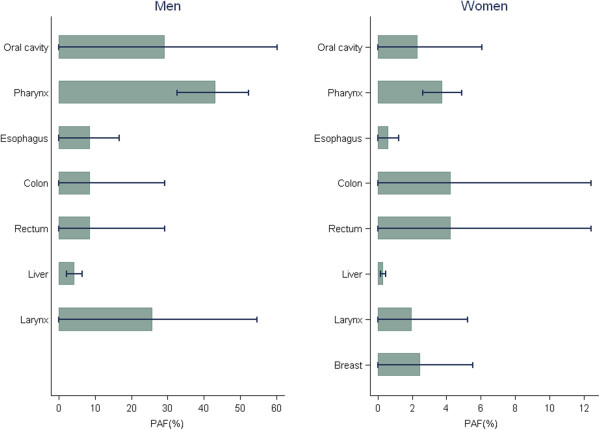
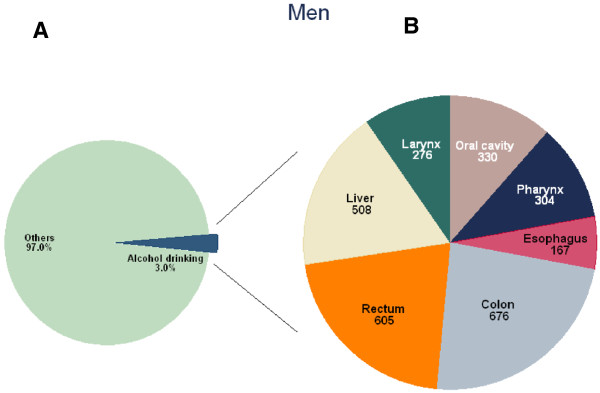
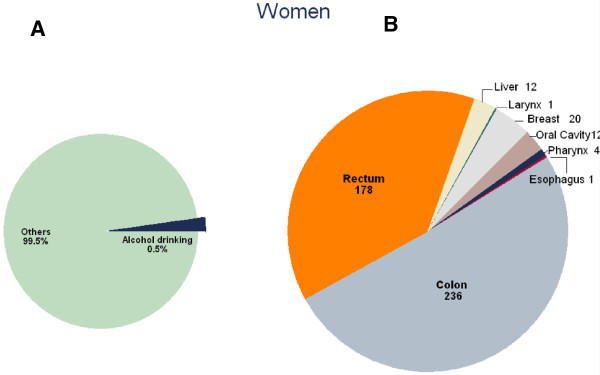
Among men, 3% (2,866 cases) of incident cancer cases and 2.8% (1,234 deaths) of cancer deaths were attributable to alcohol consumption. Among women, 0.5% (464 cancer cases) of incident cancers and 0.1% (32 deaths) of cancer deaths were attributable to alcohol consumption. In particular, the PAF for alcohol consumption in relation to oral cavity cancer incidence among Korean men was 29.3%, and the PAFs for pharyngeal and laryngeal cancer incidence were 43.3% and 25.8%, respectively. Among Korean women, the PAF for colorectal cancer incidence was the highest (4.2%) and that for breast cancer incidence was only 0.2%. Avoiding alcohol consumption, or reducing it from the median of the highest 4th quartile of consumption (56.0 g/day for men, 28.0 g/day for women) to the median of the lowest quartile (2.80 g/day for men, 0.80 g/day for women), would reduce the burden of alcohol-related cancers in Korea.
A reduction in alcohol consumption would decrease the cancer burden and a significant impact is anticipated specifically for the cancers oral cavity, pharynx, and larynx among men in the Republic of Korea.
在大韩民国,癌症是最常见的死亡原因,其发病率和死亡率在东亚地区位居首位。由于酒精饮料对人类具有致癌性,我们估算了韩国人群中与饮酒相关的癌症负担。
所研究的癌症部位为那些有确凿证据表明与饮酒存在正相关的部位:口腔、咽、食管、结肠、直肠、肝脏、喉和女性乳腺。特定性别和癌症的人群归因分数(PAF)基于以下因素计算得出:1)1989年20岁及以上成年人中饮酒者的患病率;2)1998年饮酒者的平均每日酒精摄入量(克/天);3)通过一项大型韩国队列研究得出的酒精消费与特定部位癌症发病率之间关联的相对风险(RR)估计值,或者当针对特定癌症部位有多项韩国研究时,进行荟萃分析并使用所得的荟萃RR;4)2009年的国家癌症发病率和死亡率数据。
在男性中,3%(2866例)的新发癌症病例和2.8%(1234例死亡)的癌症死亡归因于饮酒。在女性中,0.5%(464例癌症病例)的新发癌症和0.1%(32例死亡)的癌症死亡归因于饮酒。特别是,韩国男性中饮酒与口腔癌发病率相关的PAF为29.3%,咽癌和喉癌发病率的PAF分别为43.3%和25.8%。在韩国女性中,结直肠癌发病率的PAF最高(4.2%),乳腺癌发病率的PAF仅为0.2%。避免饮酒,或将饮酒量从最高四分位数中位数(男性56.0克/天,女性28.0克/天)降至最低四分位数中位数(男性2.80克/天,女性0.80克/天),将减轻韩国与酒精相关癌症的负担。
减少饮酒量将降低癌症负担,预计对大韩民国男性的口腔癌、咽癌和喉癌将产生显著影响。