Department of Epidemiology, German Institute of Human Nutrition Potsdam-Rehbruecke, 14558 Nuthetal, Germany.
BMJ. 2011 Apr 7;342:d1584. doi: 10.1136/bmj.d1584.
To compute the burden of cancer attributable to current and former alcohol consumption in eight European countries based on direct relative risk estimates from a cohort study.
Combination of prospective cohort study with representative population based data on alcohol exposure. Setting Eight countries (France, Italy, Spain, United Kingdom, the Netherlands, Greece, Germany, Denmark) participating in the European Prospective Investigation into Cancer and Nutrition (EPIC) study.
109,118 men and 254,870 women, mainly aged 37-70.
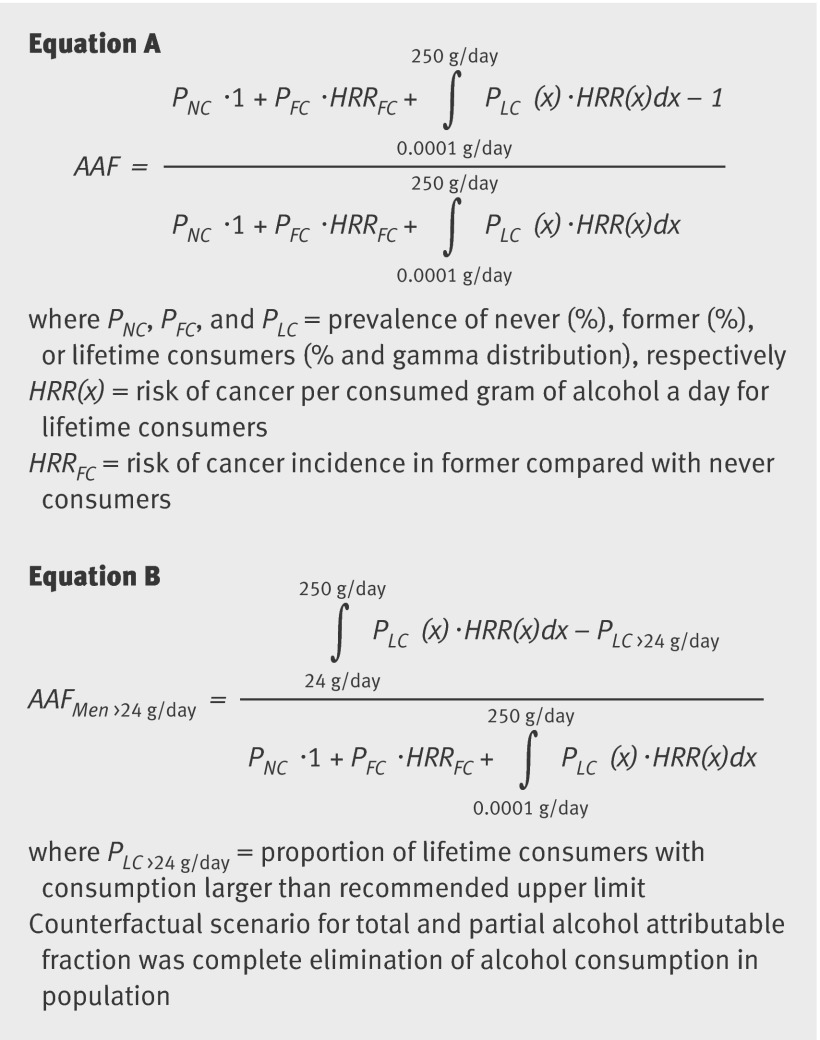
Hazard rate ratios expressing the relative risk of cancer incidence for former and current alcohol consumption among EPIC participants. Hazard rate ratios combined with representative information on alcohol consumption to calculate alcohol attributable fractions of causally related cancers by country and sex. Partial alcohol attributable fractions for consumption higher than the recommended upper limit (two drinks a day for men with about 24 g alcohol, one for women with about 12 g alcohol) and the estimated total annual number of cases of alcohol attributable cancer.
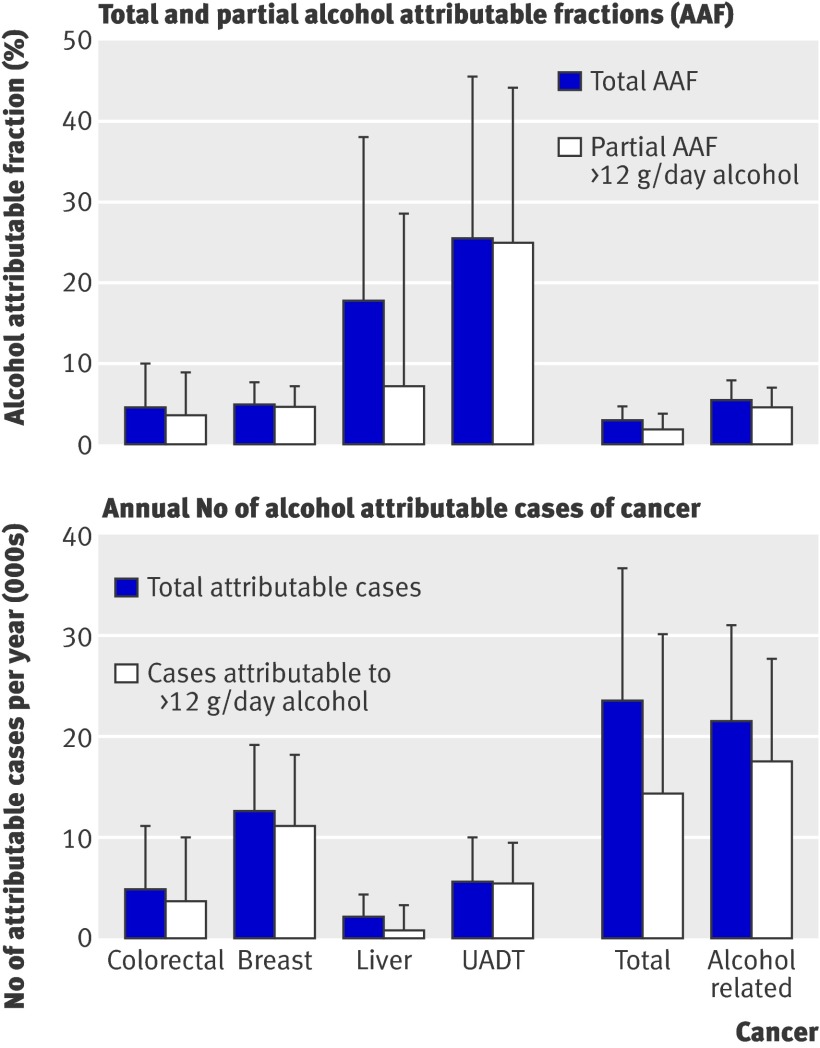
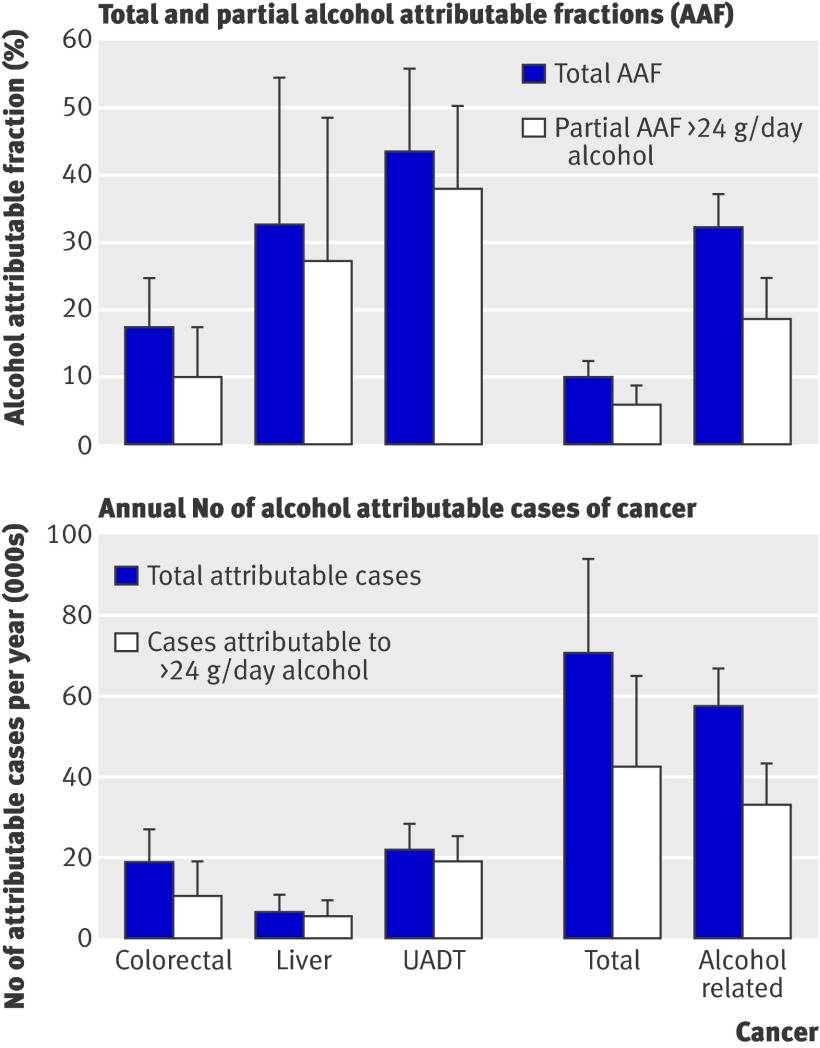
If we assume causality, among men and women, 10% (95% confidence interval 7 to 13%) and 3% (1 to 5%) of the incidence of total cancer was attributable to former and current alcohol consumption in the selected European countries. For selected cancers the figures were 44% (31 to 56%) and 25% (5 to 46%) for upper aerodigestive tract, 33% (11 to 54%) and 18% (-3 to 38%) for liver, 17% (10 to 25%) and 4% (-1 to 10%) for colorectal cancer for men and women, respectively, and 5.0% (2 to 8%) for female breast cancer. A substantial part of the alcohol attributable fraction in 2008 was associated with alcohol consumption higher than the recommended upper limit: 33,037 of 178,578 alcohol related cancer cases in men and 17,470 of 397,043 alcohol related cases in women.
In western Europe, an important proportion of cases of cancer can be attributable to alcohol consumption, especially consumption higher than the recommended upper limits. These data support current political efforts to reduce or to abstain from alcohol consumption to reduce the incidence of cancer.
基于队列研究的直接相对风险估计,计算八个欧洲国家目前和既往饮酒导致的癌症负担。
前瞻性队列研究与基于人群的酒精暴露代表性数据相结合。
参加欧洲癌症与营养前瞻性调查(EPIC)研究的八个国家(法国、意大利、西班牙、英国、荷兰、希腊、德国、丹麦)。
男性 109118 人,女性 254870 人,主要年龄在 37-70 岁之间。
表达 EPIC 参与者中癌症发病率与既往和当前饮酒之间相对风险的风险率比。风险率比与酒精暴露的代表性信息相结合,按国家和性别计算因果相关癌症的酒精归因分数。对高于推荐上限(男性每天两杯,含约 24 克酒精,女性每天一杯,含约 12 克酒精)的饮酒量和估计的每年因酒精导致的癌症总病例数的部分归因分数。
如果我们假设因果关系,在选定的欧洲国家,男性和女性中,10%(95%置信区间为 7%至 13%)和 3%(1%至 5%)的总癌症发病率归因于以前和当前的饮酒。对于选定的癌症,上呼吸道消化道为 44%(31%至 56%)和 25%(5%至 46%),肝脏为 33%(11%至 54%)和 18%(-3%至 38%),结直肠癌分别为男性和女性的 17%(10%至 25%)和 4%(-1%至 10%),女性乳腺癌为 5.0%(2%至 8%)。2008 年归因于酒精的分数的很大一部分与推荐上限以上的饮酒有关:男性 178578 例酒精相关癌症病例中有 33037 例,女性 397043 例酒精相关癌症病例中有 17470 例。
在西欧,很大一部分癌症病例可归因于饮酒,尤其是高于推荐上限的饮酒。这些数据支持当前减少或避免饮酒以降低癌症发病率的政策努力。