Zhang Bill G X, Myers Damian E, Wallace Gordon G, Brandt Milan, Choong Peter F M
Departments of Surgery, University of Melbourne, St Vincent's Hospital (Melbourne), Fitzroy, VIC 3065, Australia.
Australian Research Council Centre of Excellence for Electromaterials Science (ACES), University of Wollongong, Intelligent Polymer Research Institute, Wollongong, NSW 2500, Australia.
Int J Mol Sci. 2014 Jul 4;15(7):11878-921. doi: 10.3390/ijms150711878.
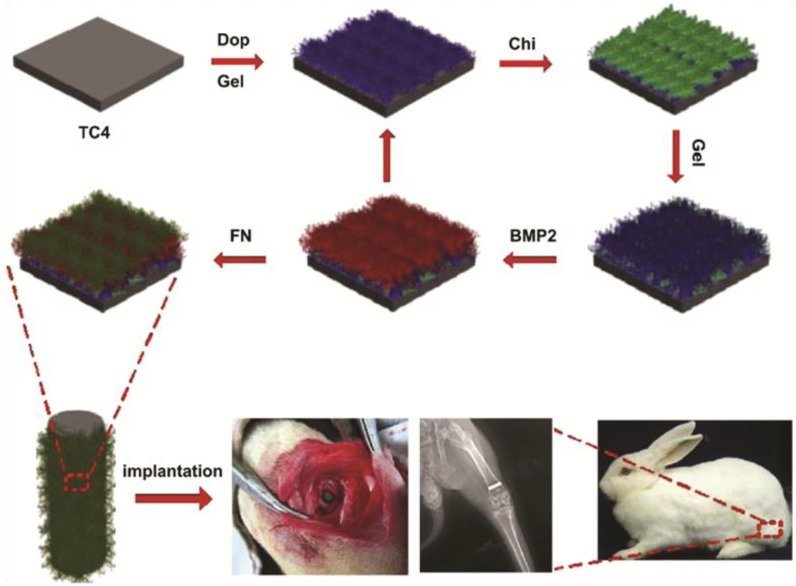
Joint replacement is a major orthopaedic procedure used to treat joint osteoarthritis. Aseptic loosening and infection are the two most significant causes of prosthetic implant failure. The ideal implant should be able to promote osteointegration, deter bacterial adhesion and minimize prosthetic infection. Recent developments in material science and cell biology have seen the development of new orthopaedic implant coatings to address these issues. Coatings consisting of bioceramics, extracellular matrix proteins, biological peptides or growth factors impart bioactivity and biocompatibility to the metallic surface of conventional orthopaedic prosthesis that promote bone ingrowth and differentiation of stem cells into osteoblasts leading to enhanced osteointegration of the implant. Furthermore, coatings such as silver, nitric oxide, antibiotics, antiseptics and antimicrobial peptides with anti-microbial properties have also been developed, which show promise in reducing bacterial adhesion and prosthetic infections. This review summarizes some of the recent developments in coatings for orthopaedic implants.
关节置换是一种用于治疗关节骨关节炎的主要骨科手术。无菌性松动和感染是假体植入失败的两个最重要原因。理想的植入物应能够促进骨整合、阻止细菌黏附并将假体感染降至最低。材料科学和细胞生物学的最新进展见证了新型骨科植入物涂层的开发,以解决这些问题。由生物陶瓷、细胞外基质蛋白、生物肽或生长因子组成的涂层赋予传统骨科假体金属表面生物活性和生物相容性,促进骨向内生长以及干细胞向成骨细胞分化,从而增强植入物的骨整合。此外,还开发了具有抗菌特性的涂层,如银、一氧化氮、抗生素、防腐剂和抗菌肽,这些涂层在减少细菌黏附和假体感染方面显示出前景。本综述总结了骨科植入物涂层的一些最新进展。