Leung Ka Yin, Kretzschmar Mirjam, Diekmann Odo
Mathematical Institute, Utrecht University, Utrecht, The Netherlands,
J Math Biol. 2015 Jul;71(1):1-56. doi: 10.1007/s00285-014-0808-5. Epub 2014 Jul 10.
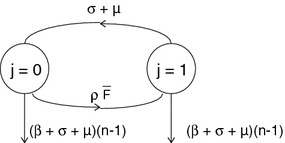
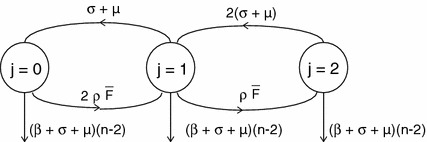
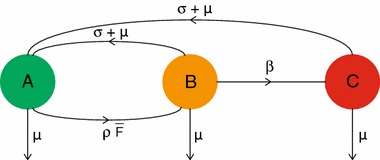
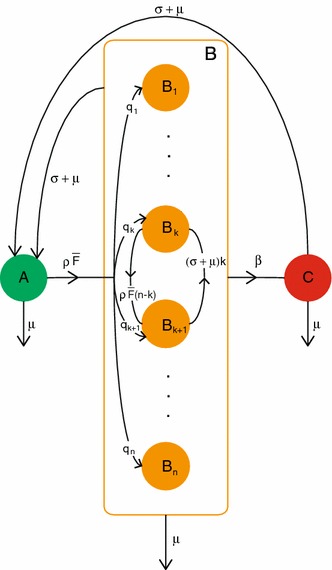
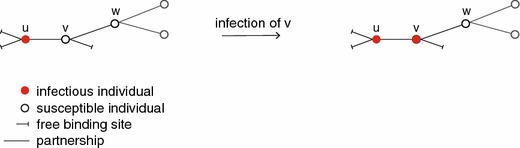
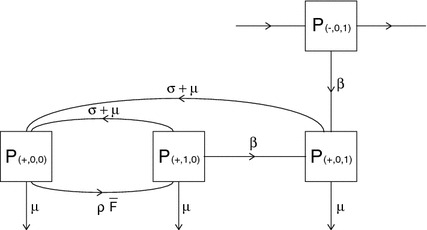
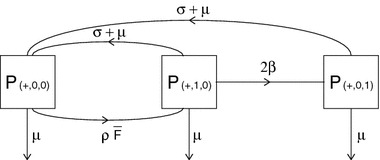
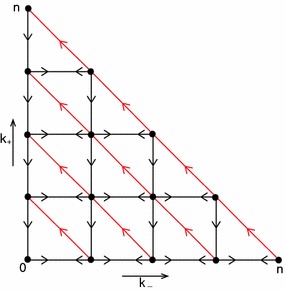
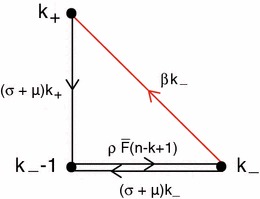
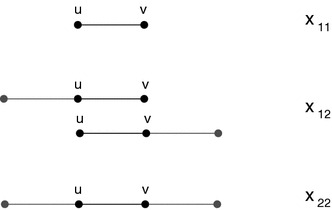
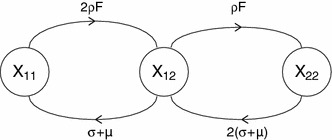
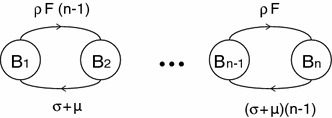
We model the spread of an SI (Susceptible → Infectious) sexually transmitted infection on a dynamic homosexual network. The network consists of individuals with a dynamically varying number of partners. There is demographic turnover due to individuals entering the population at a constant rate and leaving the population after an exponentially distributed time. Infection is transmitted in partnerships between susceptible and infected individuals. We assume that the state of an individual in this structured population is specified by its disease status and its numbers of susceptible and infected partners. Therefore the state of an individual changes through partnership dynamics and transmission of infection. We assume that an individual has precisely n 'sites' at which a partner can be bound, all of which behave independently from one another as far as forming and dissolving partnerships are concerned. The population level dynamics of partnerships and disease transmission can be described by a set of (n +1)(n +2) differential equations. We characterize the basic reproduction ratio R0 using the next-generation-matrix method. Using the interpretation of R0 we show that we can reduce the number of states-at-infection n to only considering three states-at-infection. This means that the stability analysis of the disease-free steady state of an (n +1)(n +2)-dimensional system is reduced to determining the dominant eigenvalue of a 3 × 3 matrix. We then show that a further reduction to a 2 × 2 matrix is possible where all matrix entries are in explicit form. This implies that an explicit expression for R0 can be found for every value of n.
我们对一种SI(易感→感染)性传播感染在动态同性恋网络中的传播进行建模。该网络由性伴侣数量动态变化的个体组成。由于个体以恒定速率进入群体并在经过指数分布的时间后离开群体,所以存在人口更替。感染在易感个体和感染个体之间的性伴侣关系中传播。我们假设在这个结构化群体中个体的状态由其疾病状态以及其易感和感染性伴侣的数量来确定。因此,个体的状态通过性伴侣关系动态和感染传播而发生变化。我们假设个体恰好有n个“位点”,在这些位点上可以绑定一个性伴侣,就形成和解除性伴侣关系而言,所有这些位点彼此独立运作。性伴侣关系和疾病传播的群体水平动态可以用一组(n +1)(n +2)个微分方程来描述。我们使用下一代矩阵方法来刻画基本再生数R0。利用对R0的解释,我们表明可以将感染时的状态数n减少到仅考虑三种感染时的状态。这意味着将一个(n +1)(n +2)维系统的无病稳态的稳定性分析简化为确定一个3×3矩阵的主导特征值。然后我们表明进一步简化为一个2×2矩阵是可能的,其中所有矩阵元素都以显式形式给出。这意味着对于n的每个值都可以找到R0的显式表达式。