Zhou Pei, Hong Malin, Merrill Mary M, He Huamei, Sun Lingshuang, Zhang Guihong
Key Laboratory of Animal Disease Control and Prevention of the Ministry of Agriculture, College of Veterinary Medicine, South China Agricultural University, 483 Wushan Road, Tianhe District, Guangzhou 510642, China.
BMC Vet Res. 2014 Sep 2;10:203. doi: 10.1186/s12917-014-0203-x.
In 2013, a novel H7N9 avian influenza virus (AIV) was isolated from ill humans in Shanghai and Anhui Province, China. Since then, the virus has spread quickly throughout China. Previous isolation of H7N2 virus from swine suggests that additional H7 subtype AIVs may be transmitted through pigs. However, prior to the recent zoonosis of H7N9, there were very few studies on the seroprevalence of the H7 subtypes in this species. Thus, there is a need to perform serological surveys for novel H7N9 as well as other H7 subtype AIVs in swine. This surveillance may help us understand risk factors for outbreaks of influenza A (H7N9) virus.
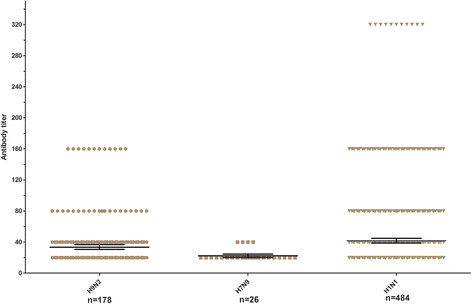
Only 2.0% (26/1310) of the pig sera had antibodies with an HI titer ≥1:20, and none had an MN titer ≥1:80, against the H7 antigen. Thus, no samples were found to be positive against H7N9. However, 13.6% (178/1310) of the pig sera had antibodies with HI titer ≥1:20 and 8.5% (112/1310) by MN titer ≥1:80 against H9 antigen. Thirty-seven percent (484/1310) of the pig sera had antibodies with HI titer ≥1:20 and 18.2% (238/1310) had MN titer ≥1:80 against pandemic 2009.
Pigs in southern China have been shown to be infected with multiple avian influenza viruses. As the prevalence of novel influenza A viruses (e.g., H7N9 avian influenza virus) may be increasing among poultry in China, similar seroepidemiological studies of pigs should be conducted in the future.
2013年,在中国上海和安徽省从患病人类中分离出一种新型H7N9禽流感病毒(AIV)。自那时起,该病毒迅速在中国传播。此前从猪中分离出H7N2病毒表明,其他H7亚型禽流感病毒可能通过猪传播。然而,在最近H7N9人畜共患病出现之前,关于该物种中H7亚型血清流行率的研究非常少。因此,有必要对猪群中的新型H7N9以及其他H7亚型禽流感病毒进行血清学调查。这种监测可能有助于我们了解甲型H7N9流感病毒爆发的风险因素。
仅2.0%(26/1310)的猪血清针对H7抗原的血凝抑制(HI)效价≥1:20,且无一血清的微量中和(MN)效价≥1:80。因此,未发现针对H7N9呈阳性的样本。然而,13.6%(178/1310)的猪血清针对H9抗原的HI效价≥1:20,8.5%(112/1310)的血清MN效价≥1:80。37%(484/1310)的猪血清针对2009年大流行病毒的HI效价≥1:20,18.2%(238/1310)的血清MN效价≥1:80。
中国南方的猪已被证明感染了多种禽流感病毒。由于中国家禽中新型甲型流感病毒(如H7N9禽流感病毒)的流行率可能正在上升,未来应开展类似的猪血清流行病学研究。