Miller Suzanne M, Hudson Shawna V, Hui Siu-Kuen Azor, Diefenbach Michael A, Fleisher Linda, Raivitch Stephanie, Belton Tanisha, Roy Gem, Njoku Anuli, Scarpato John, Viterbo Rosalia, Buyyounouski Mark, Denlinger Crystal, Miyamoto Curtis, Reese Adam, Baman Jayson
Department of Psychosocial and Behavioral Medicine, Fox Chase Cancer Center/Temple University Health System, Robert C. Young Pavilion, 333 Cottman Avenue-4th Floor, Philadelphia, PA, 19111, USA,
J Cancer Surviv. 2015 Sep;9(3):541-53. doi: 10.1007/s11764-015-0431-5. Epub 2015 Feb 20.
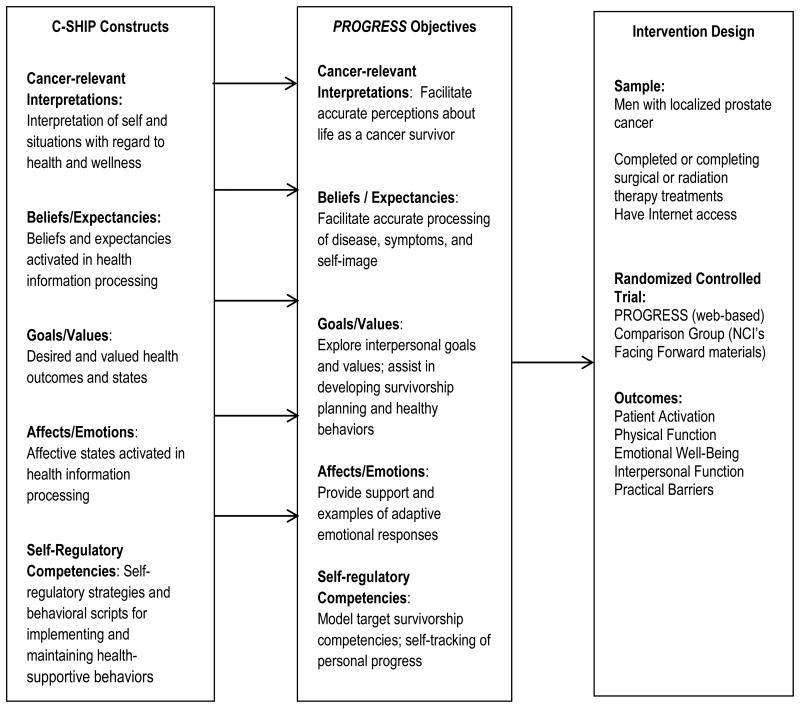
This formative research study describes the development and preliminary evaluation of a theory-guided, online multimedia psycho-educational program (PROGRESS) designed to facilitate adaptive coping among prostate cancer patients transitioning from treatment into long-term survivorship.
Guided by the Cognitive-Social Health Information Processing Model (C-SHIP) and using health communications best practices, we conducted a two-phase, qualitative formative research study with early stage prostate cancer patients (n = 29) to inform the Web program development. Phase 1 included individual (n = 5) and group (n = 12) interviews to help determine intervention content and interface. Phase 2 employed iterative user/usability testing (n = 12) to finalize the intervention. Interview data were independently coded and collectively analyzed to achieve consensus.
Survivors expressed interest in action-oriented content on (1) managing treatment side effects, (2) handling body image and comorbidities related to overweight/obesity, (3) coping with emotional and communication issues, (4) tips to reduce disruptions of daily living activities, and (5) health skills training tools. Patients also desired the use of realistic and diverse survivor images.
Incorporation of an established theoretical framework, application of multimedia intervention development best practices, and an evidence-based approach to content and format resulted in a psycho-educational tool that comprehensively addresses survivors' needs in a tailored fashion.
The results suggest that an interactive Web-based multimedia program is useful for survivors if it covers the key topics of symptom control, emotional well-being, and coping skills training; this tool has the potential to be disseminated and implemented as an adjunct to routine clinical care.
本形成性研究描述了一种理论导向的在线多媒体心理教育项目(PROGRESS)的开发和初步评估,该项目旨在促进前列腺癌患者从治疗过渡到长期生存期间的适应性应对。
以认知社会健康信息处理模型(C-SHIP)为指导,并运用健康传播的最佳实践,我们对早期前列腺癌患者(n = 29)进行了两阶段的定性形成性研究,以为网络项目的开发提供信息。第一阶段包括个体访谈(n = 5)和小组访谈(n = 12),以帮助确定干预内容和界面。第二阶段采用迭代用户/可用性测试(n = 12)来确定最终的干预措施。访谈数据进行独立编码并共同分析以达成共识。
幸存者对以下方面的行动导向内容表示感兴趣:(1)管理治疗副作用;(2)处理与超重/肥胖相关的身体形象和合并症;(3)应对情绪和沟通问题;(4)减少日常生活活动干扰的小贴士;(5)健康技能培训工具。患者还希望使用真实且多样化的幸存者图像。
纳入既定的理论框架、应用多媒体干预开发的最佳实践以及基于证据的内容和形式方法,产生了一种心理教育工具,该工具以量身定制的方式全面满足幸存者的需求。
结果表明,如果一个基于网络的交互式多媒体项目涵盖症状控制、情绪健康和应对技能培训等关键主题,那么它对幸存者是有用的;该工具有可能作为常规临床护理的辅助手段进行传播和实施。