Livingston Patricia M, Craike Melinda J, Salmon Jo, Courneya Kerry S, Gaskin Cadeyrn J, Fraser Steve F, Mohebbi Mohammadreza, Broadbent Suzanne, Botti Mari, Kent Bridie
Faculty of Health, Deakin University, Burwood, Australia.
Centre for Social and Early Emotional Development and School of Psychology, Faculty of Health, Deakin University, Burwood, Australia.
Cancer. 2015 Aug 1;121(15):2646-54. doi: 10.1002/cncr.29385. Epub 2015 Apr 15.
The purpose of this study was to determine the efficacy of a clinician referral and exercise program in improving exercise levels and quality of life for men with prostate cancer.
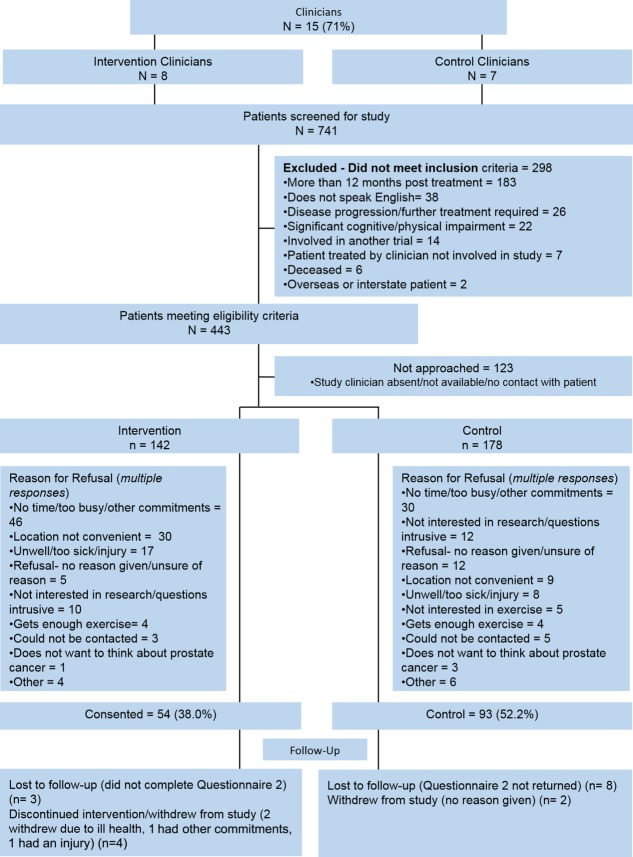
This was a multicenter cluster randomized controlled trial in Melbourne, Australia comprising 15 clinicians: 8 clinicians were randomized to refer eligible participants (n = 54) to a 12-week exercise program comprising 2 supervised gym sessions and 1 home-based session per week, and 7 clinicians were randomized to follow usual care (n = 93). The primary outcome was self-reported physical activity; the secondary outcomes were quality of life, anxiety, and symptoms of depression.
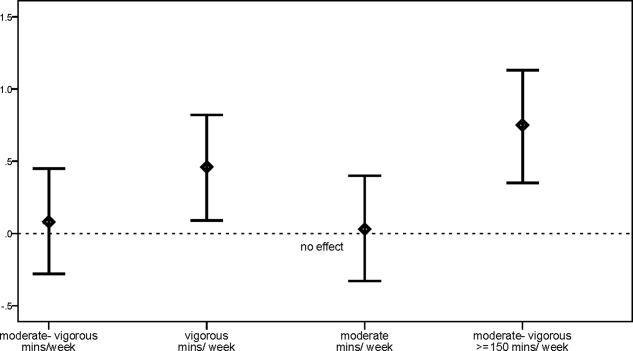
A significant intervention effect was observed for vigorous-intensity exercise (effect size: Cohen's d, 0.46; 95% confidence interval [CI], 0.09-0.82; P = .010) but not for combined moderate and vigorous exercise levels (effect size: d, 0.08; 95% CI, -0.28 to 0.45; P = .48). Significant intervention effects were also observed for meeting exercise guidelines (≥150 min/wk; odds ratio, 3.9; 95% CI, 1.9-7.8; P = .002); positive intervention effects were observed in the intervention group for cognitive functioning (effect size: d, 0.34; 95% CI, -0.02 to 0.70; P = .06) and depression symptoms (effect size: d, -0.35; 95% CI, -0.71 to 0.02; P = .06). Eighty percent of participants reported that the clinician's referral influenced their decision to participate in the exercise program.
The clinician referral and 12-week exercise program significantly improved vigorous exercise levels and had a positive impact on mental health outcomes for men living with prostate cancer. Further research is needed to determine the sustainability of the exercise program and its generalizability to other cancer populations.
本研究旨在确定临床医生转诊及运动计划对提高前列腺癌男性患者的运动水平和生活质量的疗效。
这是一项在澳大利亚墨尔本进行的多中心整群随机对照试验,涉及15名临床医生:8名临床医生被随机分配,将符合条件的参与者(n = 54)转诊至一项为期12周的运动计划,该计划包括每周2次有监督的健身房训练和1次居家训练;7名临床医生被随机分配遵循常规护理(n = 93)。主要结局是自我报告的身体活动;次要结局是生活质量、焦虑和抑郁症状。
在剧烈强度运动方面观察到显著的干预效果(效应量:科恩d值,0.46;95%置信区间[CI],0.09 - 0.82;P = 0.010),但在中度和剧烈运动综合水平方面未观察到显著效果(效应量:d值,0.08;95%CI, - 0.28至0.45;P = 0.48)。在达到运动指南(≥150分钟/周)方面也观察到显著的干预效果(优势比,3.9;95%CI,1.9 - 7.8;P = 0.002);在干预组中,在认知功能(效应量:d值,0.34;95%CI, - 0.02至0.70;P = 0.06)和抑郁症状(效应量:d值, - 0.35;95%CI, - 0.71至0.02;P = 0.06)方面观察到积极的干预效果。80%的参与者报告称临床医生的转诊影响了他们参与运动计划的决定。
临床医生转诊及为期12周的运动计划显著提高了剧烈运动水平,并对前列腺癌男性患者的心理健康结局产生了积极影响。需要进一步研究以确定该运动计划的可持续性及其对其他癌症人群的可推广性。