Plagens André, Richter Hagen, Charpentier Emmanuelle, Randau Lennart
Max Planck Institute for Terrestrial Microbiology, Karl-von-Frisch Strasse 10, 35043 Marburg, Germany.
Helmholtz Centre for Infection Research, Department of Regulation in Infection Biology, Braunschweig 38124, Germany.
FEMS Microbiol Rev. 2015 May;39(3):442-63. doi: 10.1093/femsre/fuv019. Epub 2015 Apr 30.
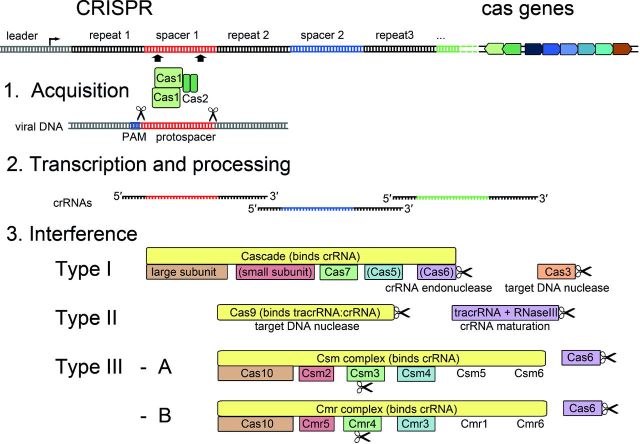
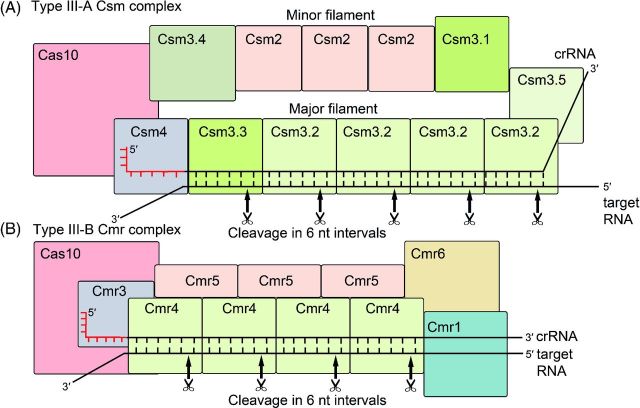
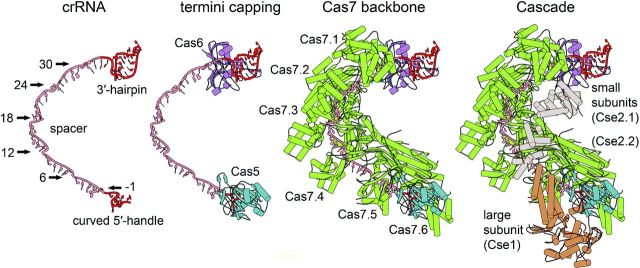
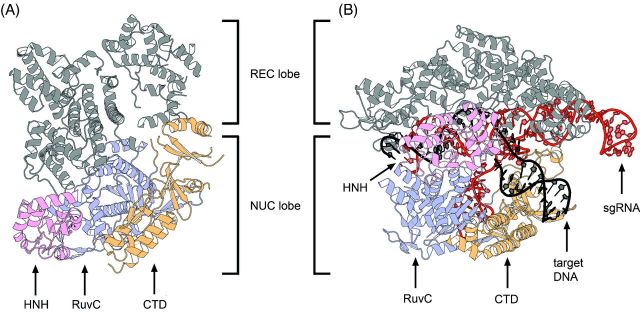
The CRISPR (clustered regularly interspaced short palindromic repeats)-Cas (CRISPR-associated) adaptive immune systems use small guide RNAs, the CRISPR RNAs (crRNAs), to mark foreign genetic material, e.g. viral nucleic acids, for degradation. Archaea and bacteria encode a large variety of Cas proteins that bind crRNA molecules and build active ribonucleoprotein surveillance complexes. The evolution of CRISPR-Cas systems has resulted in a diversification of cas genes and a classification of the systems into three types and additional subtypes characterized by distinct surveillance and interfering complexes. Recent crystallographic and biochemical advances have revealed detailed insights into the assembly and DNA/RNA targeting mechanisms of the various complexes. Here, we review our knowledge on the molecular mechanism involved in the DNA and RNA interference stages of type I (Cascade: CRISPR-associated complex for antiviral defense), type II (Cas9) and type III (Csm, Cmr) CRISPR-Cas systems. We further highlight recently reported structural and mechanistic themes shared among these systems.
CRISPR(成簇规律间隔短回文重复序列)-Cas(CRISPR相关)适应性免疫系统利用小向导RNA,即CRISPR RNA(crRNA),来标记外来遗传物质,如病毒核酸,以便进行降解。古菌和细菌编码多种与crRNA分子结合并构建活性核糖核蛋白监测复合物的Cas蛋白。CRISPR-Cas系统的进化导致了cas基因的多样化,并将该系统分为三种类型以及其他亚型,其特征在于不同的监测和干扰复合物。最近的晶体学和生物化学进展揭示了对各种复合物的组装以及DNA/RNA靶向机制的详细见解。在此,我们综述了关于I型(Cascade:抗病毒防御的CRISPR相关复合物)、II型(Cas9)和III型(Csm、Cmr)CRISPR-Cas系统在DNA和RNA干扰阶段所涉及分子机制的知识。我们还进一步强调了这些系统之间最近报道的结构和机制主题。