Veldstra J L, Bosker W M, de Waard D, Ramaekers J G, Brookhuis K A
Faculty of Behavioural and Social Sciences, University of Groningen, Grote Kruisstraat 2/1, 9712TS, Groningen, The Netherlands,
Psychopharmacology (Berl). 2015 Aug;232(16):2911-9. doi: 10.1007/s00213-015-3927-9. Epub 2015 May 10.
The driving simulator provides a safe and controlled environment for testing driving behaviour efficiently. The question is whether it is sensitive to detect drug-induced effects.
The primary aim of the current study was to investigate the sensitivity of the driving simulator for detecting drug effects. As a case in point, we investigated the dose-related effects of oral ∆(9)-tetrahydrocannabinol (THC), i.e. dronabinol, on simulator and on-the-road driving performance in equally demanding driving tasks.
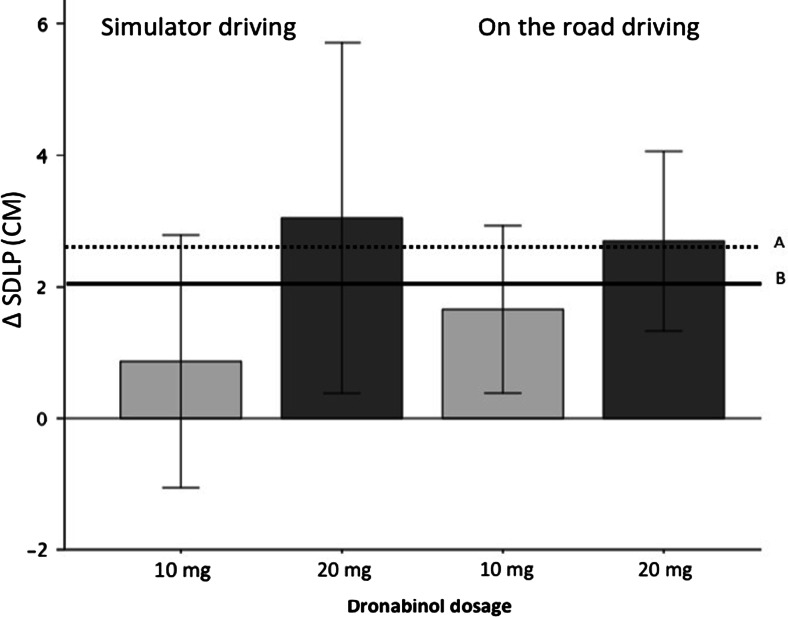
Twenty-four experienced driver participants were treated with dronabinol (Marinol®; 10 and 20 mg) and placebo. Dose-related effects of the drug on the ability to keep a vehicle in lane (weaving) and to follow the speed changes of a lead car (car following) were compared within subjects for on-the-road versus in-simulator driving. Additionally, the outcomes of equivalence testing to alcohol-induced effects were investigated.
Treatment effects found on weaving when driving in the simulator were comparable to treatment effects found when driving on the road. The effect after 10 mg dronabinol was however less strong in the simulator than on the road and inter-individual variance seemed higher in the simulator. There was, however, a differential treatment effect of dronabinol on reactions to speed changes of a lead car (car following) when driving on the road versus when driving in the simulator.
The driving simulator was proven to be sensitive for demonstrating dronabinol-induced effects particularly at higher doses. Treatment effects of dronabinol on weaving were comparable with driving on the road but inter-individual variability seemed higher in the simulator than on the road which may have potential effects on the clinical inferences made from simulator driving. Car following on the road and in the simulator were, however, not comparable.
驾驶模拟器为高效测试驾驶行为提供了一个安全且可控的环境。问题在于它对检测药物诱导效应是否敏感。
本研究的主要目的是调查驾驶模拟器检测药物效应的敏感性。作为一个例子,我们研究了口服Δ(9)-四氢大麻酚(THC),即屈大麻酚,在同等要求的驾驶任务中对模拟器和实际道路驾驶性能的剂量相关效应。
24名经验丰富的驾驶员参与者接受了屈大麻酚(Marinol®;10毫克和20毫克)和安慰剂治疗。在受试者内比较了药物对保持车辆在车道内行驶(摆动)和跟随前车速度变化(跟车)能力的剂量相关效应,分别针对实际道路驾驶和模拟器驾驶。此外,还研究了与酒精诱导效应的等效性测试结果。
在模拟器中驾驶时发现的摆动治疗效果与在实际道路上驾驶时发现的治疗效果相当。然而,10毫克屈大麻酚后的效果在模拟器中比在实际道路上要弱,并且模拟器中的个体间差异似乎更大。然而,屈大麻酚对跟车时前车速度变化的反应在实际道路驾驶和模拟器驾驶之间存在差异治疗效果。
驾驶模拟器被证明对展示屈大麻酚诱导的效应敏感,尤其是在较高剂量时。屈大麻酚对摆动的治疗效果与实际道路驾驶相当,但模拟器中的个体间变异性似乎比实际道路上更高,这可能对从模拟器驾驶得出的临床推断产生潜在影响。然而,实际道路和模拟器中的跟车情况不可比。