Yarmolinsky James, Mueller Noel T, Duncan Bruce B, Bisi Molina Maria Del Carmen, Goulart Alessandra C, Schmidt Maria Inês
Postgraduate Studies Program in Epidemiology, School of Medicine, Federal University of Rio Grande do Sul, Porto Alegre, Rio Grande do Sul, Brazil.
Postgraduate Studies Program in Epidemiology, School of Medicine, Federal University of Rio Grande do Sul, Porto Alegre, Rio Grande do Sul, Brazil; Department of Epidemiology, Mailman School of Public Health, Columbia University Medical Center, New York, NY, United States of America; Institute of Human Nutrition and Department of Medicine, College of Physicians and Surgeons, Columbia University Medical Center, New York, NY, United States of America.
PLoS One. 2015 May 15;10(5):e0126469. doi: 10.1371/journal.pone.0126469. eCollection 2015.
Observational studies have reported fairly consistent inverse associations between coffee consumption and risk of type 2 diabetes, but this association has been little investigated with regard to lesser degrees of hyperglycemia and other alterations in glucose homeostasis. Additionally, the association between coffee consumption and diabetes has been rarely investigated in South American populations. We examined the cross-sectional relationships of coffee intake with newly diagnosed diabetes and measures of glucose homeostasis, insulin sensitivity, and insulin secretion, in a large Brazilian cohort of middle-aged and elderly individuals.
We used baseline data from 12,586 participants of the Longitudinal Study of Adult Health (ELSA-Brasil). Logistic regression analyses were performed to examine associations between coffee consumption and newly diagnosed diabetes. Analysis of covariance was used to assess coffee intake in relation to two-hour glucose from an oral glucose tolerance test, fasting glucose, glycated hemoglobin, fasting and -2-hour postload insulin and measures of insulin sensitivity.
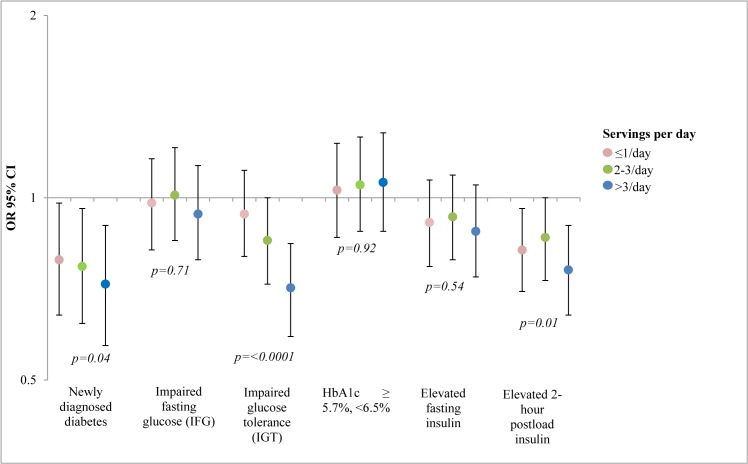
We found an inverse association between coffee consumption and newly diagnosed diabetes, after adjusting for multiple covariates [23% and 26% lower odds of diabetes for those consuming coffee 2-3 and >3 times per day, respectively, compared to those reporting never or almost never consuming coffee, (p = .02)]. An inverse association was also found for 2-hour postload glucose [Never/almost never: 7.57 mmol/L, ≤1 time/day: 7.48 mmol/L, 2-3 times/day: 7.22 mmol/L, >3 times/day: 7.12 mol/L, p<0.0001] but not with fasting glucose concentrations (p = 0.07). Coffee was additionally associated with 2-hour postload insulin [Never/almost never: 287.2 pmol/L, ≤1 time/day: 280.1 pmol/L, 2-3 times/day: 275.3 pmol/L, >3 times/day: 262.2 pmol/L, p = 0.0005) but not with fasting insulin concentrations (p = .58).
Our present study provides further evidence of a protective effect of coffee on risk of adult-onset diabetes. This effect appears to act primarily, if not exclusively, through postprandial, as opposed to fasting, glucose homeostasis.
观察性研究报告称,咖啡摄入量与2型糖尿病风险之间存在相当一致的负相关关系,但对于程度较轻的高血糖及葡萄糖稳态的其他改变,这种关联鲜少被研究。此外,在南美人群中,咖啡摄入量与糖尿病之间的关联也鲜有研究。我们在一个大型巴西中老年队列中,研究了咖啡摄入量与新诊断糖尿病以及葡萄糖稳态、胰岛素敏感性和胰岛素分泌指标之间的横断面关系。
我们使用了来自成人健康纵向研究(ELSA - Brasil)12586名参与者的基线数据。进行逻辑回归分析以研究咖啡摄入量与新诊断糖尿病之间的关联。协方差分析用于评估咖啡摄入量与口服葡萄糖耐量试验的两小时血糖、空腹血糖、糖化血红蛋白、空腹及负荷后两小时胰岛素以及胰岛素敏感性指标之间的关系。
在调整多个协变量后,我们发现咖啡摄入量与新诊断糖尿病之间存在负相关关系[每天饮用咖啡2 - 3次和超过3次的人群患糖尿病的几率分别比报告从不或几乎不喝咖啡的人群低23%和26%,(p = 0.02)]。两小时负荷后血糖也存在负相关关系[从不/几乎不:7.57 mmol/L,每天≤1次:7.48 mmol/L,每天2 - 3次:7.22 mmol/L,每天>3次:7.12 mol/L,p<0.0001],但与空腹血糖浓度无关(p = 0.07)。咖啡还与两小时负荷后胰岛素有关[从不/几乎不:287.2 pmol/L,每天≤1次:280.1 pmol/L,每天2 - 3次:275.3 pmol/L,每天>3次:262.2 pmol/L,p = 0.0005],但与空腹胰岛素浓度无关(p = 0.58)。
我们目前的研究进一步证明了咖啡对成人发病型糖尿病风险具有保护作用。这种作用似乎主要(如果不是唯一的话)通过餐后而非空腹葡萄糖稳态发挥作用。