Tomasik Jakub, Yolken Robert H, Bahn Sabine, Dickerson Faith B
Department of Chemical Engineering and Biotechnology, University of Cambridge, Cambridge, UK. ; Department of Neuroscience, Erasmus Medical Centre, Rotterdam, The Netherlands.
Stanley Division of Developmental Neurovirology, Department of Pediatrics, Johns Hopkins University School of Medicine, Baltimore, MD, USA.
Biomark Insights. 2015 Jun 1;10:47-54. doi: 10.4137/BMI.S22007. eCollection 2015.
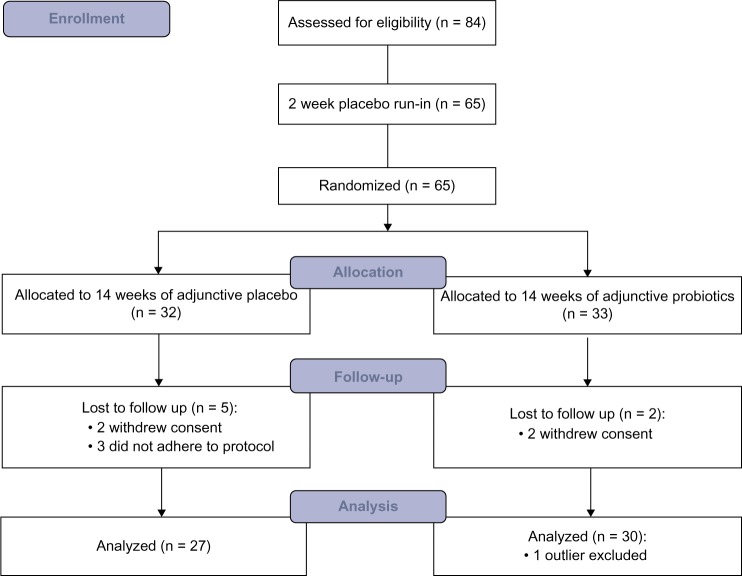
Although peripheral immune system abnormalities have been linked to schizophrenia pathophysiology, standard antipsychotic drugs show limited immunological effects. Thus, more effective treatment approaches are required. Probiotics are microorganisms that modulate the immune response of the host and, therefore, may be beneficial to schizophrenia patients. The aim of this study was to examine the possible immunomodulatory effects of probiotic supplementation in chronic schizophrenia patients. The concentrations of 47 immune-related serum proteins were measured using multiplexed immunoassays in samples collected from patients before and after 14 weeks of adjuvant treatment with probiotics (Lactobacillus rhamnosus strain GG and Bifidobacterium animalis subsp. lactis strain Bb12; n = 31) or placebo (n = 27). Probiotic add-on treatment significantly reduced levels of von Willebrand factor (vWF) and increased levels of monocyte chemotactic protein-1 (MCP-1), brain-derived neurotrophic factor (BDNF), RANTES, and macrophage inflammatory protein-1 beta (MIP-1) beta with borderline significance (P ≤ 0.08). In silico pathway analysis revealed that probiotic-induced alterations are related to regulation of immune and intestinal epithelial cells through the IL-17 family of cytokines. We hypothesize that supplementation of probiotics to schizophrenia patients may improve control of gastrointestinal leakage.
尽管外周免疫系统异常与精神分裂症的病理生理学有关,但标准抗精神病药物的免疫作用有限。因此,需要更有效的治疗方法。益生菌是调节宿主免疫反应的微生物,因此可能对精神分裂症患者有益。本研究的目的是探讨补充益生菌对慢性精神分裂症患者可能的免疫调节作用。使用多重免疫测定法测量了47种免疫相关血清蛋白的浓度,这些样本采自接受益生菌(鼠李糖乳杆菌GG株和动物双歧杆菌亚种乳酸亚种Bb12株;n = 31)或安慰剂(n = 27)辅助治疗14周前后的患者。添加益生菌治疗显著降低了血管性血友病因子(vWF)水平,并使单核细胞趋化蛋白-1(MCP-1)、脑源性神经营养因子(BDNF)、调节激活正常T细胞表达和分泌因子(RANTES)以及巨噬细胞炎性蛋白-1β(MIP-1)β水平升高,具有临界显著性(P≤0.08)。计算机通路分析显示,益生菌诱导的改变与通过IL-17细胞因子家族对免疫和肠上皮细胞的调节有关。我们推测,给精神分裂症患者补充益生菌可能会改善对胃肠道渗漏的控制。