Geniole Shawn N, Denson Thomas F, Dixson Barnaby J, Carré Justin M, McCormick Cheryl M
Psychology Department, Brock University, St. Catharines, Ontario, Canada.
School of Psychology, University of New South Wales, Sydney, New South Wales, Australia.
PLoS One. 2015 Jul 16;10(7):e0132726. doi: 10.1371/journal.pone.0132726. eCollection 2015.
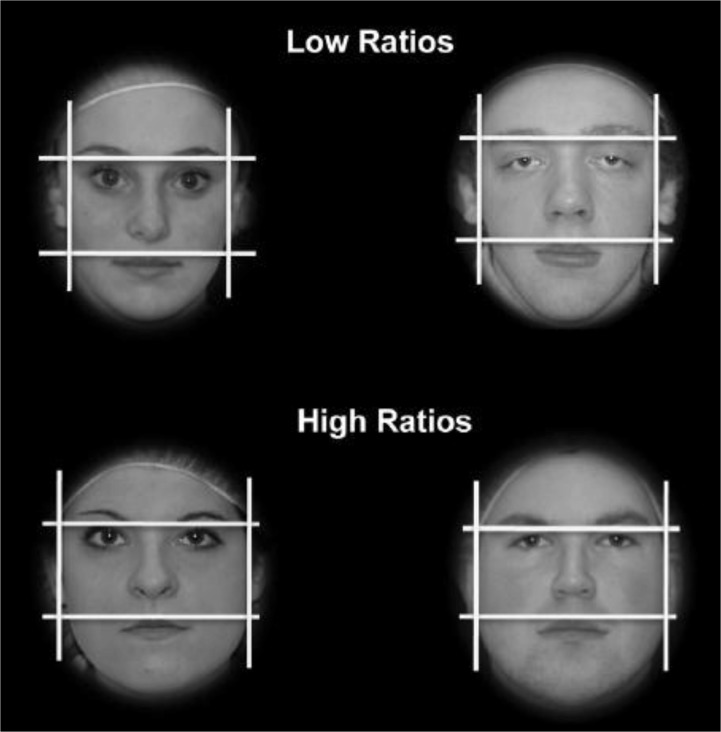
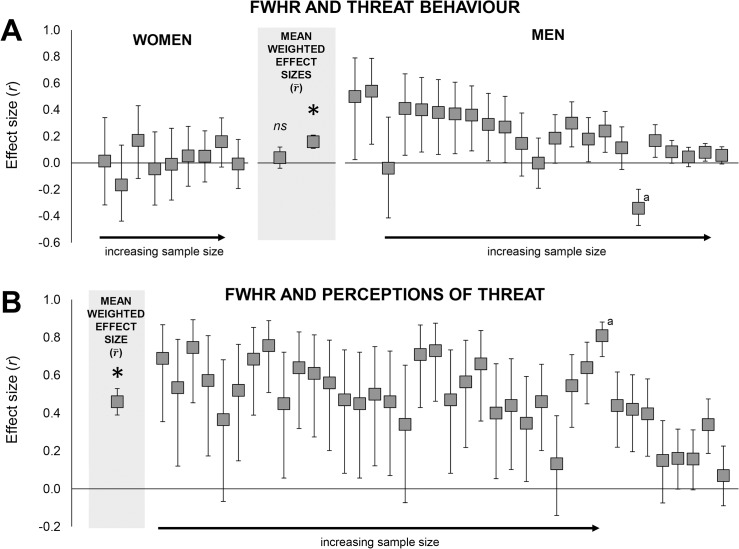
The facial width-to-height ratio (FWHR) is the width of the face divided by the height of the upper face. There is mixed evidence for the hypothesis that the FWHR is a cue of threat and dominance in the human face. We conducted a systematic review and meta-analyses of all peer-reviewed studies (and 2 unpublished studies) to estimate the magnitude of the sex difference in the FWHR, and the magnitude of the relationship between the FWHR and threatening and dominant behaviours and perceptions. Studies were eligible for inclusion if the authors reported an analysis involving the FWHR. Our analyses revealed that the FWHR was larger in men than in women (d = .11, n = 10,853), cued judgements of masculinity in men (r = .35, n of faces = 487; n of observers = 339), and was related to body mass index (r = .31, n = 2,506). Further, the FWHR predicted both threat behaviour in men (r = .16, n = 4,603) and dominance behaviour in both sexes (r = .12, n = 948) across a variety of indices. Individuals with larger FWHRs were judged by observers as more threatening (r = .46, n of faces = 1,691; n of observers = 2,076) and more dominant (r = .20, n of faces = 603; n of observers = 236) than those with smaller FWHRs. Individuals with larger FWHRs were also judged as less attractive (r = -.26, n of faces = 721; n of observers = 335), especially when women made the judgements. These findings provide some support for the hypothesis that the FWHR is part of an evolved cueing system of intra-sexual threat and dominance in men. A limitation of the meta-analyses on perceptions of threat and dominance were the low number of stimuli involving female and older adult faces.
面部宽高比(FWHR)是面部宽度除以上半脸的高度。关于FWHR是人类面部威胁和支配地位线索这一假设,证据并不一致。我们对所有同行评审研究(以及两项未发表的研究)进行了系统综述和荟萃分析,以估计FWHR的性别差异程度,以及FWHR与威胁和支配行为及认知之间的关系程度。如果作者报告了涉及FWHR的分析,那么这些研究就符合纳入条件。我们的分析表明,男性的FWHR大于女性(d = 0.11,n = 10853),提示了对男性阳刚之气的判断(r = 0.35,面部数量n = 487;观察者数量n = 339),并且与体重指数相关(r = 0.31,n = 2506)。此外,FWHR在各种指标上都预测了男性的威胁行为(r = 0.16,n = 4603)以及两性的支配行为(r = 0.12,n = 948)。与FWHR较小的个体相比,观察者认为FWHR较大的个体更具威胁性(r = 0.46,面部数量n = 1691;观察者数量n = 2076)且更具支配性(r = 0.20,面部数量n = 603;观察者数量n = 236)。FWHR较大的个体也被认为吸引力较低(r = - .26,面部数量n = 721;观察者数量n = 335),尤其是女性进行判断时。这些发现为FWHR是男性内部性威胁和支配地位的一种进化线索系统的一部分这一假设提供了一些支持。关于威胁和支配认知的荟萃分析的一个局限性是涉及女性和老年成人面部的刺激数量较少。