• 文献检索
  • 文档翻译
  • 深度研究
  • 学术资讯
  • Suppr Zotero 插件Zotero 插件
  • 邀请有礼
  • 套餐&价格
  • 历史记录
应用&插件
Suppr Zotero 插件Zotero 插件浏览器插件Mac 客户端Windows 客户端微信小程序
定价
高级版会员购买积分包购买API积分包
服务
文献检索文档翻译深度研究API 文档MCP 服务
关于我们
关于 Suppr公司介绍联系我们用户协议隐私条款
关注我们

Suppr 超能文献

核心技术专利:CN118964589B侵权必究
粤ICP备2023148730 号-1Suppr @ 2026

文献检索

告别复杂PubMed语法,用中文像聊天一样搜索,搜遍4000万医学文献。AI智能推荐,让科研检索更轻松。

立即免费搜索

文件翻译

保留排版,准确专业,支持PDF/Word/PPT等文件格式,支持 12+语言互译。

免费翻译文档

深度研究

AI帮你快速写综述,25分钟生成高质量综述,智能提取关键信息,辅助科研写作。

立即免费体验

“关怀数据”共识?对推特上表达的观点进行的定性分析。

The care.data consensus? A qualitative analysis of opinions expressed on Twitter.

作者信息

Hays Rebecca, Daker-White Gavin

机构信息

NIHR Greater Manchester Primary Care Patient Safety Translational Research Centre (PSTRC), Manchester Academic Health Science Centre, University of Manchester, Williamson Building, Oxford Road, Manchester, UK.

出版信息

BMC Public Health. 2015 Sep 2;15:838. doi: 10.1186/s12889-015-2180-9.

DOI:10.1186/s12889-015-2180-9
PMID:26329489
原文链接:https://pmc.ncbi.nlm.nih.gov/articles/PMC4556193/
Abstract

BACKGROUND

Large, integrated datasets can be used to improve the identification and management of health conditions. However, big data initiatives are controversial because of risks to privacy. In 2014, NHS England launched a public awareness campaign about the care.data project, whereby data from patients' medical records would be regularly uploaded to a central database. Details of the project sparked intense debate across a number of platforms, including social media sites such as Twitter. Twitter is increasingly being used to educate and inform patients and care providers, and as a source of data for health services research. The aim of the study was to identify and describe the range of opinions expressed about care.data on Twitter for the period during which a delay to this project was announced, and provide insight into the strengths and flaws of the project.

METHODS

Tweets with the hashtag #caredata were collected using the NCapture tool for NVivo. Methods of qualitative data analysis were used to identify emerging themes. Tweets were coded and analysed in-depth within and across themes.

RESULTS

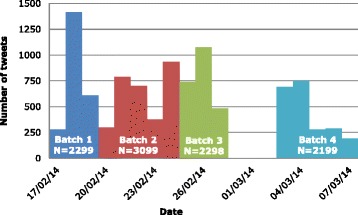
The dataset consisted of 9895 tweets, captured over 18 days during February and March 2014. Retweets (6118, 62%) and spam (240, 2%) were excluded. The remaining 3537 tweets were posted by 904 contributors, and coded into one or more of 50 sub-themes, which were organised into 9 key themes. These were: informed consent and the default 'opt-in', trust, privacy and data security, involvement of private companies, legal issues and GPs' concerns, communication failure and confusion about care.data, delayed implementation, patient-centeredness, and potential of care.data and the ideal model of implementation.

CONCLUSIONS

Various concerns were raised about care.data that appeared to be shared by those both for and against the project. Qualitatively analysing tweets enabled us to identify a range of concerns about care.data and how these might be overcome, for example, by increasing the involvement of stakeholders and those with expert knowledge. Our findings also highlight the risks of not considering public opinion, such as the potential for patient safety failures resulting from a lack of trust in the healthcare system. However, caution is advised if using Twitter as a stand-alone data source, as contributors may lie more heavily on one side of a debate than another. A mixed-methods approach would have enabled us to complement this data with a more representative overview.

摘要

背景

大型综合数据集可用于改善健康状况的识别与管理。然而,大数据计划因存在隐私风险而颇具争议。2014年,英国国民医疗服务体系(NHS)英格兰地区发起了一场关于“医疗数据”(care.data)项目的公众宣传活动,该项目将定期把患者病历数据上传至中央数据库。该项目的细节在包括推特等社交媒体网站在内的多个平台引发了激烈辩论。推特越来越多地被用于教育患者和护理人员并为其提供信息,同时也作为健康服务研究的数据来源。本研究的目的是识别并描述在宣布该项目延迟期间推特上关于“医疗数据”项目所表达的各种观点范围,并深入了解该项目的优势与缺陷。

方法

使用NVivo的NCapture工具收集带有#caredata标签的推文。采用定性数据分析方法来识别新出现的主题。对推文进行编码,并在主题内部和主题之间进行深入分析。

结果

数据集由2014年2月和3月的18天内捕获的9895条推文组成。转发推文(6118条,占62%)和垃圾信息(240条,占2%)被排除。其余3537条推文由904名贡献者发布,并被编码为50个次主题中的一个或多个,这些次主题被归纳为9个关键主题。它们分别是:知情同意与默认的“选择加入”、信任、隐私与数据安全、私人公司的参与、法律问题与全科医生的担忧、沟通失败与对“医疗数据”项目的困惑、实施延迟、以患者为中心,以及“医疗数据”项目的潜力与理想的实施模式。

结论

对于“医疗数据”项目,支持和反对该项目的人似乎都表达了各种担忧。对推文进行定性分析使我们能够识别出对“医疗数据”项目的一系列担忧以及如何克服这些担忧,例如,通过增加利益相关者和具有专业知识者的参与度。我们的研究结果还凸显了不考虑公众意见的风险,比如因对医疗系统缺乏信任而导致患者安全出现问题的可能性。然而,如果将推特作为单一数据源使用则需谨慎,因为贡献者在辩论中可能会更倾向于某一方。采用混合方法本可以使我们用更具代表性的概述来补充这些数据。
https://cdn.ncbi.nlm.nih.gov/pmc/blobs/7fda/4556193/34e562b4fc70/12889_2015_2180_Fig2_HTML.jpg
https://cdn.ncbi.nlm.nih.gov/pmc/blobs/7fda/4556193/3165f622b5b7/12889_2015_2180_Fig1_HTML.jpg
https://cdn.ncbi.nlm.nih.gov/pmc/blobs/7fda/4556193/34e562b4fc70/12889_2015_2180_Fig2_HTML.jpg
https://cdn.ncbi.nlm.nih.gov/pmc/blobs/7fda/4556193/3165f622b5b7/12889_2015_2180_Fig1_HTML.jpg
https://cdn.ncbi.nlm.nih.gov/pmc/blobs/7fda/4556193/34e562b4fc70/12889_2015_2180_Fig2_HTML.jpg

相似文献

1
The care.data consensus? A qualitative analysis of opinions expressed on Twitter.“关怀数据”共识?对推特上表达的观点进行的定性分析。
BMC Public Health. 2015 Sep 2;15:838. doi: 10.1186/s12889-015-2180-9.
2
What are health-related users tweeting? A qualitative content analysis of health-related users and their messages on twitter.与健康相关的用户在推特上发些什么?对推特上与健康相关的用户及其信息进行定性内容分析。
J Med Internet Res. 2014 Oct 15;16(10):e237. doi: 10.2196/jmir.3765.
3
Twitter use at the 2016 Conference on the Science of Dissemination and Implementation in Health: analyzing #DIScience16.2016 年传播与实施健康科学会议上的 Twitter 使用情况:分析#DIScience16。
Implement Sci. 2018 Feb 20;13(1):34. doi: 10.1186/s13012-018-0723-z.
4
Use of the Hashtag #DataSavesLives on Twitter: Exploratory and Thematic Analysis.在 Twitter 上使用话题标签#DataSavesLives:探索性和主题分析。
J Med Internet Res. 2022 Nov 15;24(11):e38232. doi: 10.2196/38232.
5
Tweeting About Prostate and Testicular Cancers: Do Twitter Conversations and the 2013 Movember Canada Campaign Objectives Align?关于前列腺癌和睾丸癌的推文:推特上的对话与2013年加拿大“蓄须运动”目标一致吗?
J Cancer Educ. 2016 Jun;31(2):236-43. doi: 10.1007/s13187-015-0796-1.
6
Twitter expands the reach and engagement of a national scientific meeting: the Irish Society of Urology.推特扩大了一场全国性科学会议——爱尔兰泌尿外科学会会议的影响力和参与度。
Ir J Med Sci. 2015 Sep;184(3):685-9. doi: 10.1007/s11845-015-1277-6. Epub 2015 Mar 5.
7
Raising Awareness About Cervical Cancer Using Twitter: Content Analysis of the 2015 #SmearForSmear Campaign.利用推特提高对宫颈癌的认识:2015年#涂片换涂片运动的内容分析
J Med Internet Res. 2017 Oct 16;19(10):e344. doi: 10.2196/jmir.8421.
8
Diabetes topics associated with engagement on Twitter.与推特上的参与度相关的糖尿病话题。
Prev Chronic Dis. 2015 May 7;12:E62. doi: 10.5888/pcd12.140402.
9
Tweeting for and against public health policy: response to the Chicago Department of Public Health's electronic cigarette Twitter campaign.支持和反对公共卫生政策的推文:对芝加哥公共卫生部电子烟推特活动的回应
J Med Internet Res. 2014 Oct 16;16(10):e238. doi: 10.2196/jmir.3622.
10
Epilepsy in the Twitter era: a need to re-tweet the way we think about seizures.推特时代的癫痫:我们需要重新思考对待癫痫发作的方式。
Epilepsy Behav. 2012 Feb;23(2):127-30. doi: 10.1016/j.yebeh.2011.10.020. Epub 2011 Nov 30.

引用本文的文献

1
Lessons for synthetic data from care.data's past.从“医疗数据”(care.data)的过往中获取合成数据的经验教训。
NPJ Digit Med. 2025 Aug 9;8(1):511. doi: 10.1038/s41746-025-01928-0.
2
Building and Sustaining Public Trust in Health Data Sharing for Musculoskeletal Research: Semistructured Interview and Focus Group Study.构建和维护公众对肌肉骨骼研究健康数据共享的信任:半结构化访谈和焦点小组研究。
J Med Internet Res. 2024 Oct 15;26:e53024. doi: 10.2196/53024.
3
Patient safety discourse in a pandemic: a Twitter hashtag analysis study on #PatientSafety.

本文引用的文献

1
Large-scale implementation of alcohol brief interventions in new settings in Scotland: a qualitative interview study of a national programme.苏格兰新环境中酒精简短干预措施的大规模实施:一项关于国家计划的定性访谈研究
BMC Public Health. 2015 Mar 25;15:289. doi: 10.1186/s12889-015-1527-6.
2
Barriers to modern contraceptive methods uptake among young women in Kenya: a qualitative study.肯尼亚年轻女性采用现代避孕方法的障碍:一项定性研究。
BMC Public Health. 2015 Feb 10;15:118. doi: 10.1186/s12889-015-1483-1.
3
Parental recommendations for population level interventions to support infant and family dietary choices: a qualitative study from the Growing Up in Wales, Environments for Healthy Living (EHL) study.
大流行中的患者安全论述:关于#PatientSafety 的 Twitter 话题标签分析研究
Front Public Health. 2023 Nov 16;11:1268730. doi: 10.3389/fpubh.2023.1268730. eCollection 2023.
4
Wearable activity trackers for nurses' health: A qualitative acceptability study.可穿戴活动追踪器对护士健康的影响:一项定性可接受性研究。
Nurs Open. 2023 Sep;10(9):6357-6368. doi: 10.1002/nop2.1884. Epub 2023 Jun 16.
5
Who tweets what about personalised medicine? Promises and concerns from Twitter discussions in Denmark.谁在推特上发布了关于个性化医疗的哪些内容?丹麦推特讨论中的承诺与担忧。
Digit Health. 2023 Apr 20;9:20552076231169832. doi: 10.1177/20552076231169832. eCollection 2023 Jan-Dec.
6
'To me, it's ones and zeros, but in reality that one is death': A qualitative study exploring researchers' experience of involving and engaging seldom-heard communities in big data research.“对我来说,这只是 1 和 0,但实际上,那就是死亡”:一项定性研究,探索研究人员在大数据研究中涉及和吸引很少被听到的社区的经验。
Health Expect. 2023 Apr;26(2):882-891. doi: 10.1111/hex.13713. Epub 2023 Jan 24.
7
The Experiences of Stakeholders Using Social Media as a Tool for Health Service Design and Quality Improvement: A Scoping Review.利益相关者利用社交媒体作为卫生服务设计和质量改进工具的经验:范围综述。
Int J Environ Res Public Health. 2022 Nov 11;19(22):14851. doi: 10.3390/ijerph192214851.
8
Use of the Hashtag #DataSavesLives on Twitter: Exploratory and Thematic Analysis.在 Twitter 上使用话题标签#DataSavesLives:探索性和主题分析。
J Med Internet Res. 2022 Nov 15;24(11):e38232. doi: 10.2196/38232.
9
Evidence-based guiding principles to build public trust in personal data use in health systems.建立公众对卫生系统中个人数据使用信任的循证指导原则。
Digit Health. 2022 Jul 17;8:20552076221111947. doi: 10.1177/20552076221111947. eCollection 2022 Jan-Dec.
10
New Data Resources, Linkages, and Infrastructure for Cancer Health Economics Research: Main Topics From a Panel Discussion.癌症健康经济学研究的新数据资源、链接和基础设施:小组讨论的主要议题。
J Natl Cancer Inst Monogr. 2022 Jul 5;2022(59):68-73. doi: 10.1093/jncimonographs/lgac016.
父母对支持婴儿和家庭饮食选择的人群层面干预措施的建议:来自威尔士成长、健康生活环境(EHL)研究的定性研究
BMC Public Health. 2015 Mar 11;15:234. doi: 10.1186/s12889-015-1561-4.
4
"I don't mind damaging my own body" a qualitative study of the factors that motivate smokers to quit.“我不介意损害自己的身体”:一项关于促使吸烟者戒烟的因素的定性研究
BMC Public Health. 2015 Jan 21;15:4. doi: 10.1186/1471-2458-15-4.
5
What do we mean by social networking sites?我们所说的社交网站是什么意思?
Stud Health Technol Inform. 2014;199:108-12.
6
Tweets about hospital quality: a mixed methods study.关于医院质量的推文:一项混合方法研究。
BMJ Qual Saf. 2014 Oct;23(10):838-46. doi: 10.1136/bmjqs-2014-002875. Epub 2014 Apr 19.
7
Twitter and public health.推特与公共卫生。
J Public Health Manag Pract. 2015 Jul-Aug;21(4):375-83. doi: 10.1097/PHH.0000000000000041.
8
Potentiality of big data in the medical sector: focus on how to reshape the healthcare system.大数据在医疗领域的潜力:聚焦于如何重塑医疗体系。
Healthc Inform Res. 2013 Jun;19(2):79-85. doi: 10.4258/hir.2013.19.2.79. Epub 2013 Jun 30.
9
Bringing big data to personalized healthcare: a patient-centered framework.将大数据应用于个性化医疗保健:以患者为中心的框架。
J Gen Intern Med. 2013 Sep;28 Suppl 3(Suppl 3):S660-5. doi: 10.1007/s11606-013-2455-8.
10
Privacy in the digital age.数字时代的隐私。
Nature. 2013 May 16;497(7449):287. doi: 10.1038/497287a.