Schumann Moritz, Yli-Peltola Kaisu, Abbiss Chris R, Häkkinen Keijo
Department of Biology of Physical Activity, University of Jyväskylä, Jyväskylä, Finland.
Centre for Exercise and Sports Science Research, School of Exercise and Health Science, Edith Cowan University, Perth, Australia.
PLoS One. 2015 Sep 29;10(9):e0139279. doi: 10.1371/journal.pone.0139279. eCollection 2015.
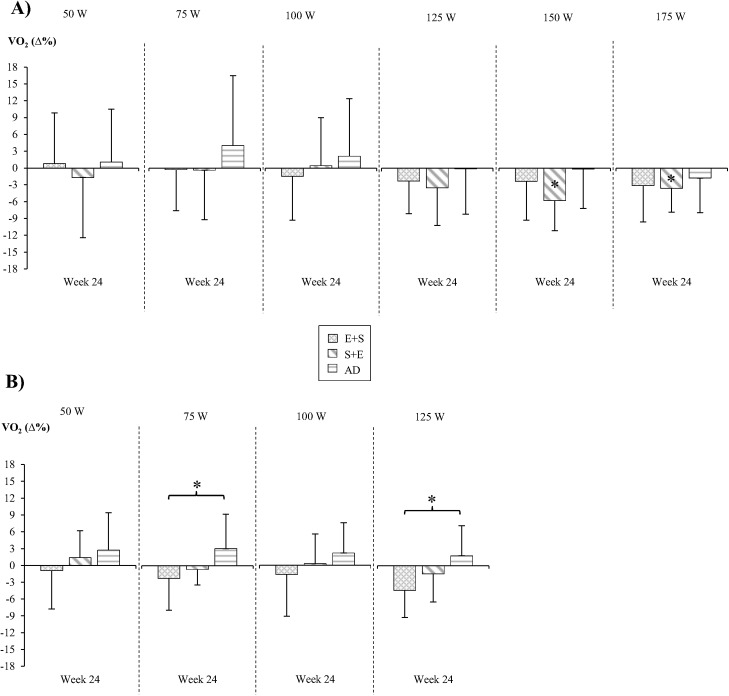
This study investigated the effects of endurance followed by strength training (ES, men n = 16; women n = 15), the reverse exercise order (SE, men n = 18, women n = 13) and concurrent endurance and strength training performed on alternating days (AD, men n = 21, women n = 18) on cardiorespiratory parameters. Peak oxygen consumption ([Formula: see text]O2peak) and oxygen consumption at sub-maximal power outputs ([Formula: see text]O2submax) of 50 to 175 Watts in men and 50 to 125 Watts in women were assessed during an incremental cycling test both before and after 24 weeks of training. Increases in [Formula: see text]O2peak in both men and women were statistically larger in AD (18±9% and 25±11%) compared to ES (7±9% and 12±12%, p = 0.002 and 0.009, respectively) and SE (7±9% and 10±8%, p = 0.005 and 0.008, respectively). No statistical group interaction was observed for [Formula: see text]O2submax in men, but in women [Formula: see text]O2submax was statistically lower at week 24 in ES compared to AD at 75 W (-2±6% vs. +3±6%, p = 0.027) and 125 W (-4±5% vs. +2±5%, p = 0.010). These findings indicate that endurance and strength training performed on alternating days may optimize the adaptations in [Formula: see text]O2peak in both sexes, while performing ES training in women may optimize cardiorespiratory fitness at sub-maximal power outputs.
本研究调查了先进行耐力训练再进行力量训练(ES组,男性n = 16;女性n = 15)、相反的训练顺序(SE组,男性n = 18,女性n = 13)以及隔天进行耐力和力量训练(AD组,男性n = 21,女性n = 18)对心肺参数的影响。在24周训练前后的递增自行车测试中,评估了男性50至175瓦、女性50至125瓦次最大功率输出时的峰值耗氧量([公式:见正文]O2peak)和耗氧量([公式:见正文]O2submax)。与ES组(男性7±9%,女性12±12%,p分别为0.002和0.009)和SE组(男性7±9%,女性10±8%,p分别为0.005和0.008)相比,AD组男性和女性的[公式:见正文]O2peak增加在统计学上更大(分别为18±9%和25±11%)。男性的[公式:见正文]O2submax未观察到统计学上的组间交互作用,但在女性中,与AD组相比,ES组在第24周时75瓦(-2±6%对+3±6%,p = 0.027)和125瓦(-4±5%对+2±5%,p = 0.010)时的[公式:见正文]O2submax在统计学上更低。这些发现表明,隔天进行耐力和力量训练可能会优化两性的[公式:见正文]O2peak适应性,而女性进行ES训练可能会优化次最大功率输出时的心肺适能。