Pellegrini Barbara, Peyré-Tartaruga Leonardo Alexandre, Zoppirolli Chiara, Bortolan Lorenzo, Bacchi Elisabetta, Figard-Fabre Hélène, Schena Federico
CeRiSM (Research Centre of Mountain Sport and Health), University of Verona, Rovereto, Italy; Department of Neurological and Movement Sciences, University of Verona, Verona, Italy.
School of Physical Education, Universidade Federal do Rio Grande do Sul, Porto Alegre, Brasil.
PLoS One. 2015 Sep 29;10(9):e0138906. doi: 10.1371/journal.pone.0138906. eCollection 2015.
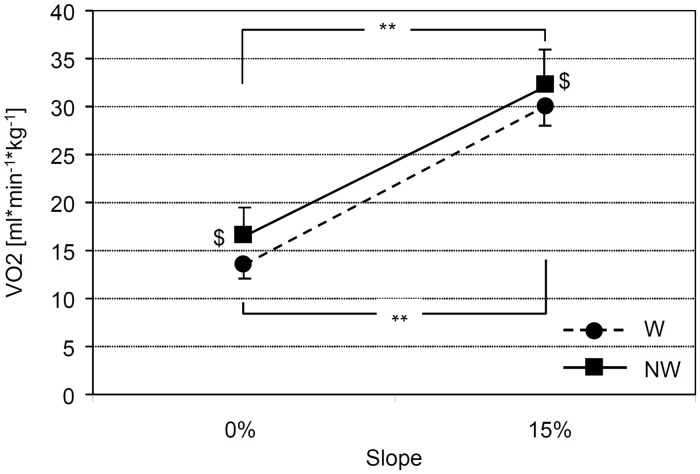
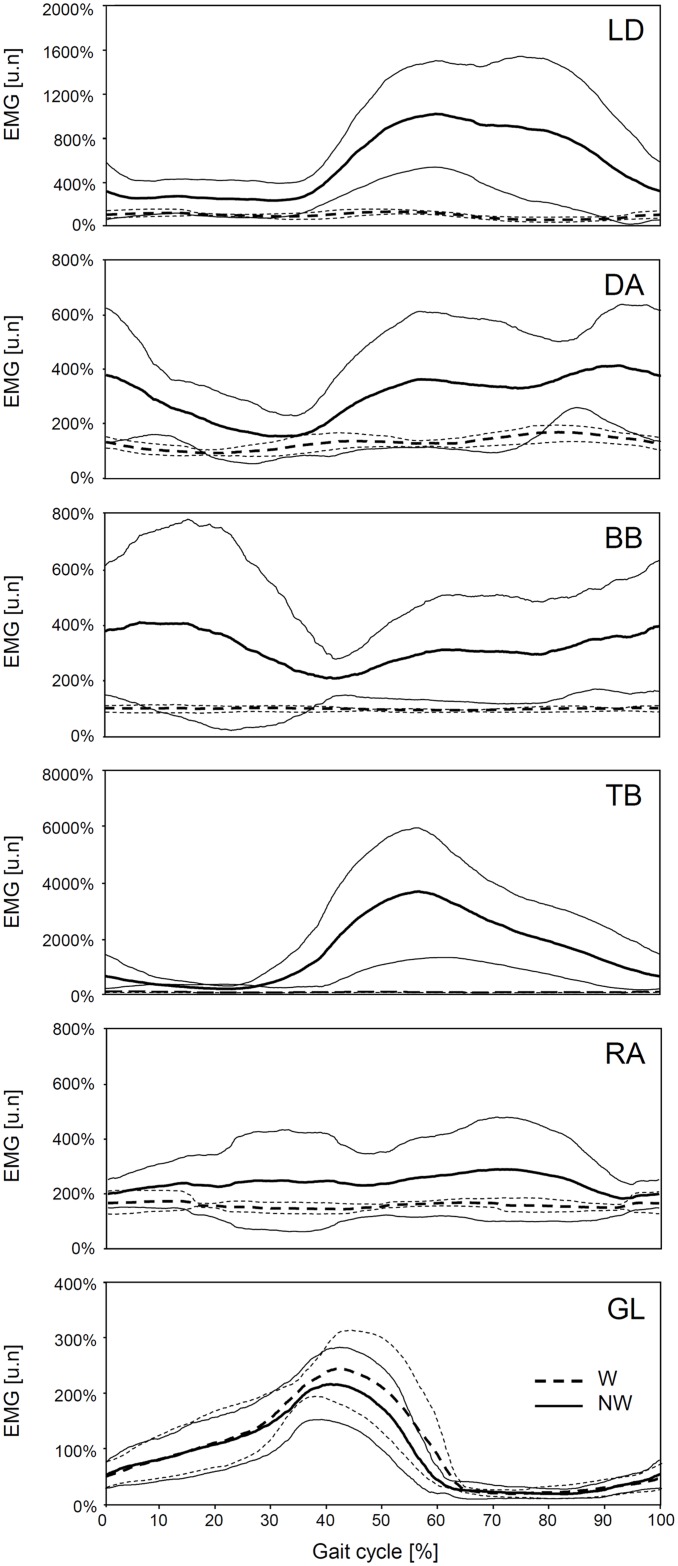
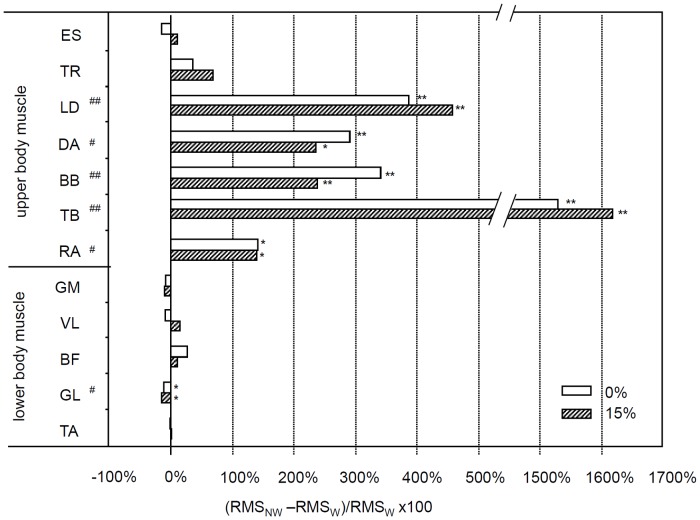
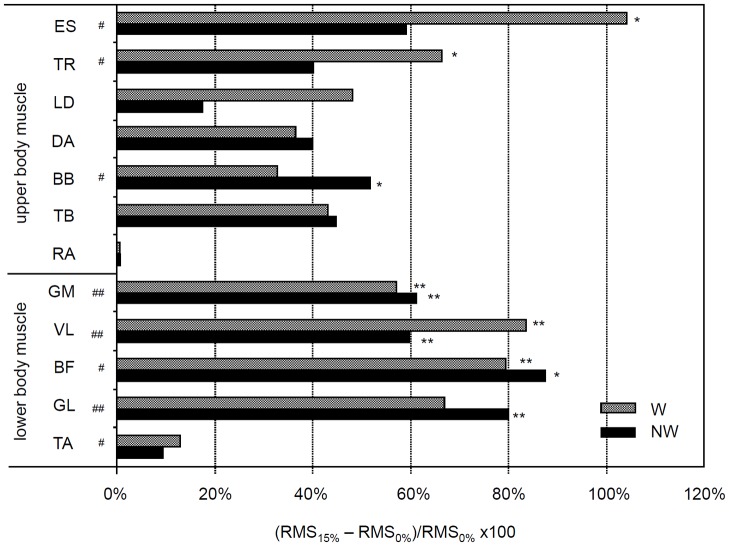
Nordic Walking (NW) owes much of its popularity to the benefits of greater energy expenditure and upper body engagement than found in conventional walking (W). Muscle activation during NW is still understudied, however. The aim of the present study was to assess differences in muscle activation and physiological responses between NW and W in level and uphill walking conditions. Nine expert Nordic Walkers (mean age 36.8±11.9 years; BMI 24.2±1.8 kg/m2) performed 5-minute treadmill trials of W and NW at 4 km/h on inclines of 0% and 15%. The electromyographic activity of seven upper body and five leg muscles and oxygen consumption (VO2) were recorded and pole force during NW was measured. VO2 during NW was 22.3% higher at 0% and only 6.9% higher at 15% than during W, while upper body muscle activation was 2- to 15-fold higher under both conditions. Lower body muscle activation was similarly increased during NW and W in the uphill condition, whereas the increase in erector spinae muscle activity was lower during NW than W. The lack of a significant increase in pole force during uphill walking may explain the lower extra energy expenditure of NW, indicating less upper body muscle activation to lift the body against gravity. NW seemed to reduce lower back muscle contraction in the uphill condition, suggesting that walking with poles may reduce effort to control trunk oscillations and could contribute to work production during NW. Although the difference in extra energy expenditure between NW and W was smaller in the uphill walking condition, the increased upper body muscle involvement during exercising with NW may confer additional benefit compared to conventional walking also on uphill terrains. Furthermore, people with low back pain may gain benefit from pole use when walking uphill.
北欧式健走(NW)的广泛流行很大程度上归功于其比传统行走(W)能消耗更多能量以及更多地锻炼上身。然而,北欧式健走过程中的肌肉激活情况仍未得到充分研究。本研究的目的是评估在平路和上坡行走条件下,北欧式健走与传统行走在肌肉激活和生理反应方面的差异。九名专业北欧式健走者(平均年龄36.8±11.9岁;体重指数24.2±1.8kg/m²)在坡度为0%和15%的跑步机上以4公里/小时的速度分别进行了5分钟的传统行走和北欧式健走试验。记录了七块上身肌肉和五块腿部肌肉的肌电图活动以及耗氧量(VO₂),并测量了北欧式健走时的撑杆力。在坡度为0%时,北欧式健走的VO₂比传统行走高22.3%,在坡度为15%时仅高6.9%,而在两种条件下上身肌肉激活程度高2至15倍。在上坡条件下,北欧式健走和传统行走时下肢肌肉激活程度同样增加,而北欧式健走时竖脊肌活动的增加幅度低于传统行走。上坡行走时撑杆力没有显著增加可能解释了北欧式健走额外能量消耗较低的原因,这表明在上坡时较少激活上身肌肉来对抗重力提升身体。北欧式健走似乎在上坡条件下减少了下背部肌肉收缩,这表明使用撑杆行走可能减少控制躯干摆动的努力,并有助于北欧式健走时的做功。尽管在上坡行走条件下,北欧式健走和传统行走之间额外能量消耗的差异较小,但与传统行走相比,北欧式健走时上身肌肉参与度增加,在上坡地形行走时可能也会带来额外益处。此外,背痛患者在上坡行走时使用撑杆可能会受益。