Kwon MiYoung, Huisingh Carrie, Rhodes Lindsay A, McGwin Gerald, Wood Joanne M, Owsley Cynthia
Department of Ophthalmology, School of Medicine, University of Alabama at Birmingham, Birmingham, Alabama.
Department of Ophthalmology, School of Medicine, University of Alabama at Birmingham, Birmingham, Alabama.
Ophthalmology. 2016 Jan;123(1):109-16. doi: 10.1016/j.ophtha.2015.08.043. Epub 2015 Oct 14.
To examine the association between glaucoma and motor vehicle collision (MVC) involvement among older drivers, including the role of visual field impairment that may underlie any association found.
A retrospective, population-based study.
A sample of 2000 licensed drivers aged ≥70 years who reside in north central Alabama.
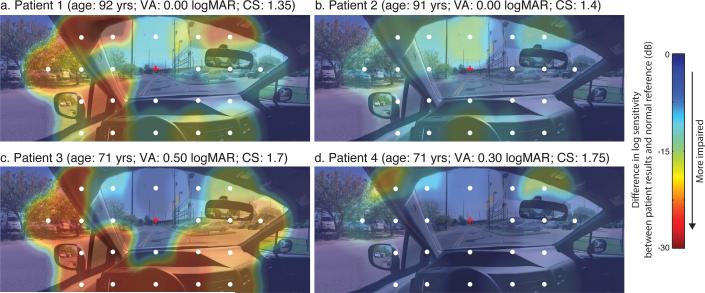
At-fault MVC involvement over the 5 years before enrollment was obtained from state records. Three aspects of visual function were measured: habitual binocular distance visual acuity, binocular contrast sensitivity (CS), and the binocular driving visual field constructed from combining the monocular visual fields of each eye. Poisson regression was used to calculate crude and adjusted rate ratios (RRs) and 95% confidence intervals (CIs).
At-fault MVC involvement over the 5 years before enrollment.
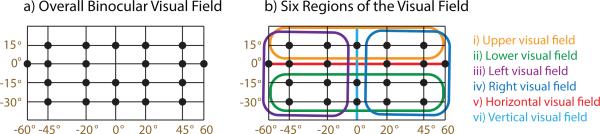
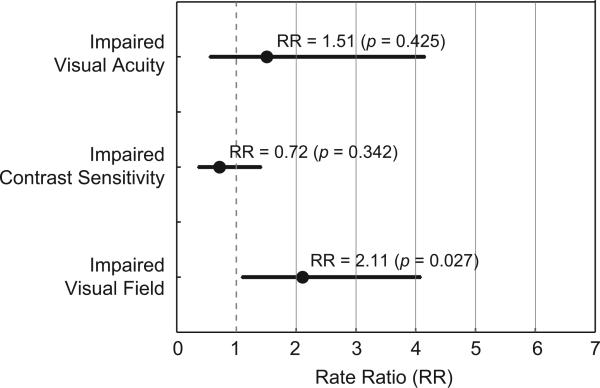
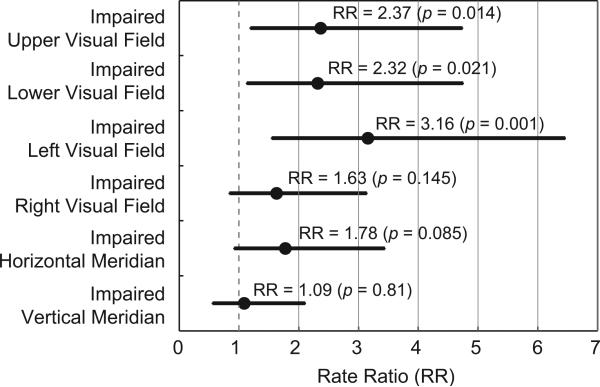
Drivers with glaucoma (n = 206) had a 1.65 times higher MVC rate (95% CI, 1.20-2.28; P = 0.002) compared with those without glaucoma after adjusting for age, and mental status. Among those with glaucoma, drivers with severe visual field loss had higher MVC rates (RR, 2.11; 95% CI, 1.09-4.09; P = 0.027), whereas no association was found among those with impaired visual acuity and CS. When the visual field was subdivided into 6 regions (upper, lower, left, and right visual fields; horizontal and vertical meridians), we found that impairment in the left, upper, or lower visual field was associated with higher MVC rates, and an impaired left visual field showed the highest RR (3.16; P = 0.001) compared with other regions. However, no association was found in deficits in the right side or along the horizontal or vertical meridian.
A population-based study suggests that older drivers with glaucoma are more likely to have a history of at-fault MVC involvement than those without glaucoma. Impairment in the driving visual field in drivers with glaucoma seems to have an independent association with at-fault MVC involvement, whereas visual acuity and CS impairments do not.
研究老年驾驶员青光眼与机动车碰撞事故(MVC)之间的关联,包括可能是所发现的任何关联基础的视野损害的作用。
一项基于人群的回顾性研究。
居住在阿拉巴马州中北部的2000名年龄≥70岁的持照驾驶员样本。
从州记录中获取入组前5年的责任MVC事故情况。测量了视觉功能的三个方面:习惯性双眼远视力、双眼对比敏感度(CS)以及通过合并每只眼睛的单眼视野构建的双眼驾驶视野。采用泊松回归计算粗率比和调整率比(RRs)以及95%置信区间(CIs)。
入组前5年的责任MVC事故情况。
在调整年龄和精神状态后,患有青光眼的驾驶员(n = 206)的MVC发生率比未患青光眼的驾驶员高1.65倍(95%CI,1.20 - 2.28;P = 0.002)。在患有青光眼的驾驶员中,严重视野缺损的驾驶员MVC发生率更高(RR,2.11;95%CI,1.09 - 4.09;P = 0.027),而在视力和CS受损的驾驶员中未发现关联。当将视野细分为6个区域(上、下、左、右视野;水平和垂直子午线)时,我们发现左、上或下视野受损与更高的MVC发生率相关,并且与其他区域相比,左视野受损的RR最高(3.16;P = 0.001)。然而,在右侧或沿水平或垂直子午线的缺损中未发现关联。
一项基于人群的研究表明,患有青光眼的老年驾驶员比未患青光眼的驾驶员更有可能有责任MVC事故史。患有青光眼的驾驶员的驾驶视野损害似乎与责任MVC事故独立相关,而视力和CS损害则不然。