Mao Bijing, Li Yafei, Zhang Zhimin, Chen Chuan, Chen Yuanyuan, Ding Chenchen, Lei Lin, Li Jian, Jiang Mei, Wang Dong, Wang Ge
Cancer Center, Institute of Surgical Research, Daping Hospital, Third Military Medical University, Chongqing, 400042, China.
Department of Epidemiology, College of Preventive Medicine, Third Military Medical University, Chongqing, 400038, China.
PLoS One. 2015 Oct 29;10(10):e0141762. doi: 10.1371/journal.pone.0141762. eCollection 2015.
Nutrients related to one-carbon metabolism were previously shown to be significantly associated with the risk of cancer. The aim of this meta-analysis was to evaluate potential relationships between one-carbon metabolic factors and renal cell cancer (RCC) risk.
PubMed, EMBASE, and Cochrane Library databases were searched through March 2015 for observational studies of quantitative RCC risk estimates in relation to one-carbon metabolic factors. The relative risks (RRs) with 95% confidence intervals (CIs) measured the relationship between one-carbon metabolic factors and RCC risk using a random-effects model.
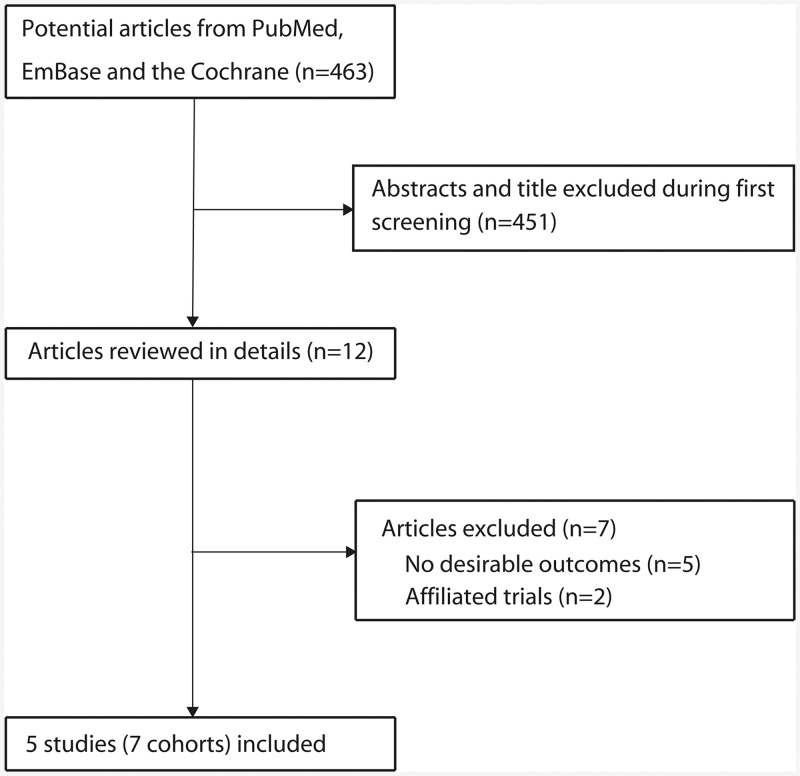
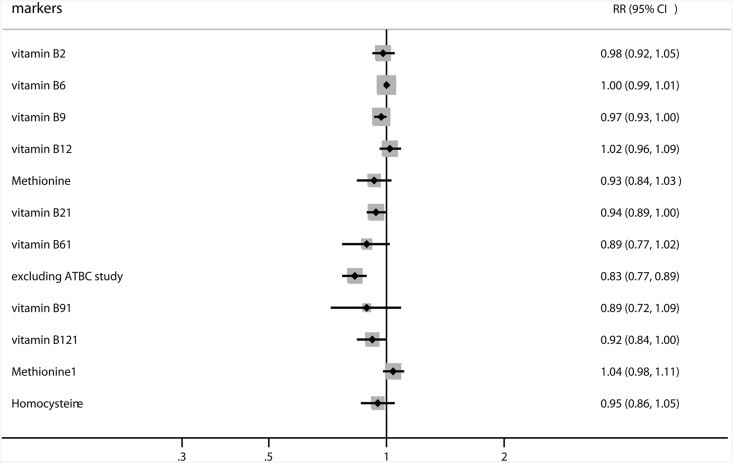
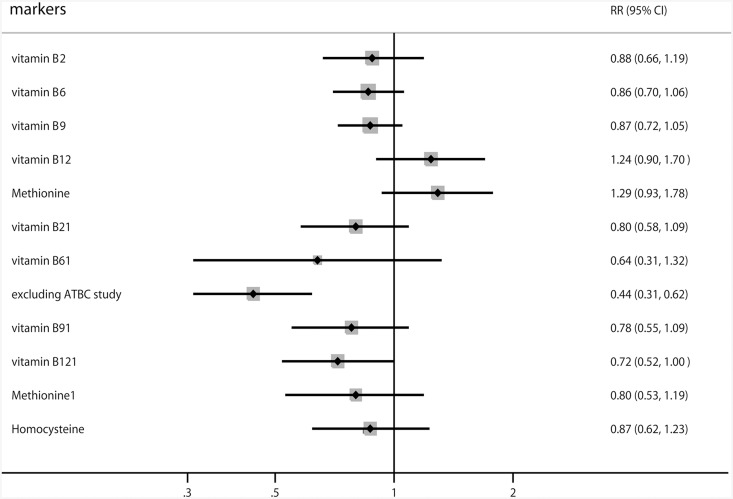
Of the 463 citations and abstracts identified by database search, seven cohorts from five observational studies reported data on 133,995 individuals, and included 2,441 RCC cases. Comparing the highest with the lowest category, the pooled RRs of RCC were 0.72 (95%CI: 0.52-1.00; P = 0.048) for vitamin B12. In addition, an increase in folic acid supplementation of 100 μg/day was associated with a 3% lower risk of RCC (RR, 0.97; 95%CI: 0.93-1.00; P = 0.048). Similarly, an increase of 5 nmol/L of vitamin B2 was associated with a reduced risk of RCC 0.94 (95%CI: 0.89-1.00; P = 0.045). Sensitivity analyses suggested that a higher serum vitamin B6 might contribute to a reduced risk of RCC (RR, 0.83; 95%CI: 0.77-0.89; P < 0.001).
Higher levels of serum vitamin B2, B6, B12, and folic acid supplementation lowered the risk of RCC among the study participants.
先前研究表明,与一碳代谢相关的营养素与癌症风险显著相关。本荟萃分析旨在评估一碳代谢因子与肾细胞癌(RCC)风险之间的潜在关系。
检索截至2015年3月的PubMed、EMBASE和Cochrane图书馆数据库,查找关于一碳代谢因子与RCC风险定量估计的观察性研究。采用随机效应模型,以95%置信区间(CI)的相对风险(RR)衡量一碳代谢因子与RCC风险之间的关系。
通过数据库检索确定了463篇引文和摘要,来自五项观察性研究的七个队列报告了133,995名个体的数据,其中包括2,441例RCC病例。将最高类别与最低类别进行比较,维生素B12的RCC合并RR为0.72(95%CI:0.52 - 1.00;P = 0.048)。此外,叶酸补充量每天增加100μg与RCC风险降低3%相关(RR,0.97;95%CI:0.93 - 1.00;P = 0.048)。同样,维生素B2增加5 nmol/L与RCC风险降低相关,RR为0.94(95%CI:0.89 - 1.00;P = 0.045)。敏感性分析表明,较高的血清维生素B6水平可能有助于降低RCC风险(RR,0.83;95%CI:0.77 - 0.89;P < 0.001)。
在研究参与者中,较高水平的血清维生素B2、B6、B12和叶酸补充可降低RCC风险。