American Hip Institute, Chicago, Illinois, USA. ; Congress Medical Associates, Pasadena, California, USA.
Ohio University, Athens, Ohio, USA.
Orthop J Sports Med. 2013 Aug 12;1(3):2325967113499130. doi: 10.1177/2325967113499130. eCollection 2013 Aug.
Professional athletes are subject to various injuries that are often dictated by the nature of their sport. Professional basketball players previously have been shown to sustain injuries throughout the musculoskeletal system, most commonly to the ankle and knee.
The purpose of this study was to report the epidemiology of injuries specific to the pelvis, hip, and thigh and their effect on games missed in professional basketball players.
Descriptive epidemiological.
Records were recalled from the National Basketball Association epidemiological database for athletic-related pelvis, hip, or thigh injuries that occurred from the 1988-1989 through the 2011-2012 seasons. The primary information collected included anatomic location where the injury occurred, when in the course of the season injury occurred, specific pathology, date, activity at the time of injury, injury mechanism, number of practices and games missed, and whether surgery was required. The number of practices and games missed were summed to yield the number of days missed per episode.
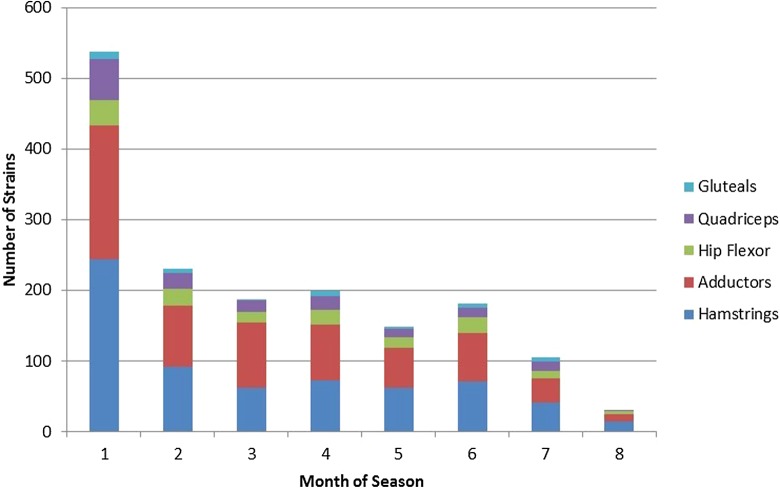
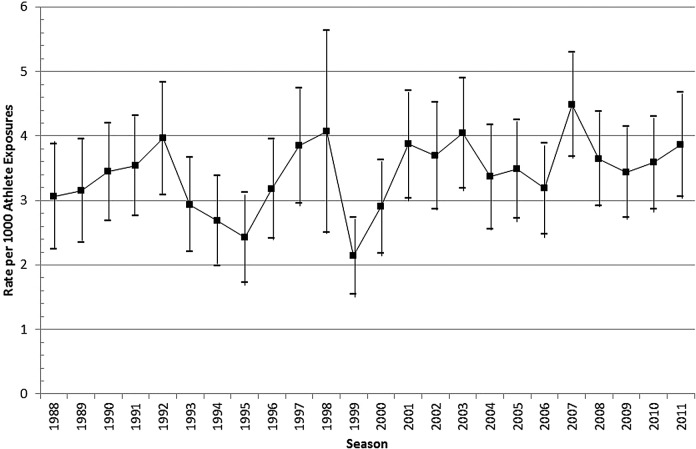
There were 2852 cases (14.6% of all athletic-related injuries) involving 967 individual players. In 1746 (61.2%) cases, injuries occurred during game competition. Across the course of this study, clinical incidence of injury to the pelvis, hip, or thigh was 1.50 per 100 players. The mean (±standard deviation) number of days missed per case was 6.3 ± 10.2. The quadriceps group was the most commonly injured structure (contusions and strains) and had a significantly higher game-related injury rate than other structures (0.96 per 100 athletic exposures, 95% confidence interval [CI] = 0.87-1.04). Players had the greatest risk (relative risk = 1.38, 95% CI = 1.26-1.52) of sustaining a strain than any other type of injury, with a game-related injury rate of 1.79 (95% CI = 1.67-1.90). The hamstring muscle group was the most frequently strained. Strains were more likely to occur in the preseason.
Pelvis, hip, and thigh injuries in professional basketball players are commonly extra-articular strains and contusions and represent a significant burden of injury. The actual amount of intra-articular hip disorders may be underestimated, as the awareness of these disorders has increased only in the past decade. With the awareness of the types of injuries that occur in this region, focused injury prevention strategies may be beneficial to players and teams at all levels of competition, not only professional athletes.
职业运动员会受到各种伤病的困扰,这些伤病通常与他们所从事的运动项目的性质有关。此前有研究表明,职业篮球运动员的全身骨骼肌肉系统都容易受伤,最常见的受伤部位是脚踝和膝盖。
本研究旨在报告特定于骨盆、臀部和大腿的伤病的流行病学情况,以及它们对职业篮球运动员错过比赛的影响。
描述性流行病学研究。
从 1988-1989 赛季至 2011-2012 赛季的美国国家篮球协会(NBA)运动相关伤病的流行病学数据库中检索记录,以获取发生在骨盆、臀部或大腿的与运动相关的伤病。收集的主要信息包括受伤部位的解剖位置、赛季中受伤的时间、具体病理、受伤日期、受伤时的活动、受伤机制、错过的训练和比赛次数,以及是否需要手术。将错过的训练和比赛次数相加,得到每个伤病事件的缺课天数。
共有 2852 例(占所有运动相关伤病的 14.6%)涉及 967 名球员。1746 例(61.2%)伤病发生在比赛中。在整个研究期间,骨盆、臀部或大腿受伤的临床发病率为 1.50/100 名球员。每个伤病事件的平均(±标准差)缺课天数为 6.3±10.2 天。股四头肌群是最常受伤的结构(挫伤和拉伤),与其他结构相比,其与比赛相关的受伤率显著更高(0.96/100 次运动暴露,95%置信区间[CI]:0.87-1.04)。与其他任何类型的伤病相比,球员拉伤的风险最大(相对风险=1.38,95%CI:1.26-1.52),比赛相关的拉伤率为 1.79(95%CI:1.67-1.90)。腘绳肌最容易拉伤。拉伤更可能发生在季前赛。
职业篮球运动员的骨盆、臀部和大腿伤病通常为关节外拉伤和挫伤,是伤病负担的重要组成部分。髋关节内疾病的实际数量可能被低估了,因为这些疾病的认识仅在过去十年才有所增加。了解该区域发生的伤病类型,可能有助于各级比赛(不仅是职业运动员)的球员和球队制定有针对性的伤病预防策略。