Kim Ji Chul, Large Edward W
Department of Psychological Sciences, University of Connecticut Storrs, CT, USA.
Front Comput Neurosci. 2015 Dec 24;9:152. doi: 10.3389/fncom.2015.00152. eCollection 2015.
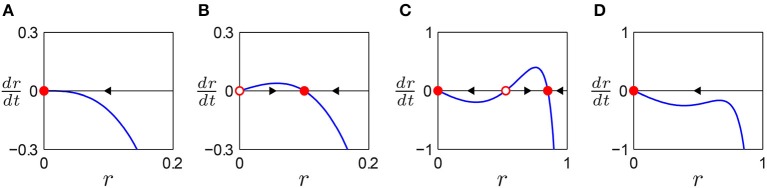
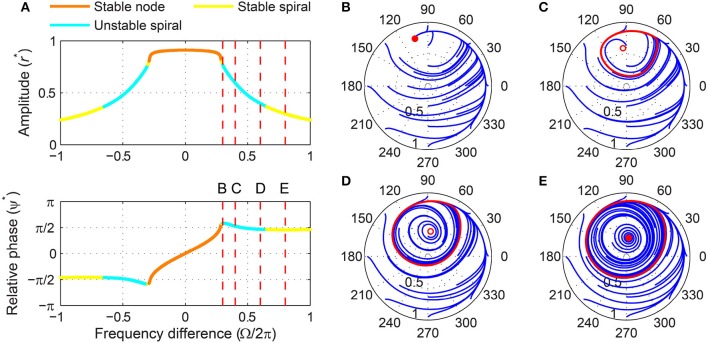
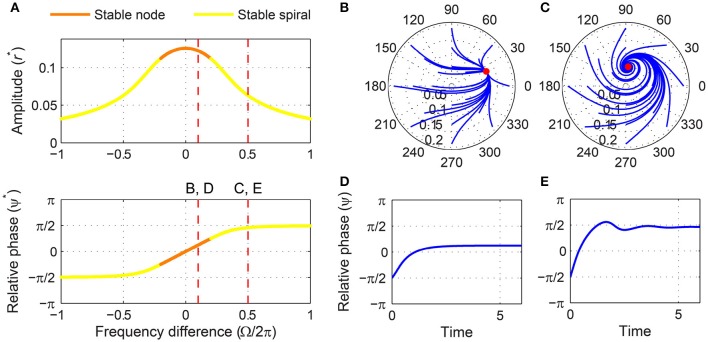
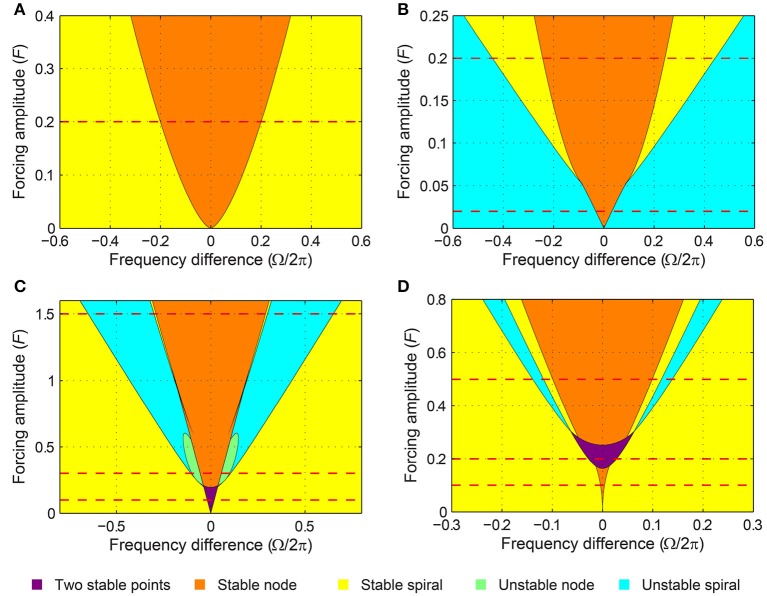
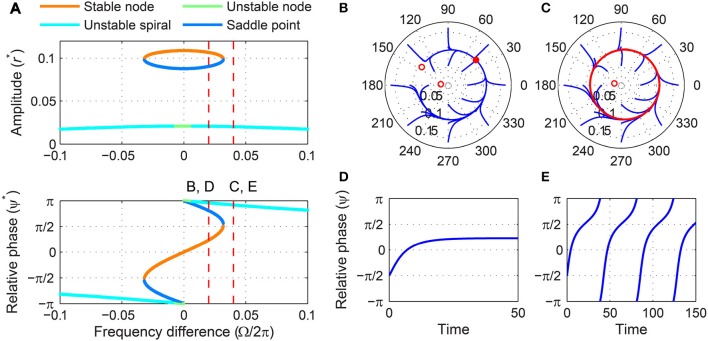
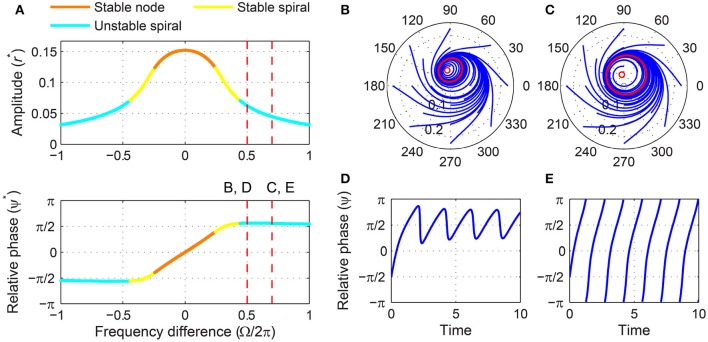
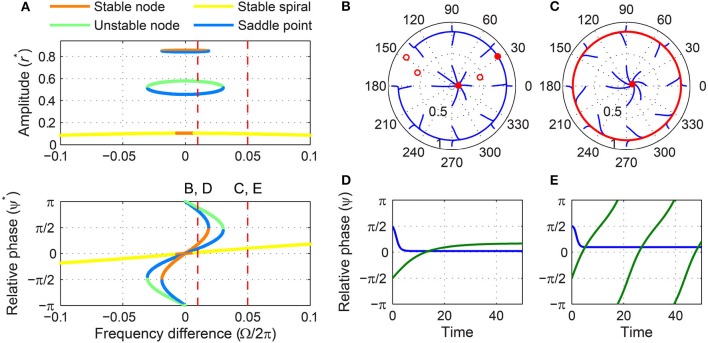
Oscillatory instability at the Hopf bifurcation is a dynamical phenomenon that has been suggested to characterize active non-linear processes observed in the auditory system. Networks of oscillators poised near Hopf bifurcation points and tuned to tonotopically distributed frequencies have been used as models of auditory processing at various levels, but systematic investigation of the dynamical properties of such oscillatory networks is still lacking. Here we provide a dynamical systems analysis of a canonical model for gradient frequency neural networks driven by a periodic signal. We use linear stability analysis to identify various driven behaviors of canonical oscillators for all possible ranges of model and forcing parameters. The analysis shows that canonical oscillators exhibit qualitatively different sets of driven states and transitions for different regimes of model parameters. We classify the parameter regimes into four main categories based on their distinct signal processing capabilities. This analysis will lead to deeper understanding of the diverse behaviors of neural systems under periodic forcing and can inform the design of oscillatory network models of auditory signal processing.
霍普夫分岔处的振荡不稳定性是一种动力学现象,有人认为它可以表征在听觉系统中观察到的活跃非线性过程。处于霍普夫分岔点附近并调谐到拓扑分布频率的振荡器网络已被用作各级听觉处理的模型,但对这种振荡网络动力学特性的系统研究仍然缺乏。在这里,我们对由周期性信号驱动的梯度频率神经网络的典型模型进行了动力学系统分析。我们使用线性稳定性分析来确定在模型和强迫参数的所有可能范围内典型振荡器的各种驱动行为。分析表明,对于不同的模型参数 regime,典型振荡器表现出定性不同的驱动状态集和转变。我们根据其不同的信号处理能力将参数 regime 分为四大类。这种分析将有助于更深入地理解周期性强迫下神经系统的多样行为,并可为听觉信号处理的振荡网络模型设计提供参考。