Lee Soomin, Choi Kyoung-Hee, Yoon Yohan
Department of Food and Nutrition, Sookmyung Women's University, Seoul 140-742, Korea.
Department of Oral Microbiology, College of Dentistry, Wonkwang University, Iksan 570-749, Korea.
Korean J Food Sci Anim Resour. 2014;34(2):257-61. doi: 10.5851/kosfa.2014.34.2.257. Epub 2014 Apr 30.
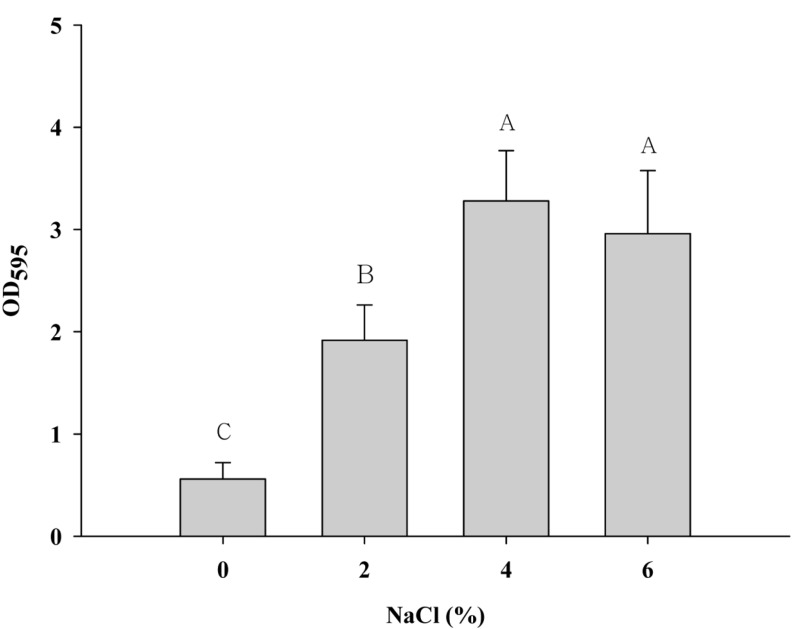
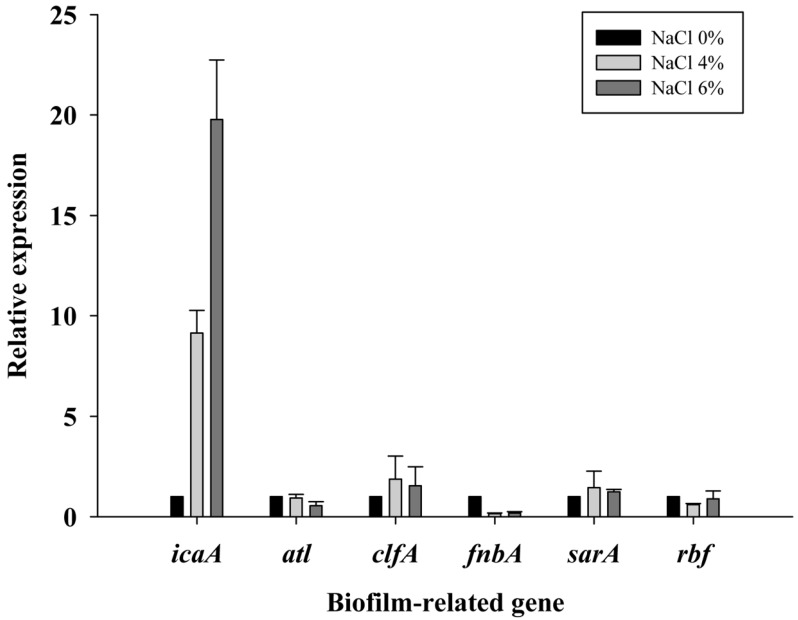
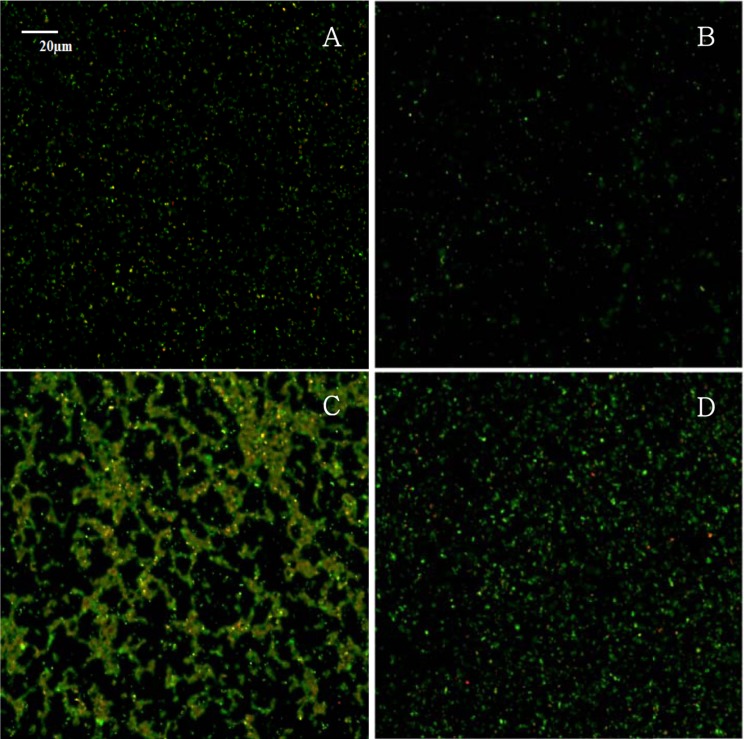
The objective of this study was to evaluate the effects of NaCl on the biofilm formations of the isolate from Staphylococcus aureus outbreaks linked to ham. The S. aureus ATCC13565 isolated from ham was exposed to NaCl concentrations of 0%, 2%, 4%, and 6% supplemented in tryptic soy broth (TSB) for 24 h at 35℃, followed by plating 0.1 mL of the culture on tryptic soy agar containing 0%, 2%, 4%, and 6% NaCl, respectively. After incubating at 35℃ for 24 h, the colonies on the plates were collected and diluted to OD600 = 0.1. The diluents of S. aureus were incubated on a 96-well flat bottom plate containing TSB plus the appropriate NaCl concentrations, and the biofilm formation was quantified by crystal violet staining after being incubated at 35℃ for 9 h. Confocal laser scanning microscope (CLSM) was also used for visualizing the biofilm formation of S. aureus at NaCl concentrations of 0%, 2%, 4%, and 6%. The transcriptional analysis of biofilm-related genes, such as icaA, atl, clfA, fnbA, sarA, and rbf, was conducted by quantitative real-time PCR. Crystal violet staining and CLSM showed that the biofilm formations of S. aureus increased (p<0.05) along with the NaCl concentrations. Moreover, the expression of the icaA genes was higher at the NaCl concentrations of 4% and 6% as compared with 0% of NaCl by approximately 9-folds and 20-folds, respectively. These results indicated that the NaCl formulated in processed food may increase the biofilm formations of S. aureus by increasing the icaA gene expressions.
本研究的目的是评估氯化钠对与火腿相关的金黄色葡萄球菌暴发分离株生物膜形成的影响。将从火腿中分离出的金黄色葡萄球菌ATCC13565暴露于胰蛋白胨大豆肉汤(TSB)中添加的0%、2%、4%和6%的氯化钠浓度下,在35℃培养24小时,然后分别将0.1 mL培养物接种到含有0%、2%、4%和6%氯化钠的胰蛋白胨大豆琼脂上。在35℃孵育24小时后,收集平板上的菌落并稀释至OD600 = 0.1。将金黄色葡萄球菌的稀释液在含有TSB和适当氯化钠浓度的96孔平底培养板上孵育,在35℃孵育9小时后,通过结晶紫染色对生物膜形成进行定量。共聚焦激光扫描显微镜(CLSM)也用于观察金黄色葡萄球菌在0%、2%、4%和6%氯化钠浓度下的生物膜形成。通过定量实时PCR对生物膜相关基因,如icaA、atl、clfA、fnbA、sarA和rbf进行转录分析。结晶紫染色和CLSM显示,金黄色葡萄球菌的生物膜形成随着氯化钠浓度的增加而增加(p<0.05)。此外,与0%氯化钠相比,icaA基因在4%和6%氯化钠浓度下的表达分别高出约9倍和20倍。这些结果表明,加工食品中配制的氯化钠可能通过增加icaA基因表达来增加金黄色葡萄球菌的生物膜形成。