Cena Lorenzo G, Chisholm William P, Keane Michael J, Cumpston Amy, Chen Bean T
Health Effects Laboratory Division, National Institute for Occupational Safety and Health, Morgantown, West Virginia, USA.
Aerosol Sci Technol. 2014;48(12):1254-1263. doi: 10.1080/02786826.2014.980883. Epub 2014 Nov 4.
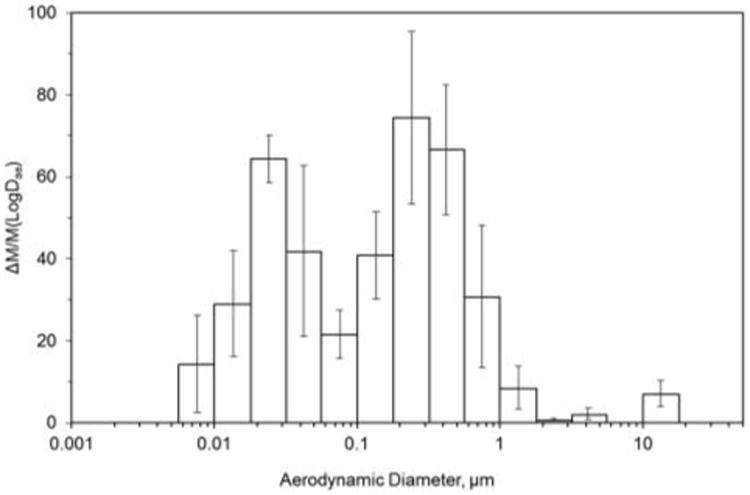
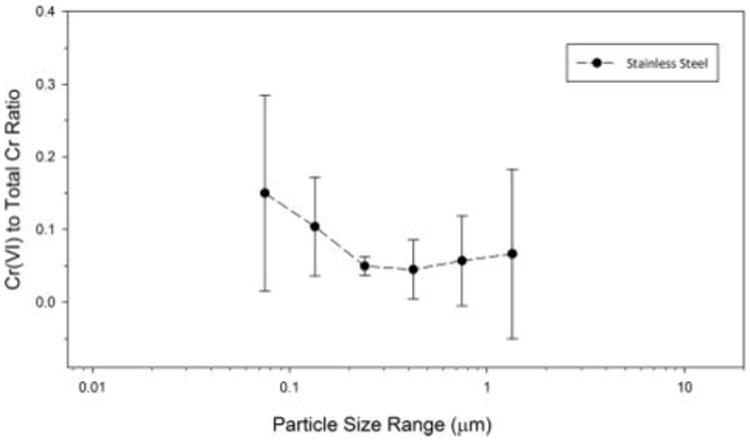
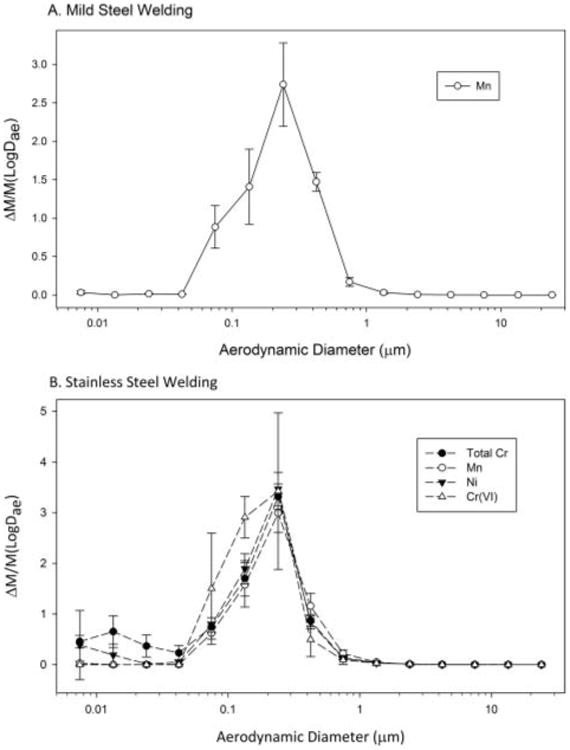
A laboratory study was conducted to determine the mass of total Cr, Cr(VI), Mn, and Ni in 15 size fractions for mild and stainless steel gas-metal arc welding (GMAW) fumes. Samples were collected using a nano multi orifice uniform deposition impactor (MOUDI) with polyvinyl chloride filters on each stage. The filters were analyzed by inductively coupled plasma mass spectrometry (ICP-MS) and ion chromatography. Limits of detection (LODs) and quantitation (LOQs) were experimentally calculated and percent recoveries were measured from spiked metals in solution and dry, certified welding-fume reference material. The fraction of Cr(VI) in total Cr was estimated by calculating the ratio of Cr(VI) to total Cr mass for each particle size range. Expected, regional deposition of each metal was estimated according to respiratory-deposition models. The weight percent (standard deviation) of Mn in mild steel fumes was 9.2% (6.8%). For stainless steel fumes, the weight percentages were 8.4% (5.4%) for total Cr, 12.2% (6.5%) for Mn, 2.1% (1.5%) for Ni and 0.5% (0.4%) for Cr(VI). All metals presented a fraction between 0.04 and 0.6 m. Total Cr and Ni presented an additional fraction <0.03 m. On average 6% of the Cr was found in the Cr(VI) valence state. There was no statistical difference between the smallest and largest mean Cr(VI) to total Cr mass ratio (-value D 0.19), hence our analysis does not show that particle size affects the contribution of Cr(VI) to total Cr. The predicted total respiratory deposition for the metal particles was ∼25%. The sites of principal deposition were the head airways (7-10%) and the alveolar region (11-14%). Estimated Cr(VI) deposition was highest in the alveolar region (14%).
进行了一项实验室研究,以测定低碳钢和不锈钢气体保护金属电弧焊(GMAW)烟尘中15个粒径级分的总铬、六价铬、锰和镍的质量。使用纳米多喷孔均匀沉积冲击器(MOUDI)在每个阶段配备聚氯乙烯过滤器采集样品。通过电感耦合等离子体质谱(ICP-MS)和离子色谱法对过滤器进行分析。通过实验计算了检测限(LOD)和定量限(LOQ),并从溶液中的加标金属和干燥的、经认证的焊接烟尘参考物质中测量了回收率。通过计算每个粒径范围的六价铬与总铬质量之比,估算了六价铬在总铬中的比例。根据呼吸沉积模型估算了每种金属的预期区域沉积量。低碳钢烟尘中锰的重量百分比(标准偏差)为9.2%(6.8%)。对于不锈钢烟尘,总铬的重量百分比为8.4%(5.4%),锰为12.2%(6.5%),镍为2.1%(1.5%),六价铬为0.5%(0.4%)。所有金属的粒径级分均在0.04至0.6微米之间。总铬和镍还存在一个小于0.03微米的粒径级分。平均6%的铬以六价铬价态存在。最小和最大的平均六价铬与总铬质量比之间没有统计学差异(p值 = 0.19),因此我们的分析并未表明粒径会影响六价铬对总铬的贡献。金属颗粒的预测总呼吸沉积量约为25%。主要沉积部位是头部气道(7 - 10%)和肺泡区域(11 - 14%)。六价铬的估计沉积量在肺泡区域最高(14%)。