Rojas-Rueda David, de Nazelle Audrey, Andersen Zorana J, Braun-Fahrländer Charlotte, Bruha Jan, Bruhova-Foltynova Hana, Desqueyroux Hélène, Praznoczy Corinne, Ragettli Martina S, Tainio Marko, Nieuwenhuijsen Mark J
ISGlobal, Centre for Research in Environmental Epidemiology (CREAL), Barcelona, Spain.
Municipal Institute of Medical Research (IMIM-Hospital del Mar), Barcelona, Spain.
PLoS One. 2016 Mar 1;11(3):e0149990. doi: 10.1371/journal.pone.0149990. eCollection 2016.
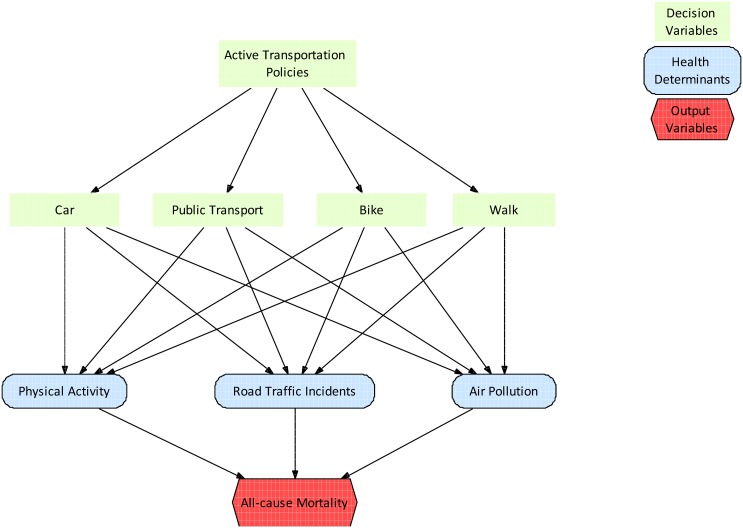
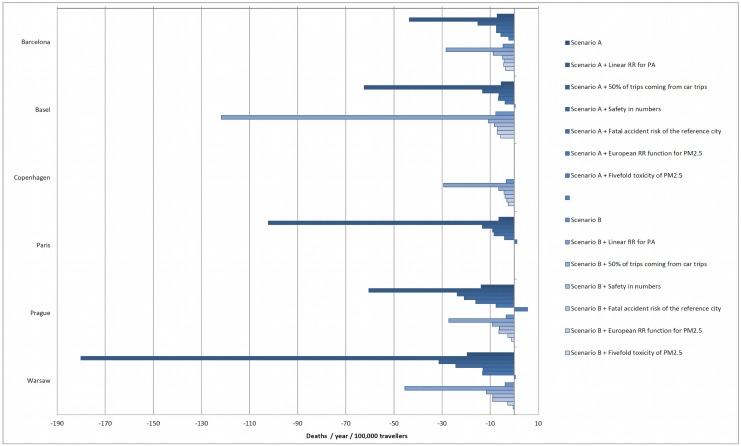
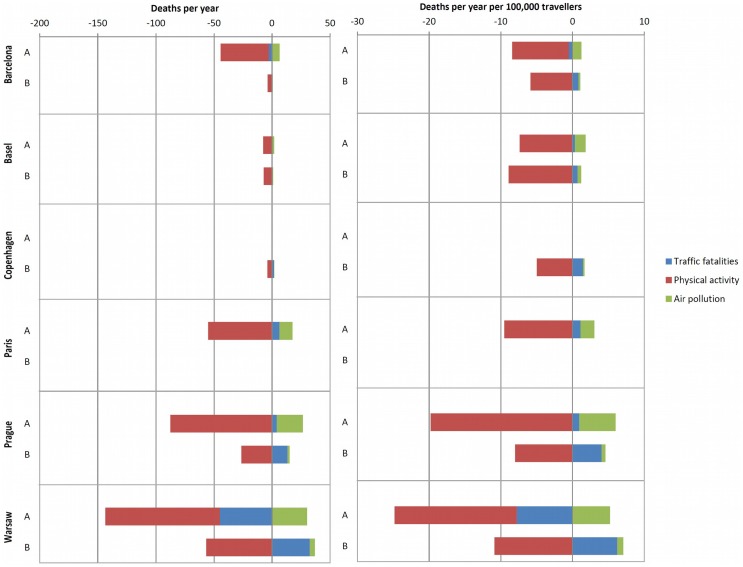
Policies that stimulate active transportation (walking and bicycling) have been related to heath benefits. This study aims to assess the potential health risks and benefits of promoting active transportation for commuting populations (age groups 16-64) in six European cities. We conducted a health impact assessment using two scenarios: increased cycling and increased walking. The primary outcome measure was all-cause mortality related to changes in physical activity level, exposure to fine particulate matter air pollution with a diameter <2.5 μm, as well as traffic fatalities in the cities of Barcelona, Basel, Copenhagen, Paris, Prague, and Warsaw. All scenarios produced health benefits in the six cities. An increase in bicycle trips to 35% of all trips (as in Copenhagen) produced the highest benefits among the different scenarios analysed in Warsaw 113 (76-163) annual deaths avoided, Prague 61 (29-104), Barcelona 37 (24-56), Paris 37 (18-64) and Basel 5 (3-9). An increase in walking trips to 50% of all trips (as in Paris) resulted in 19 (3-42) deaths avoided annually in Warsaw, 11(3-21) in Prague, 6 (4-9) in Basel, 3 (2-6) in Copenhagen and 3 (2-4) in Barcelona. The scenarios would also reduce carbon dioxide emissions in the six cities by 1,139 to 26,423 (metric tonnes per year). Policies to promote active transportation may produce health benefits, but these depend of the existing characteristics of the cities. Increased collaboration between health practitioners, transport specialists and urban planners will help to introduce the health perspective in transport policies and promote active transportation.
鼓励主动出行(步行和骑自行车)的政策已被证明与健康益处相关。本研究旨在评估在欧洲六个城市中,推广主动出行对通勤人群(16 - 64岁年龄组)的潜在健康风险和益处。我们使用两种情景进行了健康影响评估:增加自行车出行和增加步行出行。主要结果指标包括与身体活动水平变化、暴露于直径<2.5μm的细颗粒物空气污染以及巴塞罗那、巴塞尔、哥本哈根、巴黎、布拉格和华沙等城市的交通死亡事故相关的全因死亡率。所有情景在这六个城市均产生了健康益处。在华沙,将自行车出行比例提高到所有出行的35%(如哥本哈根)在分析的不同情景中产生的益处最大,每年可避免113例(76 - 163例)死亡;在布拉格可避免61例(29 - 104例);在巴塞罗那可避免37例(24 - 56例);在巴黎可避免37例(18 - 64例);在巴塞尔可避免5例(3 - 9例)。将步行出行比例提高到所有出行的50%(如巴黎),每年在华沙可避免19例(3 - 42例)死亡,在布拉格可避免11例(3 - 21例),在巴塞尔可避免6例(4 - 9例),在哥本哈根可避免3例(2 - 6例),在巴塞罗那可避免例3(2 - 4例)。这些情景还将使这六个城市的二氧化碳排放量每年减少1139至26423公吨。推广主动出行的政策可能会带来健康益处,但这取决于城市的现有特征。健康从业者、交通专家和城市规划者之间加强合作将有助于在交通政策中引入健康视角并推广主动出行。