Rulli Maria Cristina, Bellomi Davide, Cazzoli Andrea, De Carolis Giulia, D'Odorico Paolo
Departiment of Civil and Environmental Engineering, Politecnico di Milano, Piazza Leonardo da Vinci 32, I-20133 Milan, Italy.
Department of Environmental Sciences, University of Virginia, 291 McCormick Rd., Charlottesville, VA 22903, USA.
Sci Rep. 2016 Mar 3;6:22521. doi: 10.1038/srep22521.
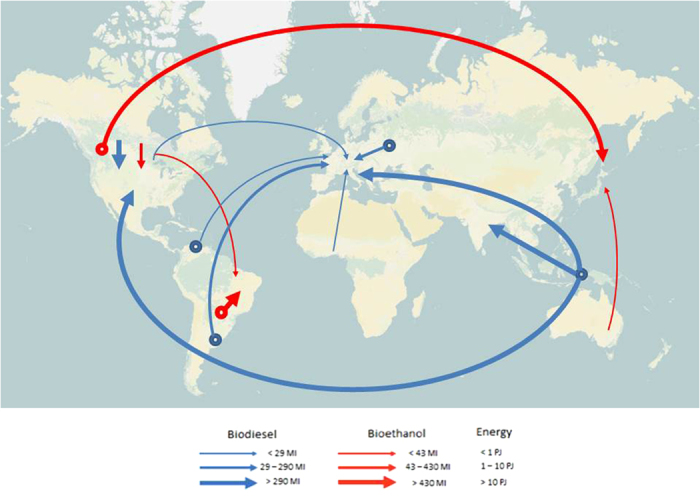
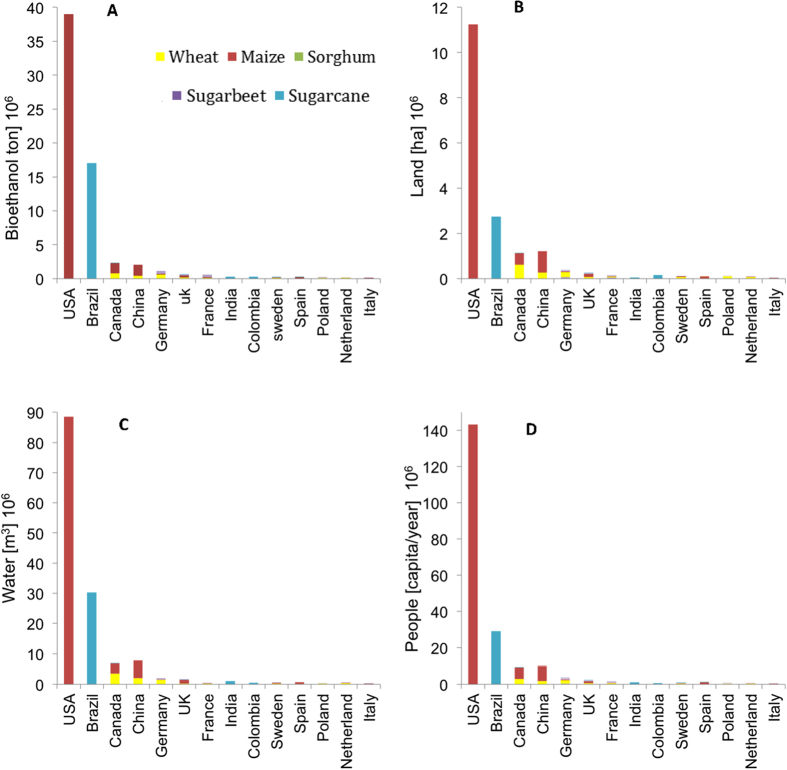
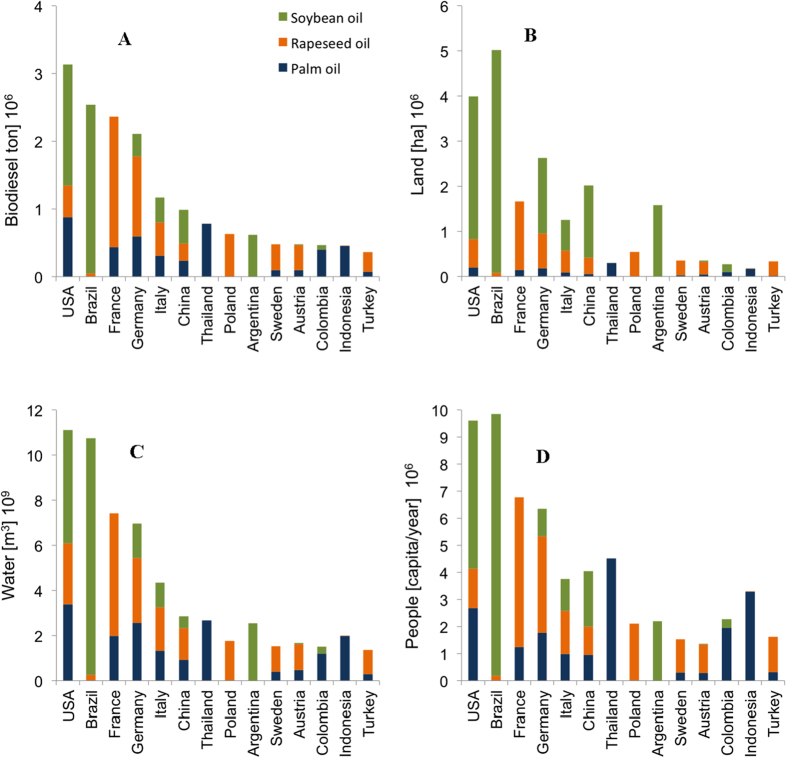
Recent energy security strategies, investment opportunities and energy policies have led to an escalation in biofuel consumption at the expenses of food crops and pastureland. To evaluate the important impacts of biofuels on food security, the food-energy nexus needs to be investigated in the context of its linkages with the overall human appropriation of land and water resources. Here we provide a global assessment of biofuel crop production, reconstruct global patterns of biofuel crop/oil trade and determine the associated displacement of water and land use. We find that bioethanol is mostly produced with domestic crops while 36% of biodiesel consumption relies on international trade, mainly from Southeast Asia. Altogether, biofuels rely on about 2-3% of the global water and land used for agriculture, which could feed about 30% of the malnourished population. We evaluate the food-energy tradeoff and the impact an increased reliance on biofuel would have on the number of people the planet can feed.
近期的能源安全战略、投资机遇和能源政策导致了生物燃料消费量的上升,而这是以粮食作物和牧场为代价的。为评估生物燃料对粮食安全的重要影响,需要在其与土地和水资源总体人类占用之间的联系背景下,对粮食-能源关系进行研究。在此,我们对生物燃料作物生产进行了全球评估,重构了生物燃料作物/石油贸易的全球模式,并确定了相关的水和土地利用置换情况。我们发现,生物乙醇大多由国内作物生产,而36%的生物柴油消费依赖国际贸易,主要来自东南亚。总体而言,生物燃料依赖约2%至3%的全球农业用水和土地,这些水和土地可养活约30%的营养不良人口。我们评估了粮食-能源的权衡,以及对生物燃料依赖增加对地球可养活人口数量的影响。