Tonkikh A A, Voloshina E N, Werner P, Blumtritt H, Senkovskiy B, Güntherodt G, Parkin S S P, Dedkov Yu S
Max Planck Institute of Microstructure Physics, Weinberg 2, 06120 Halle (Saale), Germany.
Institute for Physics of Microstructures RAS, 603950, GSP-105, Nizhny Novgorod, Russia.
Sci Rep. 2016 Mar 24;6:23547. doi: 10.1038/srep23547.
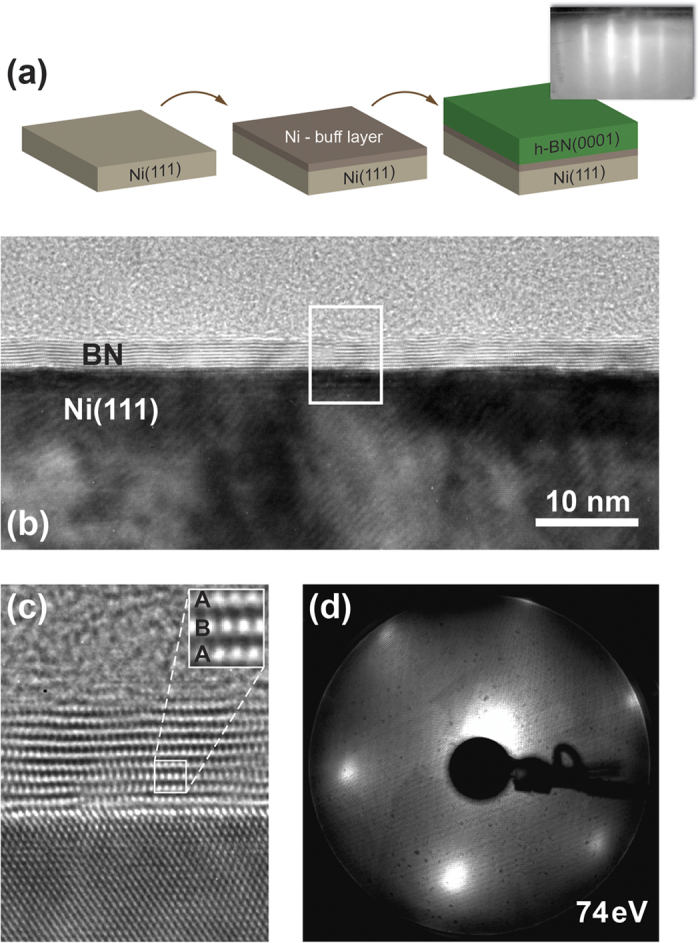
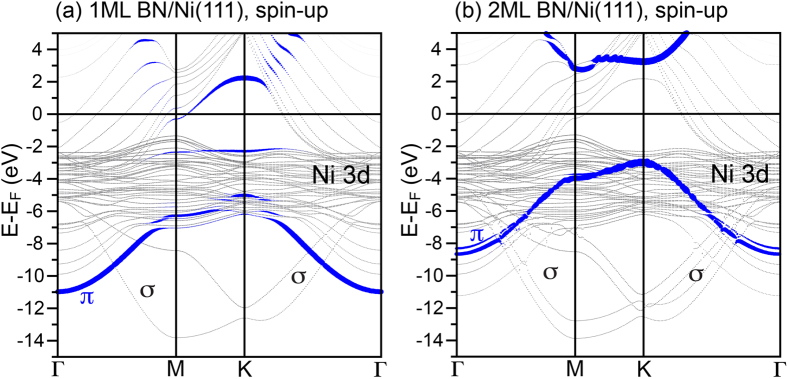
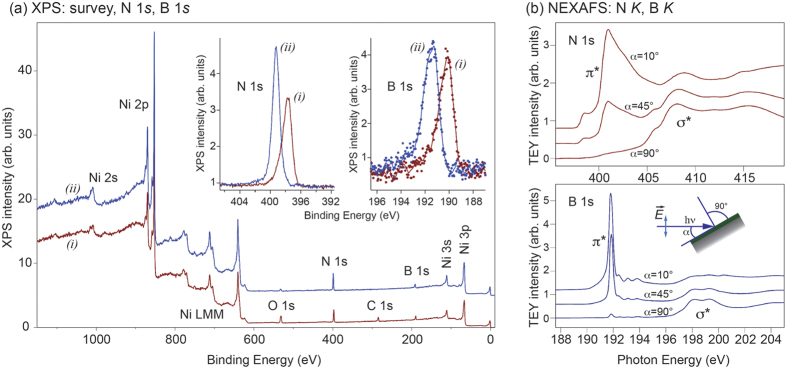
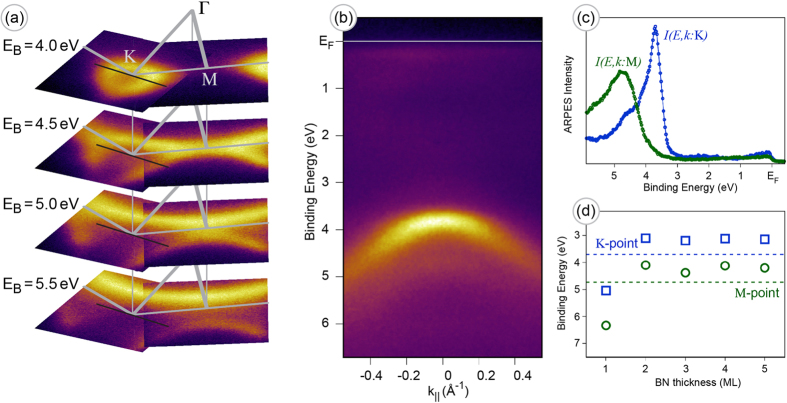
Hexagonal boron nitride (h-BN) is a promising material for implementation in spintronics due to a large band gap, low spin-orbit coupling, and a small lattice mismatch to graphene and to close-packed surfaces of fcc-Ni(111) and hcp-Co(0001). Epitaxial deposition of h-BN on ferromagnetic metals is aimed at small interface scattering of charge and spin carriers. We report on the controlled growth of h-BN/Ni(111) by means of molecular beam epitaxy (MBE). Structural and electronic properties of this system are investigated using cross-section transmission electron microscopy (TEM) and electron spectroscopies which confirm good agreement with the properties of bulk h-BN. The latter are also corroborated by density functional theory (DFT) calculations, revealing that the first h-BN layer at the interface to Ni is metallic. Our investigations demonstrate that MBE is a promising, versatile alternative to both the exfoliation approach and chemical vapour deposition of h-BN.
六方氮化硼(h-BN)由于具有大的带隙、低的自旋轨道耦合以及与石墨烯以及面心立方Ni(111)和六方密排Co(0001)的密排表面的小晶格失配,是一种有望应用于自旋电子学的材料。在铁磁金属上外延沉积h-BN旨在使电荷和自旋载流子的界面散射最小化。我们报道了通过分子束外延(MBE)实现h-BN/Ni(111)的可控生长。利用横截面透射电子显微镜(TEM)和电子能谱对该系统的结构和电子性质进行了研究,结果证实其与体相h-BN的性质吻合良好。密度泛函理论(DFT)计算也证实了后者,结果表明与Ni界面处的第一层h-BN是金属性的。我们的研究表明,MBE是一种有前景的、通用的替代方法,可替代h-BN的剥离法和化学气相沉积法。