Tincati Camilla, Douek Daniel C, Marchetti Giulia
Clinic of Infectious, Diseases Department of Health Sciences, San Paolo Hospital, University of Milan, Via di Rudini' 8, 20142 Milan, Italy.
Human Immunology Section, Vaccine Research Center, National Institute of Allergy and Infectious Disease, National Institutes of Health, Bethesda, MD USA.
AIDS Res Ther. 2016 Apr 11;13:19. doi: 10.1186/s12981-016-0103-1. eCollection 2016.
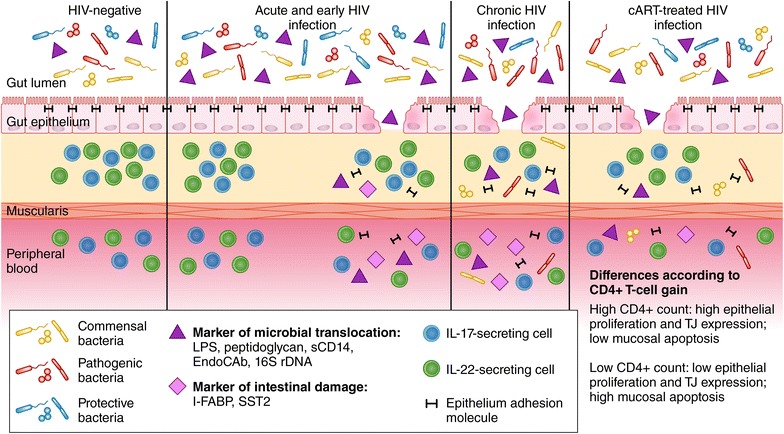
Over the past 10 years, extensive work has been carried out in the field of microbial translocation in HIV infection, ranging from studies on its clinical significance to investigations on its pathogenic features. In the present work, we review the most recent findings on this phenomenon, focusing on the predictive role of microbial translocation in HIV-related morbidity and mortality, the mechanisms by which it arises and potential therapeutic approaches. From a clinical perspective, current work has shown that markers of microbial translocation may be useful in predicting clinical events in untreated HIV infection, while conflicting data exist on their role in cART-experienced subjects, possibly due to the inclusion of extremely varied patient populations in cohort studies. Results from studies addressing the pathogenesis of microbial translocation have improved our knowledge of the damage of the gastrointestinal epithelial barrier occurring in HIV infection. However, the extent to which mucosal impairment translates directly to increased gastrointestinal permeability remains an open issue. In this respect, novel work has established a role for IL-17 and IL-22-secreting T cell populations in limiting microbial translocation and systemic T-cell activation/inflammation, thus representing a possible target of immune-therapeutic interventions shown to be promising in the animal model. Further, recent reports have not only confirmed the presence of a dysbiotic intestinal community in the course of HIV infection but have also shown that it may be linked to mucosal damage, microbial translocation and peripheral immune activation. Importantly, technical advances have also shed light on the metabolic activity of gut microbes, highlighting the need for novel therapeutic approaches to correct the function, as well as the composition, of the gastrointestinal microbiota.
在过去10年里,在HIV感染中的微生物易位领域开展了大量工作,范围从其临床意义的研究到致病特征的调查。在本研究中,我们回顾了关于这一现象的最新发现,重点关注微生物易位在HIV相关发病和死亡中的预测作用、其产生的机制以及潜在的治疗方法。从临床角度来看,目前的研究表明,微生物易位标志物可能有助于预测未经治疗的HIV感染中的临床事件,而关于它们在接受抗逆转录病毒治疗(cART)的患者中的作用存在相互矛盾的数据,这可能是由于队列研究中纳入了极其多样化的患者群体。针对微生物易位发病机制的研究结果增进了我们对HIV感染中发生的胃肠道上皮屏障损伤的认识。然而,黏膜损伤直接转化为胃肠道通透性增加的程度仍是一个悬而未决的问题。在这方面,新的研究确定了分泌白细胞介素-17(IL-17)和白细胞介素-22(IL-22)的T细胞群体在限制微生物易位和全身T细胞激活/炎症方面的作用,因此代表了在动物模型中显示出有前景的免疫治疗干预的一个可能靶点。此外,最近的报告不仅证实了HIV感染过程中存在肠道微生物群落失调,还表明它可能与黏膜损伤、微生物易位和外周免疫激活有关。重要的是,技术进步也揭示了肠道微生物的代谢活性,突出了需要新的治疗方法来纠正胃肠道微生物群的功能及其组成。