Hiraiwa Tetsuya, Salbreux Guillaume
Max Planck Institute for the Physics of Complex Systems, Nöthnitzer Straße 38, 01187 Dresden, Germany.
Fachbereich Physik, Freie Universität Berlin, Berlin 14195, Germany.
Phys Rev Lett. 2016 May 6;116(18):188101. doi: 10.1103/PhysRevLett.116.188101.
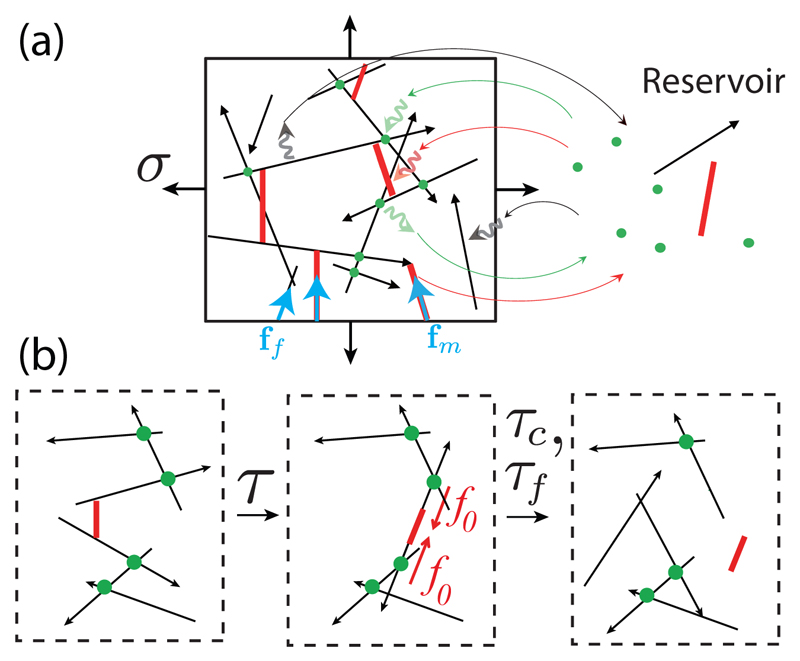
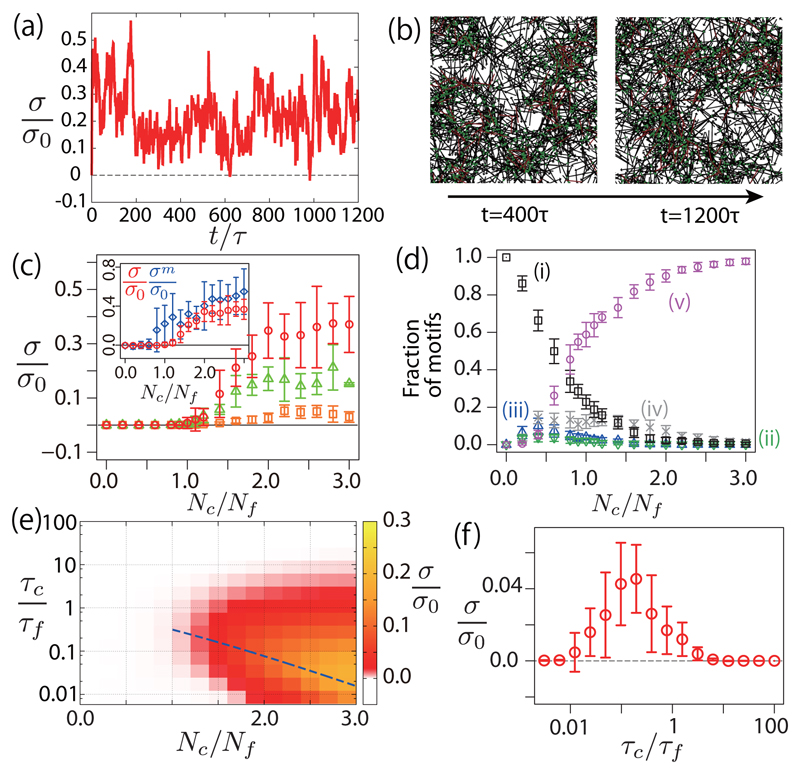
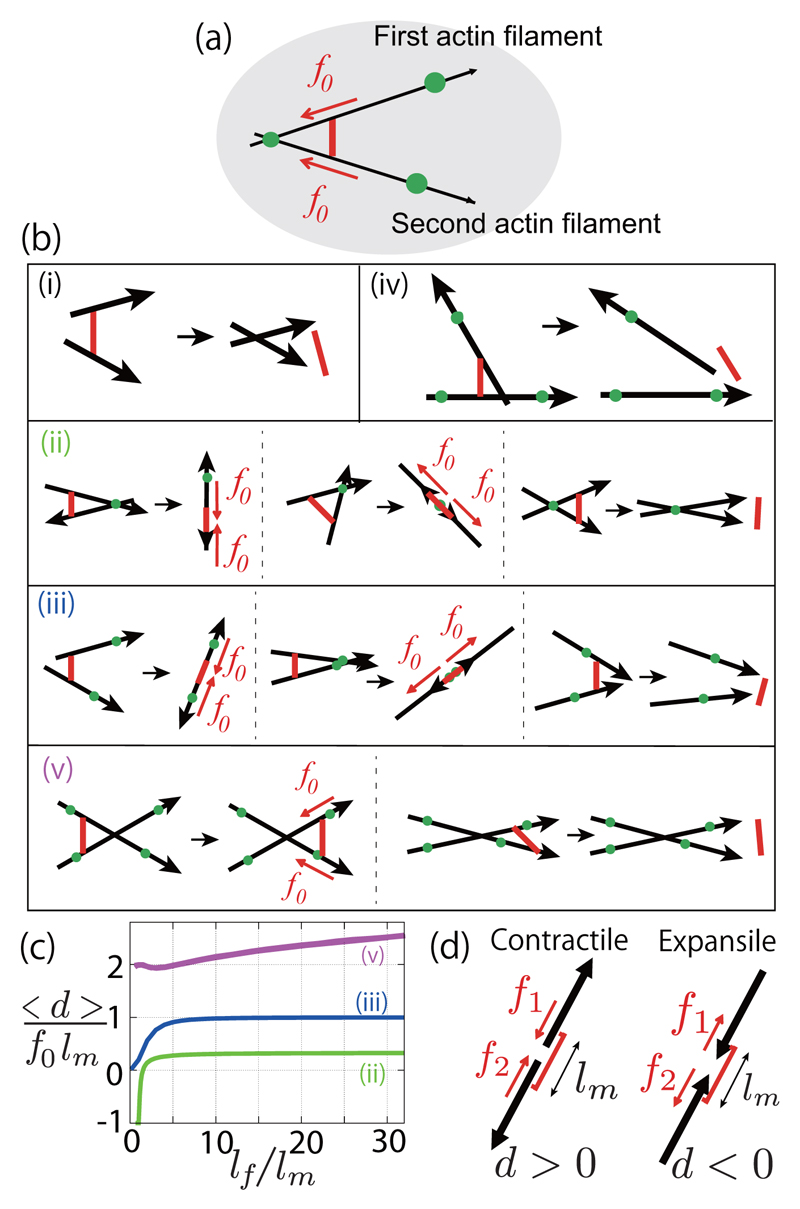
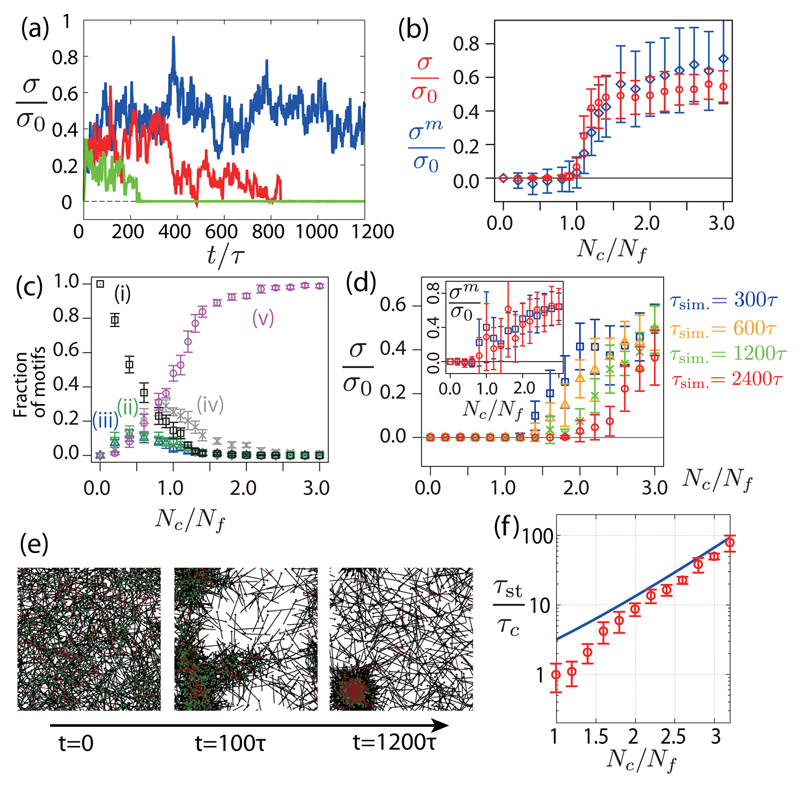
We study the effect of turnover of cross-linkers, motors, and filaments on the generation of a contractile stress in a network of filaments connected by passive cross-linkers and subjected to the forces exerted by molecular motors. We perform numerical simulations where filaments are treated as rigid rods and molecular motors move fast compared to the time scale of an exchange of cross-linkers. We show that molecular motors create a contractile stress above a critical number of cross-linkers. When passive cross-linkers are allowed to turn over, the stress exerted by the network vanishes due to the formation of clusters. When both filaments and passive cross-linkers turn over, clustering is prevented and the network reaches a dynamic contractile steady state. A maximum stress is reached for an optimum ratio of the filament and cross-linker turnover rates. Taken together, our work reveals conditions for stress generation by molecular motors in a fluid isotropic network of rearranging filaments.
我们研究了交联剂、分子马达和细丝的周转对由被动交联剂连接并受分子马达施加力作用的细丝网络中收缩应力产生的影响。我们进行了数值模拟,其中细丝被视为刚性杆,并且与交联剂交换的时间尺度相比,分子马达移动得很快。我们表明,分子马达在超过临界数量的交联剂时会产生收缩应力。当允许被动交联剂周转时,由于簇的形成,网络施加的应力会消失。当细丝和被动交联剂都周转时,簇的形成会被阻止,网络达到动态收缩稳态。对于细丝和交联剂周转速率的最佳比例,会达到最大应力。综上所述,我们的工作揭示了在重排细丝的流体各向同性网络中分子马达产生应力的条件。