Trovato Alessia, Reid Anthony, Takarinda Kudakwashe C, Montaldo Chiara, Decroo Tom, Owiti Philip, Bongiorno Francesco, Di Carlo Stefano
Medici Senza Frontiere Italia, Via Magenta 5, Roma, 00185 Italy.
FCFP, Médecins Sans Frontières Bruxelles, Operational Research Unit Luxembourg, 68 rue de Gasperich L-1617, Luxembourg City, Luxembourg.
Confl Health. 2016 Jun 15;10:14. doi: 10.1186/s13031-016-0080-y. eCollection 2016.
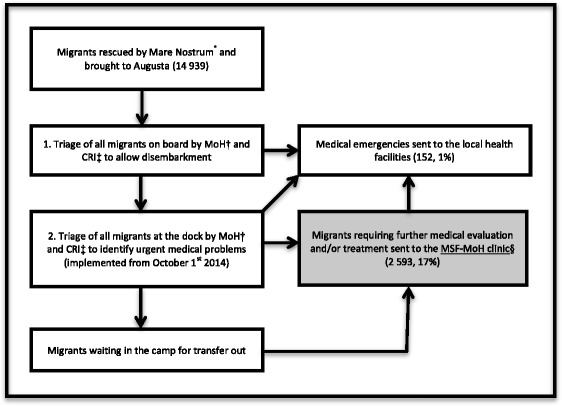
In recent years Europe has received an increasing influx of migrants, many of whom risked their lives crossing the Mediterranean Sea. In October 2013, Italy launched a search and rescue operation at sea in response to migrant deaths during the sea crossing. In August 2014, Médecins sans Frontières and the local Ministry of Health established an outpatient clinic at Augusta harbor, in Sicily, which received 26 % of total sea migrants arrived in Italy in 2014, to provide immediate medical assessment and care.
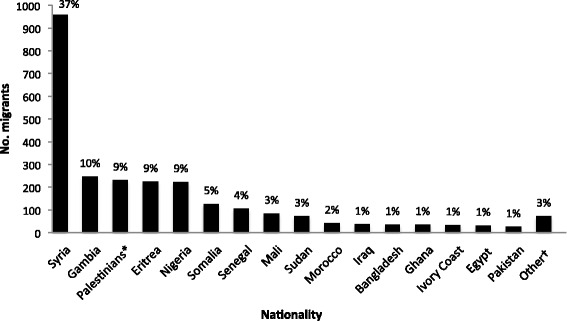
This is a descriptive study of demographic and clinical data of sea migrants seen at the port clinic in Augusta from August to December 2014. We compared migrants from Near Eastern, war-torn regions (Group 1) and the others, mostly African (Group 2), as there were significant differences in terms of demographic and morbidity profiles.
There were 2593 migrants consulting the clinic (17 % af all rescued migrants) with 5 % being referred to hospital. Most were young males. The overall burden of vulnerability (pregnant women, children ≤5 years, unaccompanied minors, single parents with children of minor age, disabled and elderly persons) was 24 %. There were more small children, pregnant women, elderly, disabled, and persons with chronic diseases in Group 1, as compared to Group 2. Group 2 had more unaccompanied minors. Morbitidies in common were respiratory, dermatological, trauma-related and gastrointestinal conditions. However, acute and chronic cardiovascular disease, as well as diabetes, were more frequent in Group 1; chronic diseases affected 19 % of this group. Group 2 had more patients with skin diseases. Most migrants attributed their presenting symptoms to the perils of their journey. No risks for public health were detected.
Among sea migrants, we identified two groups with different demographic and clinical characteristics, as well as vulnerability patterns. Overall morbidity suggested that the dangerous journey affected migrants' health. Medical activities at reception sites should include screening for vulnerability and chronic disease management. Ensuring medical care to migrants on arrival can address European humanitarian obligations and provide support to local medical facilities.
近年来,欧洲接收的移民数量不断增加,其中许多人冒着生命危险穿越地中海。2013年10月,意大利针对移民在渡海过程中的死亡事件,展开了海上搜救行动。2014年8月,无国界医生组织与当地卫生部在西西里岛的奥古斯塔港设立了一家门诊诊所,该诊所接待了2014年抵达意大利的26%的海上移民,为他们提供即时医疗评估和护理。
这是一项对2014年8月至12月在奥古斯塔港口诊所就诊的海上移民的人口统计学和临床数据的描述性研究。我们比较了来自中东战乱地区的移民(第1组)和其他移民,后者大多来自非洲(第2组),因为两组在人口统计学和发病率方面存在显著差异。
共有2593名移民到诊所就诊(占所有获救移民的17%),其中5%被转诊至医院。大多数是年轻男性。弱势群体(孕妇、5岁及以下儿童、无人陪伴的未成年人、有未成年子女的单亲、残疾人和老年人)的总体比例为24%。与第2组相比,第1组中有更多的幼儿、孕妇、老年人、残疾人以及患有慢性病的人。第2组中有更多无人陪伴的未成年人。常见疾病包括呼吸系统疾病、皮肤病、创伤相关疾病和胃肠道疾病。然而,急性和慢性心血管疾病以及糖尿病在第1组中更为常见;慢性病影响了该组19%的人。第2组中有更多皮肤病患者。大多数移民将他们目前的症状归因于旅途的危险。未检测到公共卫生风险。
在海上移民中,我们识别出了两组具有不同人口统计学和临床特征以及脆弱性模式的人群。总体发病率表明,危险的旅程影响了移民的健康。接收地点的医疗活动应包括对脆弱性的筛查和慢性病管理。确保移民抵达时获得医疗护理既能履行欧洲的人道主义义务,又能为当地医疗设施提供支持。