Departamento de Microbiologia Geral, Instituto de Microbiologia Paulo de Góes, Universidade Federal do Rio de Janeiro (UFRJ), Rio de Janeiro, Brazil; Department of Molecular Genetics and Microbiology, Stony Brook University, Stony Brook, New York, USA.
Departamento de Microbiologia Geral, Instituto de Microbiologia Paulo de Góes, Universidade Federal do Rio de Janeiro (UFRJ), Rio de Janeiro, Brazil.
mSphere. 2016 Jun 29;1(4). doi: 10.1128/mSphere.00099-16. eCollection 2016 Jul-Aug.
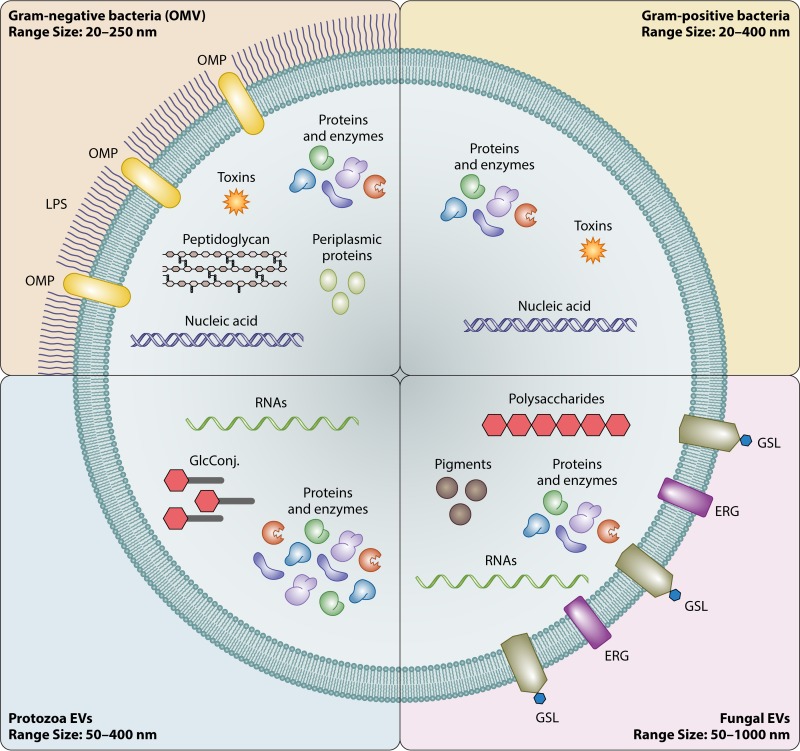
Extracellular vesicles (EVs) are produced by virtually all cell types. Within the past few years, work in this field has revealed more information about fungal EVs. Fungal EVs have been shown to carry proteins, lipids, pigments, polysaccharides, and RNA; these components are known virulence factors, a fact which supports the hypothesis that fungal EVs concentrate pathogenic determinants. Additionally, recent studies have demonstrated that fungal EVs stimulate the host immune system. In this review, putative roles of fungal EVs are discussed, including their potential as vaccination tools and their possible contribution to pathogenesis in invasive fungal diseases.
细胞外囊泡 (EVs) 几乎由所有细胞类型产生。在过去的几年中,该领域的研究揭示了更多关于真菌 EVs 的信息。已经证明真菌 EVs 携带蛋白质、脂质、色素、多糖和 RNA;这些成分是已知的毒力因子,这一事实支持了真菌 EVs 浓缩致病性决定因素的假说。此外,最近的研究表明,真菌 EVs 可刺激宿主免疫系统。在这篇综述中,讨论了真菌 EVs 的可能作用,包括它们作为疫苗工具的潜力及其在侵袭性真菌感染发病机制中的可能贡献。