Tan Li Li, Sanjay Srinivasan, Morgan Philip B
School of Chemical and Life Sciences, Singapore Polytechnic, Singapore 139651.
Ophthalmology and Visual Sciences, Khoo Teck Puat Hospital, Singapore 768828; Yong Loo Lin School of Medicine, National University of Singapore, Singapore 119228.
J Ophthalmol. 2016;2016:7285132. doi: 10.1155/2016/7285132. Epub 2016 Jun 28.
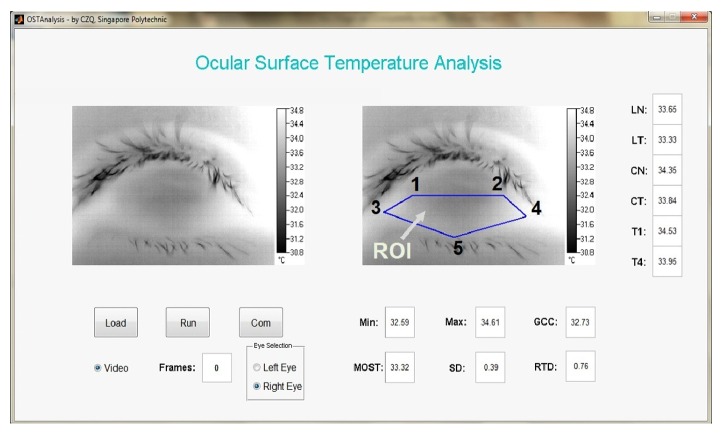
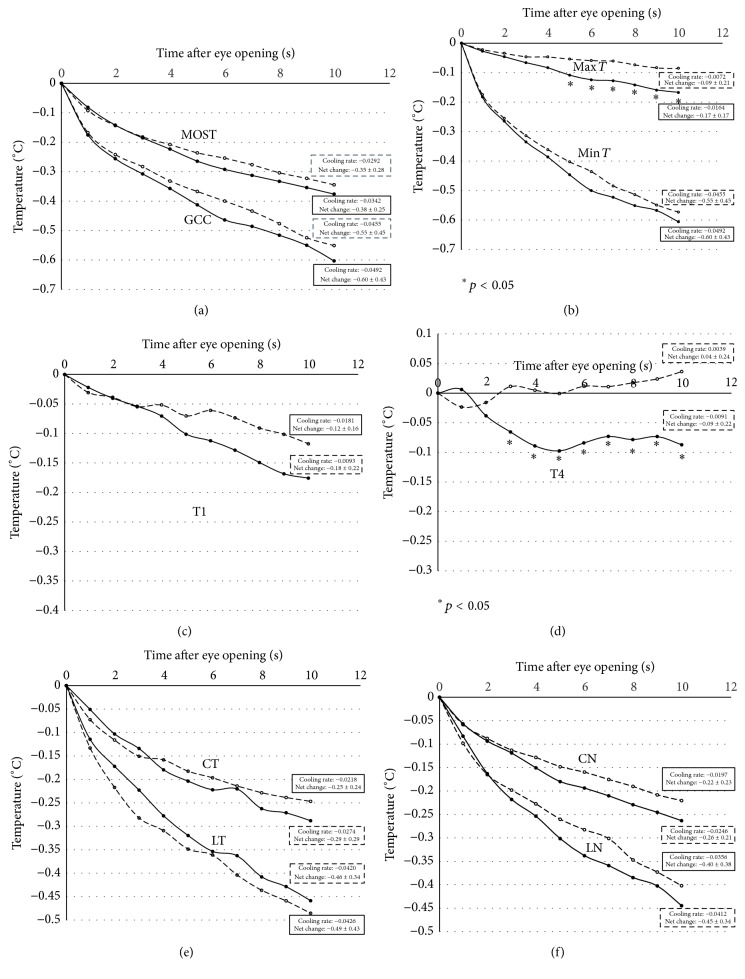
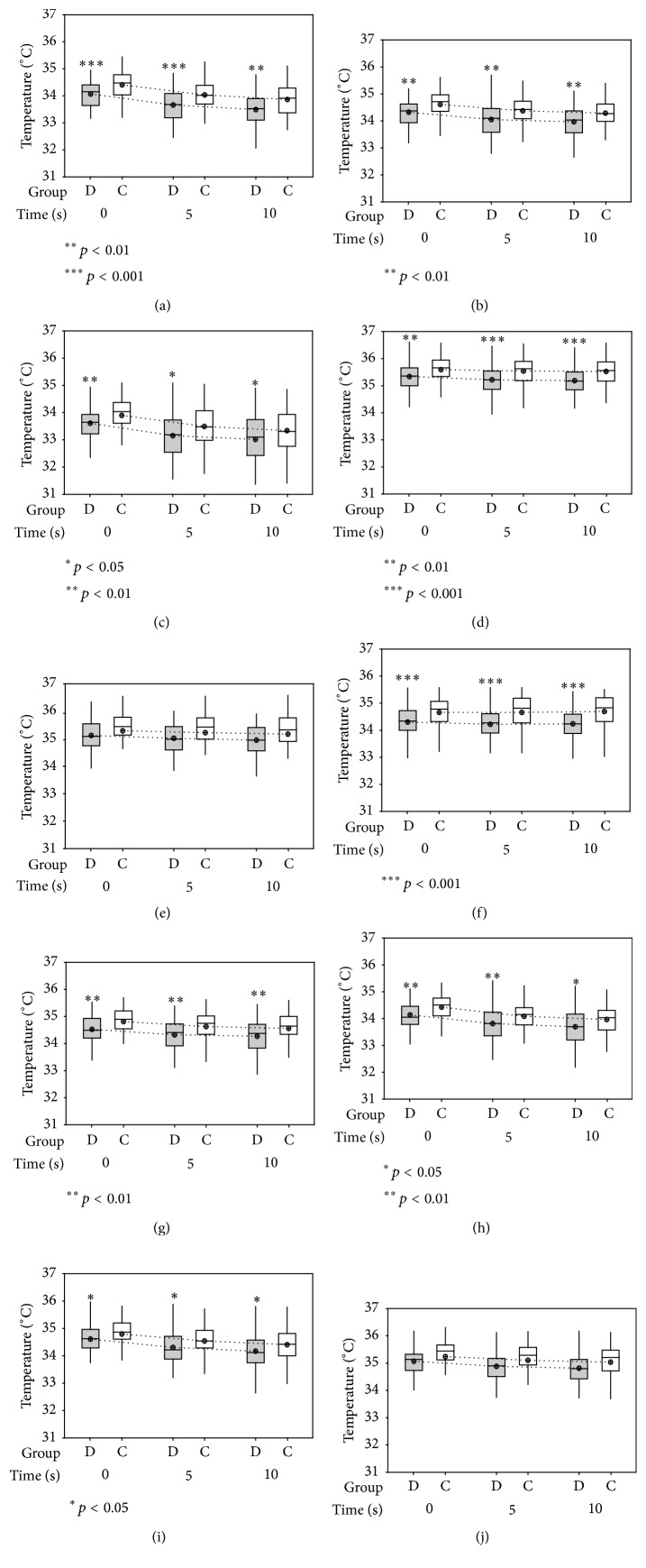
Purpose. To study ocular surface temperature (OST) in dry eyes by static and dynamic measures. Methods. OST was recorded on 62 dry eyes and 63 age- and sex-matched controls. Static measures were study of absolute OST at t = 0, 5, and 10 s after eye opening. Dynamic measures were study of mean change and net change in OST over 10 s of sustained eye opening. Ten OST indices studied were temperatures of the geometric center of the cornea (GCC), extreme temporal (T1) and nasal conjunctiva (T4), midtemporal (CT) and nasal conjunctiva (CN), temporal (LT) and nasal (LN) limbus, and mean (MOST), maximum (Max T), and minimum (Min T) temperatures of the region of interest. Results. For static measures, dry eyes recorded significantly lower GCC, MOST, Min T, Max T, T4, CT, LT, LN, and CN. For dynamic measures, dry eyes had significantly steeper regression line of mean change (corresponding to greater net change) for Max T 5 s onward and T4 at 3 s onward. Conclusions. Both static and dynamic measures of the OST were valuable and can be used as clinical tool to assess dry eye.
目的。通过静态和动态测量研究干眼患者的眼表温度(OST)。方法。记录62例干眼患者和63例年龄及性别匹配的对照者的OST。静态测量是在睁眼后0、5和10秒时研究绝对OST。动态测量是研究持续睁眼10秒期间OST的平均变化和净变化。所研究的10个OST指标包括角膜几何中心(GCC)、颞侧极端(T1)和鼻侧结膜(T4)、颞侧中部(CT)和鼻侧结膜(CN)、颞侧(LT)和鼻侧(LN)角膜缘的温度,以及感兴趣区域的平均(MOST)、最高(Max T)和最低(Min T)温度。结果。对于静态测量,干眼患者的GCC、MOST、Min T、Max T、T4、CT、LT、LN和CN显著较低。对于动态测量,干眼患者在5秒及以后的Max T和3秒及以后的T4的平均变化回归线显著更陡(对应更大的净变化)。结论。OST的静态和动态测量均有价值,可作为评估干眼的临床工具。