Chien Chin-Lung
Psychology, Kaohsiung Medical UniversityKaohsiung, Taiwan; Positive Psychology Center, Kaohsiung Medical UniversityKaohsiung, Taiwan.
Front Psychol. 2016 Jun 30;7:924. doi: 10.3389/fpsyg.2016.00924. eCollection 2016.
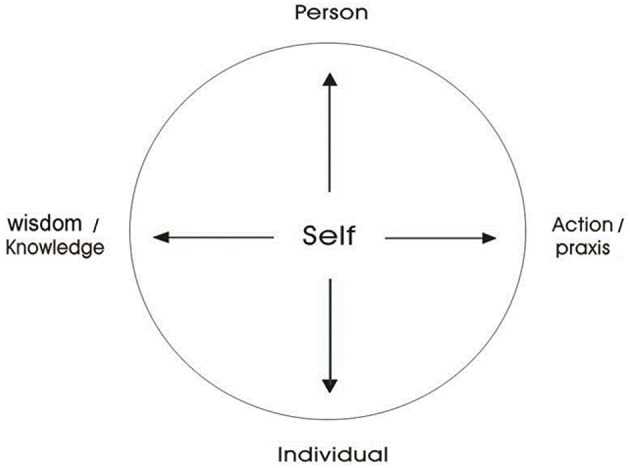
In a dyad interaction, respecting and obeying those with high status (authority) is highly valued in Chinese societies. Regarding explicit behaviors, Chinese people usually show respect to and obey authority, which we call authoritarian orientation. Previous literature has indicated that Chinese people have a high degree of authoritarian personality, which was considered a national character. However, under Confucian relationalism (Hwang, 2012a), authoritarian orientation is basically an ethical issue, and thus, should not be reduced to the contention of authoritarian personality. Based on Yang's (1993) indigenous conceptualization, Chien (2013) took an emic bottom-up approach to construct an indigenous model of Chinese authoritarian orientation; it represents a "culture-inclusive theory." However, Chien's model lacks the role of agency or intentionality. To resolve this issue and to achieve the epistemological goal of indigenous psychology (that is, "one mind, many mentalities"), this paper took the "cultural system approach" (Hwang, 2015b) to construct a culture-inclusive theory of authoritarian orientation in order to represent the universal mind of human beings as well as the mentalities of people in a particular culture. Two theories that reflect the universal mind, the "Face and Favor model" (Hwang, 1987) and the "Mandala Model of Self" (Hwang, 2011a,c), were used as analytical frameworks for interpreting Chien's original model. The process of constructing the culture-inclusive theory of authoritarian orientation may represent a paradigm for the construction of indigenous culture-inclusive theories while inspiring further development. Some future research directions are proposed herein.
在二元互动中,尊重和服从地位高(有权威)的人在中国社会备受重视。在显性行为方面,中国人通常尊重并服从权威,我们称之为权威取向。以往文献表明,中国人具有高度的权威人格,这被视为一种民族性格。然而,在儒家关系主义(黄光国,2012a)的视角下,权威取向本质上是一个伦理问题,因此,不应简化为权威人格的争论。基于杨国枢(1993)的本土概念化,钱永祥(2013)采用了一种从本土视角自下而上的方法来构建中国权威取向的本土模型;它代表了一种“文化包容理论”。然而,钱永祥的模型缺乏能动性或意向性的作用。为了解决这个问题并实现本土心理学的认识论目标(即“一心,多心态”),本文采用“文化系统方法”(黄光国,2015b)来构建一个权威取向的文化包容理论,以展现人类的普遍心理以及特定文化中人们的心理状态。两种反映普遍心理的理论,即“面子与人情模型”(黄光国,1987)和“自我的曼陀罗模型”(黄光国,2011a、c),被用作解释钱永祥原始模型的分析框架。构建权威取向文化包容理论的过程可能代表了构建本土文化包容理论的一种范式,同时也能激发进一步的发展。本文在此提出了一些未来的研究方向。