López-Carvajal Liliana, Cardona-Arias Jaiberth Antonio, Zapata-Cardona María Isabel, Sánchez-Giraldo Vanesa, Vélez Iván Darío
University of Antioquia, Calle 62 No. 62-59, Lab 632, Medellin, Colombia.
School of Microbiology, University of Antioquia UdeA, Calle 70 No. 52-21, Medellín, Colombia.
BMC Infect Dis. 2016 Jul 26;16:360. doi: 10.1186/s12879-016-1663-3.
Cryotherapy is a local treatment for cutaneous leishmaniasis with variable efficacy and greater safety than conventional treatment. The objective of this study is to evaluate the efficacy and safety of cryotherapy for the treatment of cutaneous leishmaniasis and to compare it with pentavalent antimonials.
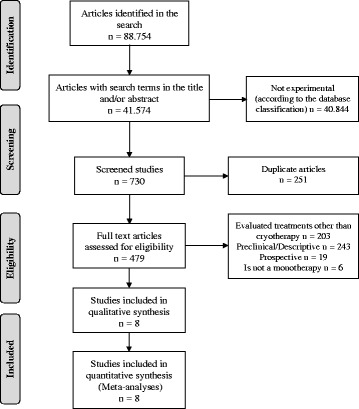
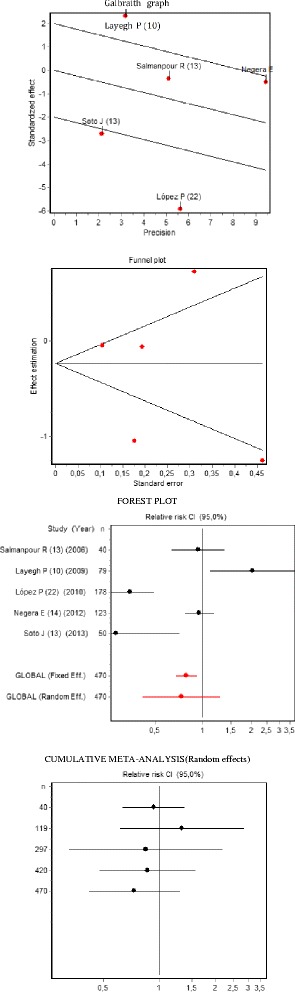
A meta-analysis based on a search of nine databases with eight strategies was conducted. Inclusion and exclusion criteria were applied, the methodological quality of each article was evaluated, and the reproducibility of the study selection and information extraction from each clinical trial was assured. The per lesion and per patient efficacy was calculated, and a meta-analysis of relative risks with the random effects model and the Dersimonian and Laird's, Begg, and Egger tests, along with a sensitivity analysis, were performed. A meta-regression based on the methodological quality of the trials included was also performed.
Eight studies were included in which respective per lesion efficacies of 67.3 % and 67.7 % were reported for cryotherapy and pentavalent antimonials. In 271 patients treated with cryotherapy and in 199 with pentavalent antimonials, respective per protocol and intent to treat efficacies of 63.6 % and 54.2 % were found in the first group, and per protocol and intent to treat efficacies of 74.7 % and 68.3 % were found in the second group. The relative risk for the comparison of efficacy in the two groups was 0.73 (0.42-1.29). The results of the sensitivity analysis and the meta-regression analysis of relative risks were statistically equal to the overall results.
This investigation provides evidence in favor of the use of cryotherapy given that its efficacy is similar to that of pentavalent antimonials.
冷冻疗法是皮肤利什曼病的一种局部治疗方法,其疗效不一,但比传统治疗方法更安全。本研究的目的是评估冷冻疗法治疗皮肤利什曼病的疗效和安全性,并将其与五价锑剂进行比较。
采用八种策略对九个数据库进行检索,进行荟萃分析。应用纳入和排除标准,评估每篇文章的方法学质量,并确保从每个临床试验中选择研究和提取信息的可重复性。计算每个病灶和每位患者的疗效,并采用随机效应模型以及德西蒙尼安和莱尔德检验、贝格检验和埃格检验对相对风险进行荟萃分析,同时进行敏感性分析。还基于纳入试验的方法学质量进行了荟萃回归分析。
纳入八项研究,其中报告冷冻疗法和五价锑剂的每个病灶有效率分别为67.3%和67.7%。在接受冷冻疗法治疗的271例患者和接受五价锑剂治疗的199例患者中,第一组的符合方案集和意向性分析的有效率分别为63.6%和54.2%,第二组的符合方案集和意向性分析的有效率分别为74.7%和68.3%。两组疗效比较的相对风险为0.73(0.42 - 1.29)。敏感性分析结果和相对风险的荟萃回归分析在统计学上与总体结果相等。
本研究提供了支持使用冷冻疗法的证据,因为其疗效与五价锑剂相似。