Azpiroz Fernando, Molne Laura, Mendez Sara, Nieto Adoración, Manichanh Chaysavanh, Mego Marianela, Accarino Anna, Santos Javier, Sailer Manuela, Theis Stephan, Guarner Francisco
*Digestive System Research Unit, University Hospital Vall d'Hebron, Barcelona †Centro de Investigación Biomédica en Red de Enfermedades Hepáticas y Digestivas (Ciberehd) (Virtual Center for Biomedical Research Hepatic and Digestive Diseases), Madrid ‡Department de Medicina, Universitat Autònoma de Barcelona (Department of Medicine, Autonomous University of Barcelona), Bellaterra (Cerdanyola del Vallès), Spain §BENEO-Institute, Obrigheim, Germany.
J Clin Gastroenterol. 2017 Aug;51(7):619-625. doi: 10.1097/MCG.0000000000000723.
To determine the effect of a prebiotic chicory-derived inulin-type fructan on the tolerance of intestinal gas.
Subjects with gas-related complaints exhibit impaired handling of intestinal gas loads and we hypothesized that inulin would have a beneficial effect.
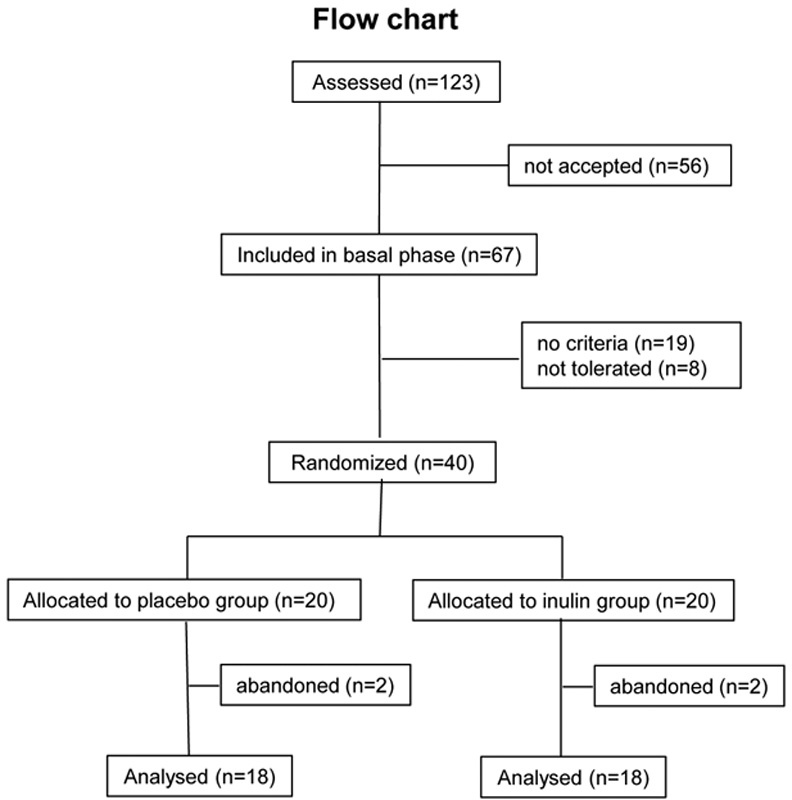
Placebo-controlled, parallel, randomized, double-blind trial. Subjects with abdominal symptoms and reduced tolerance of intestinal gas (selected by a pretest) received either inulin (8 g/d, n=18) or maltodextrin as a placebo (8 g/d, n=18) for 4 weeks. A gas challenge test (4 h jejunal gas infusion at 12 mL/min while measuring abdominal symptoms and gas retention for 3 h) was performed before and at the end of the intervention phase. Gastrointestinal symptoms and bowel habits (using daily questionnaires for 1 wk) and fecal bifidobacteria counts were measured before and at the end of the intervention.
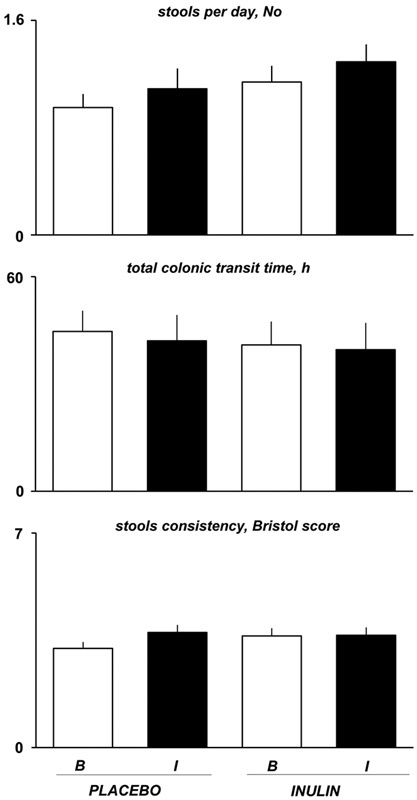
Inulin decreased gas retention during the gas challenge test (by 22%; P=0.035 vs. baseline), while the placebo did not, but the intergroup difference was not statistically significant (P=0.343). Inulin and placebo reduced the perception of abdominal sensations in the gas challenge test to a similar extent (by 52% and 43%, respectively). Participants reported moderate gastrointestinal symptoms and normal bowel habits during baseline examination, and these findings remained unchanged in both groups during the intervention. Inulin led to a higher relative abundance of bifidobacteria counts (P=0.01 vs. placebo).
A daily dose of inulin that promotes bifidobacteria growth and may improve gut function, is well tolerated by subjects with gastrointestinal complaints.
确定一种源自菊苣的益生元菊粉型果聚糖对肠道气体耐受性的影响。
有气体相关不适症状的受试者肠道气体负荷处理能力受损,我们推测菊粉会有有益作用。
安慰剂对照、平行、随机、双盲试验。有腹部症状且肠道气体耐受性降低的受试者(通过预试验挑选)接受菊粉(8克/天,n = 18)或麦芽糊精作为安慰剂(8克/天,n = 18),为期4周。在干预阶段开始前和结束时进行气体激发试验(以12毫升/分钟的速度在空肠输注气体4小时,同时测量腹部症状和气体潴留3小时)。在干预开始前和结束时测量胃肠道症状和排便习惯(使用每日问卷,为期1周)以及粪便双歧杆菌计数。
在气体激发试验中,菊粉降低了气体潴留(降低了22%;与基线相比,P = 0.035),而安慰剂则没有,但组间差异无统计学意义(P = 0.343)。在气体激发试验中,菊粉和安慰剂在减轻腹部感觉方面的程度相似(分别降低了52%和43%)。参与者在基线检查时报告有中度胃肠道症状和正常排便习惯,在干预期间两组的这些结果均未改变。菊粉使双歧杆菌计数的相对丰度更高(与安慰剂相比,P = 0.01)。
每日剂量的菊粉可促进双歧杆菌生长并可能改善肠道功能,胃肠道不适的受试者对其耐受性良好。