Lyall Donald M, Inskip Hazel M, Mackay Daniel, Deary Ian J, McIntosh Andrew M, Hotopf Matthew, Kendrick Tony, Pell Jill P, Smith Daniel J
, PhD, Institute of Health & Wellbeing, University of Glasgow, Glasgow, UK.
, PhD, MRC Lifecourse Epidemiology Unit, University of Southampton, Southampton, UK.
BJPsych Open. 2016 Jan 28;2(1):38-44. doi: 10.1192/bjpo.bp.115.002154. eCollection 2016 Jan.
Low birth weight has been inconsistently associated with risk of developing affective disorders, including major depressive disorder (MDD). To date, studies investigating possible associations between birth weight and bipolar disorder (BD), or personality traits known to predispose to affective disorders such as neuroticism, have not been conducted in large cohorts.
To assess whether very low birth weight (<1500 g) and low birth weight (1500-2490 g) were associated with higher neuroticism scores assessed in middle age, and lifetime history of either MDD or BD. We controlled for possible confounding factors.
Retrospective cohort study using baseline data on the 83 545 UK Biobank participants with detailed mental health and birth weight data. Main outcomes were prevalent MDD and BD, and neuroticism assessed using the Eysenck Personality Inventory Neuroticism scale - Revised (EPIN-R).
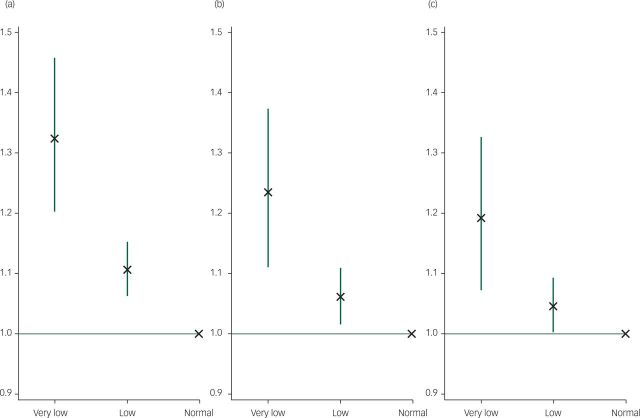
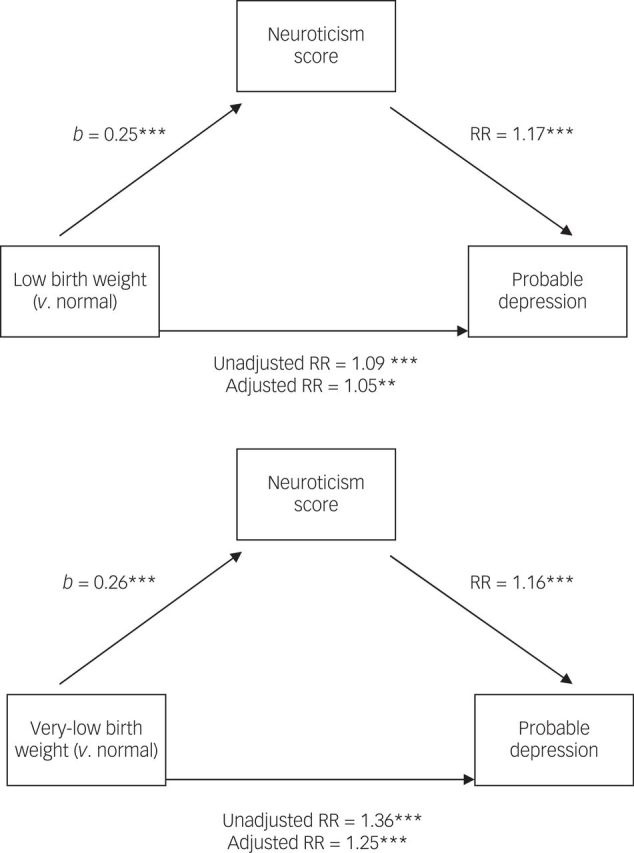
Referent to normal birth weight, very low/low birth weight were associated with higher neuroticism scores, increased MDD and BD. The associations between birth weight category and MDD were partially mediated by higher neuroticism.
These findings suggest that intrauterine programming may play a role in lifetime vulnerability to affective disorders.
None.
© The Royal College of Psychiatrists 2016. This is an open access article distributed under the terms of the Creative Commons Non-Commercial, No Derivatives (CC BY-NC-ND) licence.
低出生体重与包括重度抑郁症(MDD)在内的情感障碍发病风险之间的关联并不一致。迄今为止,尚未在大型队列中开展关于出生体重与双相情感障碍(BD)之间可能存在的关联,或与诸如神经质等易引发情感障碍的人格特质之间可能存在的关联的研究。
评估极低出生体重(<1500克)和低出生体重(1500 - 2490克)是否与中年时评估的较高神经质得分以及MDD或BD的终生病史相关。我们对可能的混杂因素进行了控制。
采用回顾性队列研究,使用来自83545名英国生物银行参与者的基线数据,这些数据包含详细的心理健康和出生体重信息。主要结局指标为MDD和BD的患病率,以及使用艾森克人格问卷神经质修订版(EPIN - R)评估的神经质。
与正常出生体重相比,极低/低出生体重与较高的神经质得分、MDD和BD的增加相关。出生体重类别与MDD之间的关联部分由较高的神经质介导。
这些发现表明,子宫内编程可能在情感障碍的终生易感性中起作用。
无。
©皇家精神病医学院2016年。本文是一篇开放获取文章,根据知识共享非商业性、无衍生作品(CC BY - NC - ND)许可协议分发。