Liu Miaomiao, Huang Yining, Ma Zongwei, Jin Zhou, Liu Xingyu, Wang Haikun, Liu Yang, Wang Jinnan, Jantunen Matti, Bi Jun, Kinney Patrick L
State Key Laboratory of Pollution Control and Resource Reuse, School of the Environment, Nanjing University, Nanjing, Jiangsu, China.
Department of Environmental Health, Rollins School of Public Health, Emory University, Atlanta, GA, USA.
Environ Int. 2017 Jan;98:75-81. doi: 10.1016/j.envint.2016.10.003. Epub 2016 Oct 13.
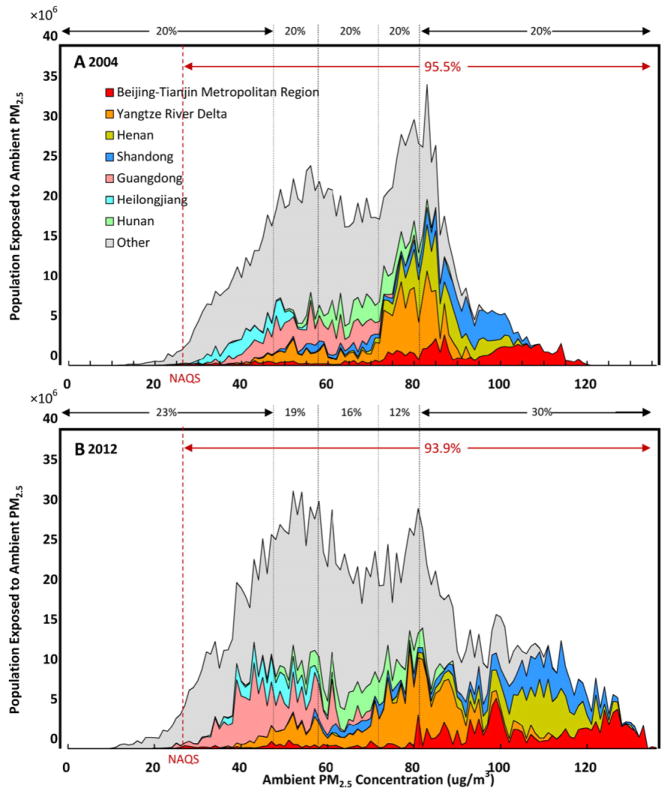
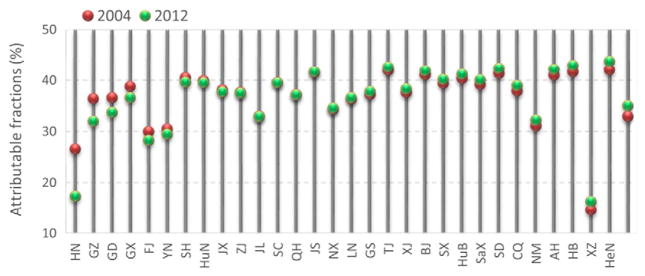
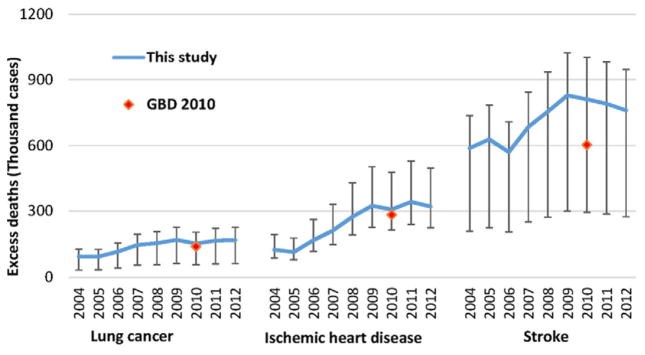
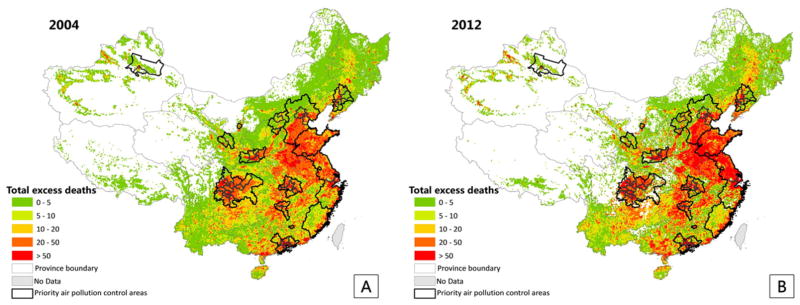
While recent assessments have quantified the burden of air pollution at the national scale in China, air quality managers would benefit from assessments that disaggregate health impacts over regions and over time. We took advantage of a new 10×10km satellite-based PM dataset to analyze spatial and temporal trends of air pollution health impacts in China, from 2004 to 2012. Results showed that national PM related deaths from stroke, ischemic heart disease and lung cancer increased from approximately 800,000 cases in 2004 to over 1.2 million cases in 2012. The health burden exhibited strong spatial variations, with high attributable deaths concentrated in regions including the Beijing-Tianjin Metropolitan Region, Yangtze River Delta, Pearl River Delta, Sichuan Basin, Shandong, Wuhan Metropolitan Region, Changsha-Zhuzhou-Xiangtan, Henan, and Anhui, which have heavy air pollution, high population density, or both. Increasing trends were found in most provinces, but with varied growth rates. While there was some evidence for improving air quality in recent years, this was offset somewhat by the countervailing influences of in-migration together with population growth. We recommend that priority areas for future national air pollution control policies be adjusted to better reflect the spatial hotspots of health burdens. Satellite-based exposure and health impact assessments can be a useful tool for tracking progress on both air quality and population health burden reductions.
虽然近期的评估已经对中国全国范围内的空气污染负担进行了量化,但空气质量管理人员将受益于能够按地区和时间分解健康影响的评估。我们利用一个新的基于卫星的10×10公里颗粒物数据集,分析了2004年至2012年中国空气污染对健康影响的空间和时间趋势。结果显示,全国与颗粒物相关的中风、缺血性心脏病和肺癌死亡病例从2004年的约80万例增加到2012年的超过120万例。健康负担呈现出强烈的空间差异,高归因死亡集中在北京-天津大都市地区、长江三角洲、珠江三角洲、四川盆地、山东、武汉大都市地区、长株潭、河南和安徽等地区,这些地区空气污染严重、人口密度高或两者兼具。大多数省份都呈现出上升趋势,但增长率各不相同。虽然有证据表明近年来空气质量有所改善,但人口迁入和人口增长的抵消影响在一定程度上削弱了这种改善。我们建议调整未来国家空气污染控制政策的优先领域,以更好地反映健康负担的空间热点。基于卫星的暴露和健康影响评估可以成为跟踪空气质量和人口健康负担减轻进展情况的有用工具。