Díaz-Gutiérrez Jesús, Martínez-González Miguel Ángel, Pons Izquierdo Juan José, González-Muniesa Pedro, Martínez J Alfredo, Bes-Rastrollo Maira
University of Navarra, Department of Preventive Medicine and Public Health, School of Medicine, Pamplona, Spain.
IDISNA Navarra's Health Research Institute, Pamplona, Spain.
PLoS One. 2016 Nov 3;11(11):e0164483. doi: 10.1371/journal.pone.0164483. eCollection 2016.
Residence at high altitude has been associated with lower obesity rates probably due to hypoxia conditions. However, there is no evidence of this association in a free-living population.
We assessed the association between the altitude where each participant of a Spanish cohort (the SUN Project) was living and the incidence of overweight/obesity.
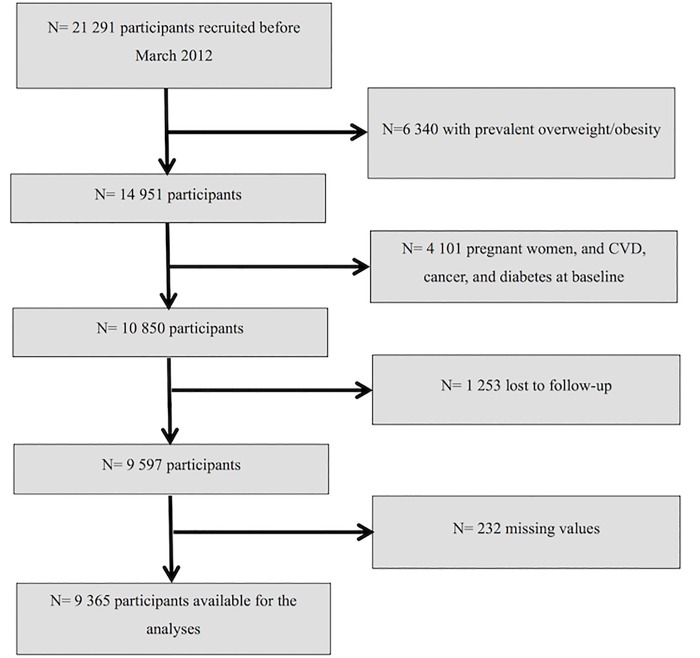
The SUN Project is a dynamic, prospective, multipurpose cohort of Spanish university graduates with a retention rate of 89%. We included in the analysis 9 365 participants free of overweight/obesity at baseline. At the baseline questionnaire, participants reported their postal code and the time they had been living in their city/village. We imputed the altitude of each postal code according to the data of the Spanish National Cartographic Institute and categorized participants in tertiles. We used Cox regression models to adjust for potential confounding variables.
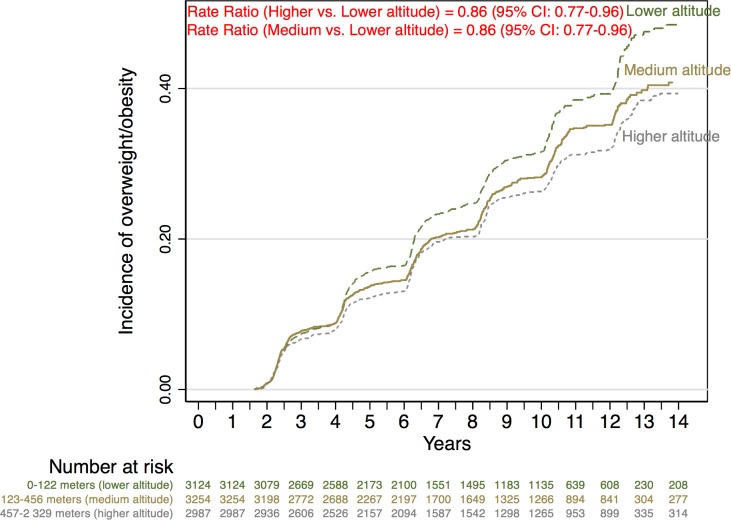
During a median follow-up of 10 years, we identified 2 156 incident cases of overweight/obesity. After adjusting for sex, age, time of residence at current city, baseline body mass index, physical activity, sedentarism and years of education (≤ 3 years, ≥ 4 years, Master/PhD), those participants in the third tertile (>456 m) exhibited a statistically significant 14% reduction in the risk of developing overweight/obesity in comparison to those in the first tertile (<124 m) (adjusted HR = 0.86; 95% CI: 0.77, 0.96).
Living in cities of higher altitude was inversely associated with the risk of developing overweight/obesity in a cohort of Spanish university graduates.
居住在高海拔地区可能由于缺氧环境而与较低的肥胖率相关。然而,在自由生活人群中尚无这种关联的证据。
我们评估了西班牙队列研究(SUN项目)中每位参与者居住的海拔高度与超重/肥胖发生率之间的关联。
SUN项目是一个动态、前瞻性、多用途的西班牙大学毕业生队列,保留率为89%。我们纳入分析的是9365名基线时无超重/肥胖的参与者。在基线调查问卷中,参与者报告了他们的邮政编码以及在其城市/村庄居住的时间。我们根据西班牙国家制图研究所的数据估算了每个邮政编码对应的海拔高度,并将参与者分为三个三分位数组。我们使用Cox回归模型对潜在的混杂变量进行调整。
在中位随访10年期间,我们确定了2156例超重/肥胖的发病病例。在对性别、年龄、在当前城市的居住时间、基线体重指数、身体活动、久坐不动情况和受教育年限(≤3年、≥4年、硕士/博士)进行调整后,与处于第一个三分位数组(<124米)的参与者相比,处于第三个三分位数组(>456米)的参与者发生超重/肥胖的风险在统计学上显著降低了14%(调整后的风险比=0.86;95%置信区间:0.77,0.96)。
在一组西班牙大学毕业生中,居住在海拔较高的城市与发生超重/肥胖的风险呈负相关。