Ciesielski Timothy H, Aldrich Melinda C, Marsit Carmen J, Hiatt Robert A, Williams Scott M
Institute for Quantitative Biomedical Sciences, Dartmouth College, Hanover, NH; Department of Genetics, Geisel School of Medicine at Dartmouth, Hanover, NH; Public Health Program, Regis College, Weston, Mass.
Department of Thoracic Surgery, Vanderbilt University Medical Center, Nashville, Tenn; Division of Epidemiology, Department of Medicine, Vanderbilt University Medical Center, Nashville, Tenn.
Transl Res. 2017 Apr;182:123-134. doi: 10.1016/j.trsl.2016.11.002. Epub 2016 Nov 10.
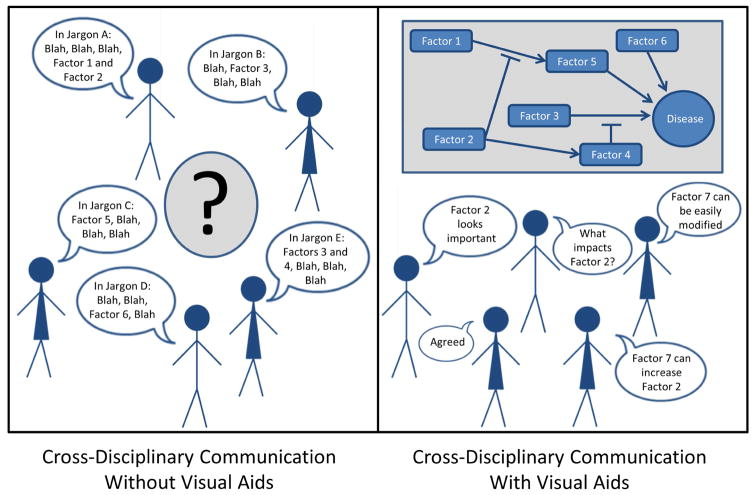
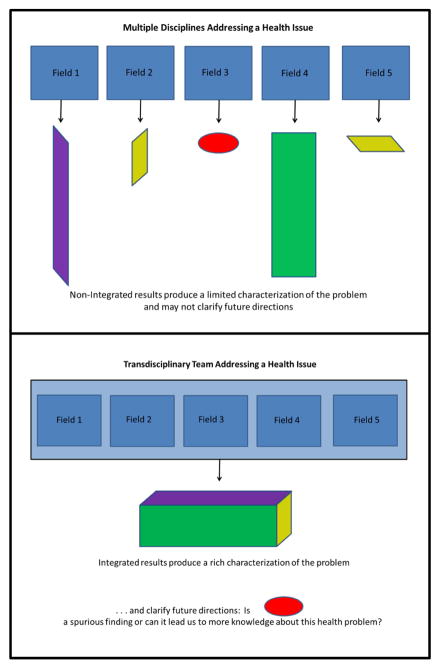
The primary goal of translational research is to generate and apply knowledge that can improve human health. Although research conducted within the confines of a single discipline has helped us to achieve this goal in many settings, this unidisciplinary approach may not be optimal when disease causation is complex and health decisions are pressing. To address these issues, we suggest that transdisciplinary approaches can facilitate the progress of translational research, and we review publications that demonstrate what these approaches can look like. These examples serve to (1) demonstrate why transdisciplinary research is useful, and (2) stimulate a conversation about how it can be further promoted. While we note that open-minded communication is a prerequisite for germinating any transdisciplinary work and that epidemiologists can play a key role in promoting it, we do not propose a rigid protocol for conducting transdisciplinary research, as one really does not exist. These achievements were developed in settings where typical disciplinary and institutional barriers were surmountable, but they were not accomplished with a single predetermined plan. The benefits of cross-disciplinary communication are hard to predict a priori and a detailed research protocol or process may impede the realization of novel and important insights. Overall, these examples demonstrate that enhanced cross-disciplinary information exchange can serve as a starting point that helps researchers frame better questions, integrate more relevant evidence, and advance translational knowledge more effectively. Specifically, we discuss examples where transdisciplinary approaches are helping us to better explore, assess, and intervene to improve human health.
转化研究的主要目标是产生并应用能够改善人类健康的知识。尽管在单一学科范围内开展的研究在许多情况下帮助我们实现了这一目标,但当疾病病因复杂且健康决策紧迫时,这种单学科方法可能并非最佳选择。为解决这些问题,我们认为跨学科方法能够促进转化研究的进展,并且我们回顾了展示这些方法可能呈现何种形式的出版物。这些例子旨在:(1)说明跨学科研究为何有用,以及(2)激发关于如何进一步推动它的讨论。虽然我们指出开放的交流是开展任何跨学科工作的先决条件,并且流行病学家在促进这方面可发挥关键作用,但我们并未提出开展跨学科研究的严格方案,因为实际上并不存在这样的方案。这些成果是在典型的学科和机构壁垒可被克服的环境中取得的,但它们并非通过单一的预定计划实现。跨学科交流的益处很难预先预测,详细的研究方案或流程可能会阻碍新颖且重要的见解的实现。总体而言,这些例子表明加强跨学科信息交流可作为一个起点,帮助研究人员提出更好的问题、整合更相关的证据并更有效地推进转化知识。具体而言,我们讨论了跨学科方法如何帮助我们更好地探索、评估和干预以改善人类健康的例子。