
宇航员在太空长期停留后线粒体动态平衡和氧化还原状态的变化。
Changes in mitochondrial homeostasis and redox status in astronauts following long stays in space.
机构信息
Department of Oncology and Space Environmental Medicine, Graduate School of Medical and Dental Sciences, Kagoshima University, Kagoshima City, Kagoshima 890-8544, Japan.
Divison of Aerospace Medicine, The Jikei University School of Medicine, Minato-ku, Tokyo 105-8461, Japan.
出版信息
Sci Rep. 2016 Dec 16;6:39015. doi: 10.1038/srep39015.
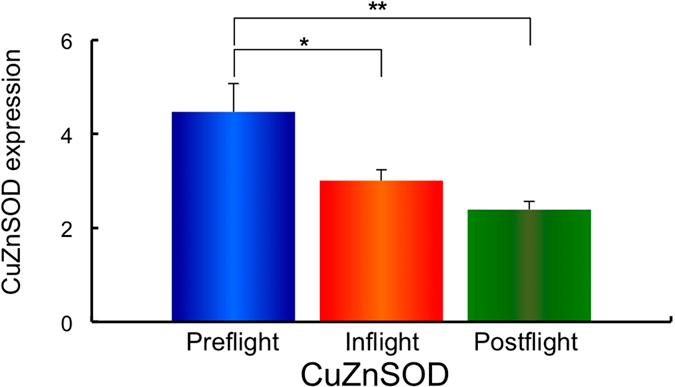
The effects of long-term exposure to extreme space conditions on astronauts were investigated by analyzing hair samples from ten astronauts who had spent six months on the International Space Station (ISS). Two samples were collected before, during and after their stays in the ISS; hereafter, referred to as Preflight, Inflight and Postflight, respectively. The ratios of mitochondrial (mt) to nuclear (n) DNA and mtRNA to nRNA were analyzed via quantitative PCR. The combined data of Preflight, Inflight and Postflight show a significant reduction in the mtDNA/nDNA in Inflight, and significant reductions in the mtRNA/nRNA ratios in both the Inflight and Postflight samples. The mtRNA/mtDNA ratios were relatively constant, except in the Postflight samples. Using the same samples, the expression of redox and signal transduction related genes, MnSOD, CuZnSOD, Nrf2, Keap1, GPx4 and Catalase was also examined. The results of the combined data from Preflight, Inflight and Postflight show a significant decrease in the expression of all of the redox-related genes in the samples collected Postflight, with the exception of Catalase, which show no change. This decreased expression may contribute to increased oxidative stress Inflight resulting in the mitochondrial damage that is apparent Postflight.
研究人员通过分析 10 名在国际空间站(ISS)上停留了 6 个月的宇航员的头发样本,研究了长期暴露在极端太空环境对宇航员的影响。在宇航员进入国际空间站之前(Preflight)、期间(Inflight)和之后(Postflight)采集了两个样本;分别命名为飞行前、飞行中和飞行后。通过定量 PCR 分析了线粒体(mt)与核(n)DNA 和 mtRNA 与 nRNA 的比例。Preflight、Inflight 和 Postflight 的综合数据显示,Inflight 中 mtDNA/nDNA 显著减少,Inflight 和 Postflight 样本中的 mtRNA/nRNA 比值显著降低。mtRNA/mtDNA 比值相对稳定,除了在 Postflight 样本中。使用相同的样本,还检测了氧化还原和信号转导相关基因 MnSOD、CuZnSOD、Nrf2、Keap1、GPx4 和 Catalase 的表达。Preflight、Inflight 和 Postflight 的综合数据结果表明,除 Catalase 外,所有与氧化还原相关的基因在飞行后样本中的表达均显著下降,而 Catalase 则没有变化。这种表达减少可能导致飞行中氧化应激增加,从而导致明显的飞行后线粒体损伤。




 Zotero 插件