Williams Alex H, O'Donnell Cian, Sejnowski Terrence J, O'Leary Timothy
Department of Neurosciences, University of California, San Diego, La Jolla, United States.
Howard Hughes Medical Institute, Salk Institute for Biological Studies, La Jolla, United States.
Elife. 2016 Dec 30;5:e20556. doi: 10.7554/eLife.20556.
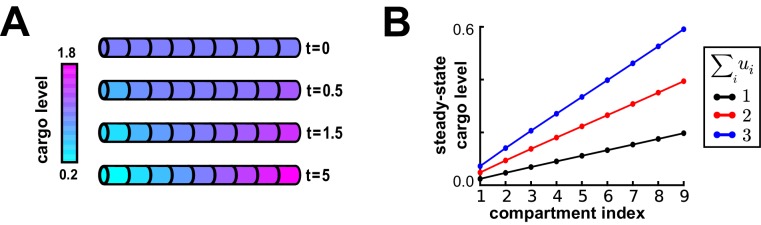
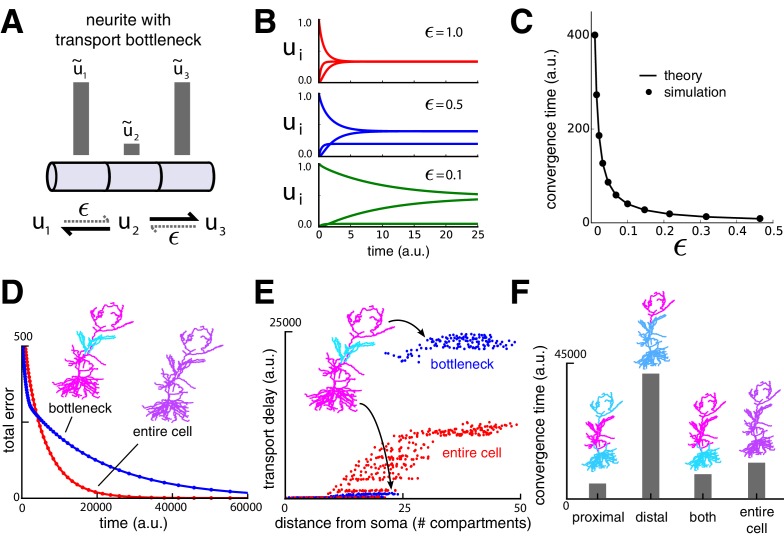
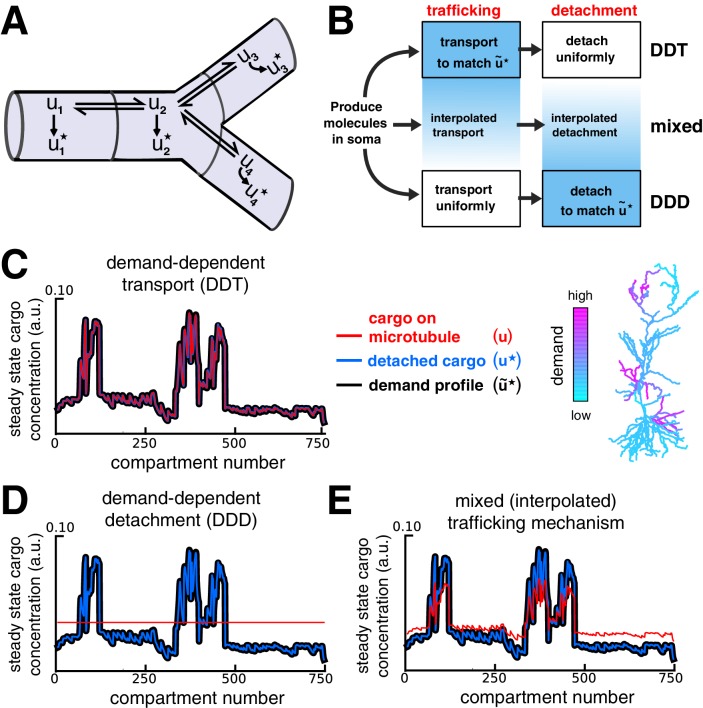
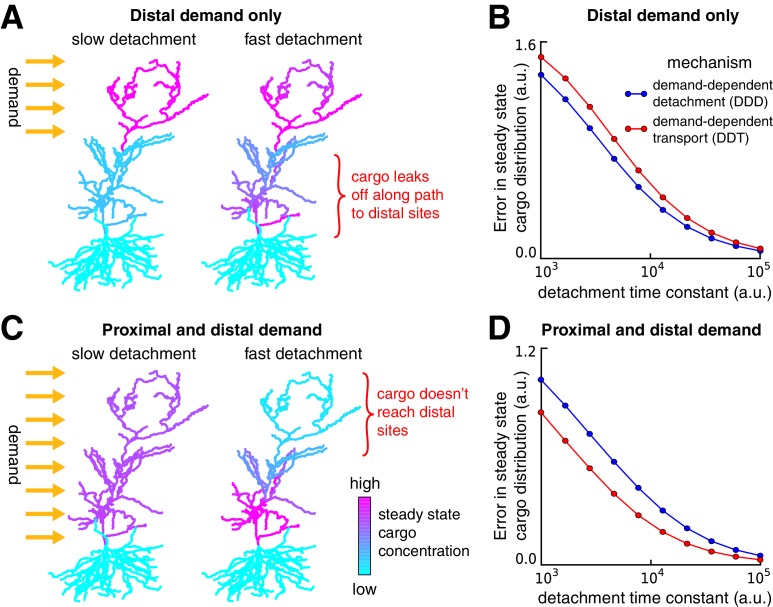
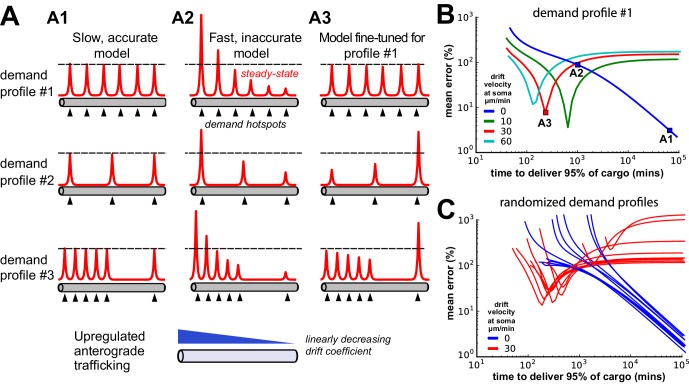
Nervous system function requires intracellular transport of channels, receptors, mRNAs, and other cargo throughout complex neuronal morphologies. Local signals such as synaptic input can regulate cargo trafficking, motivating the leading conceptual model of neuron-wide transport, sometimes called the 'sushi-belt model' (Doyle and Kiebler, 2011). Current theories and experiments are based on this model, yet its predictions are not rigorously understood. We formalized the sushi belt model mathematically, and show that it can achieve arbitrarily complex spatial distributions of cargo in reconstructed morphologies. However, the model also predicts an unavoidable, morphology dependent tradeoff between speed, precision and metabolic efficiency of cargo transport. With experimental estimates of trafficking kinetics, the model predicts delays of many hours or days for modestly accurate and efficient cargo delivery throughout a dendritic tree. These findings challenge current understanding of the efficacy of nucleus-to-synapse trafficking and may explain the prevalence of local biosynthesis in neurons.
神经系统的功能需要在复杂的神经元形态中对通道、受体、信使核糖核酸及其他货物进行细胞内运输。诸如突触输入等局部信号可调节货物运输,这推动了全神经元运输的主要概念模型的发展,该模型有时被称为“寿司带模型”(多伊尔和基布勒,2011年)。当前的理论和实验均基于此模型,但其预测尚未得到严格理解。我们对寿司带模型进行了数学形式化,并表明它能够在重构形态中实现货物任意复杂的空间分布。然而,该模型还预测,在货物运输的速度、精度和代谢效率之间存在不可避免的、依赖于形态的权衡。根据运输动力学的实验估计,该模型预测,在整个树突状树中进行适度准确和高效的货物递送会有长达数小时或数天的延迟。这些发现挑战了当前对细胞核到突触运输效率的理解,并可能解释了神经元中局部生物合成的普遍性。